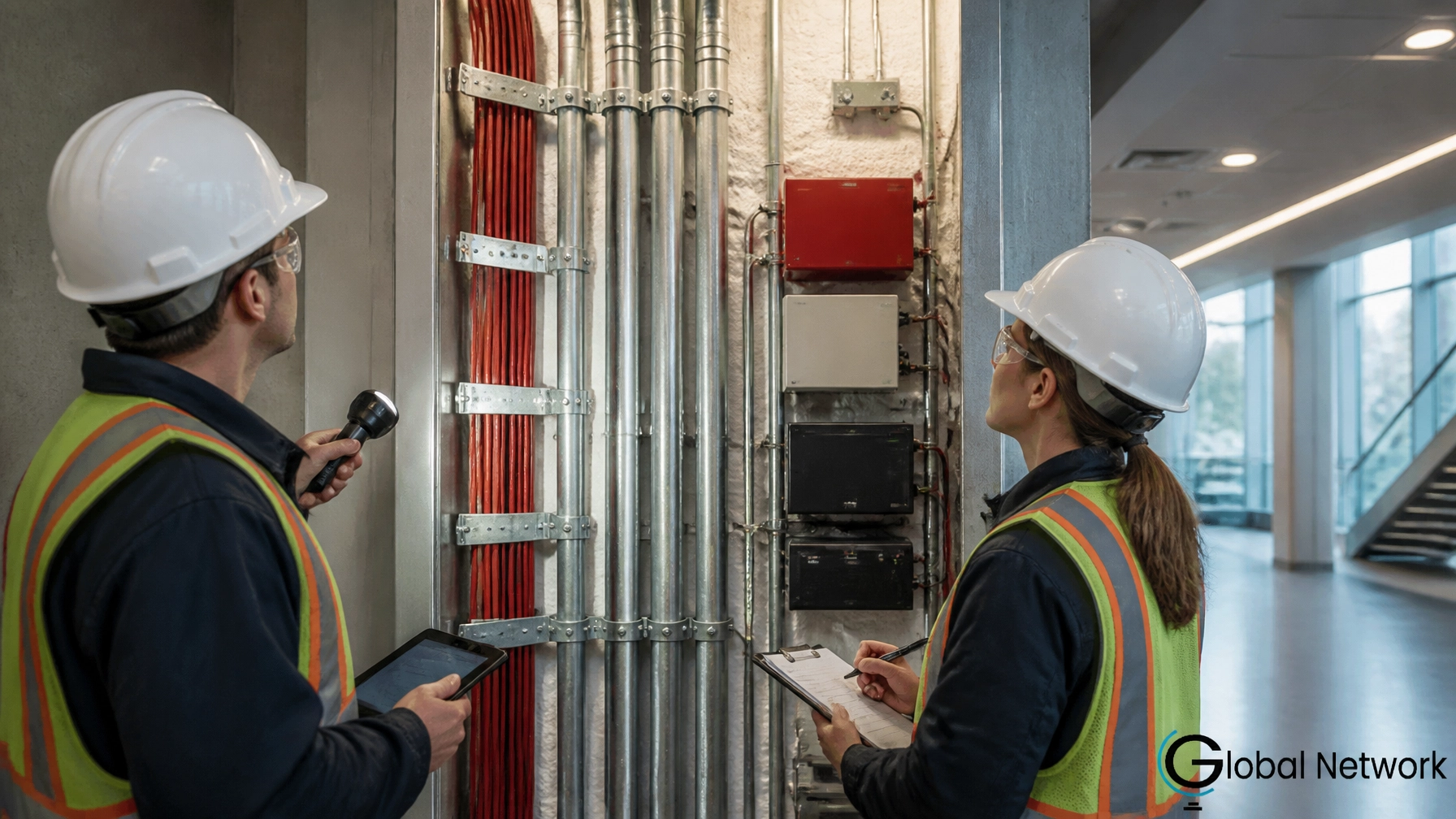
Pathway Survivability: How Fire-Rated Riser and Cable Pathways Keep Your DAS Alive in an Emergency
In an emergency, reliable first responder communication depends on more than antennas, signal strength, and Bi-Directional Amplifier (BDA) performance. It also depends on whether the cables, circuits, and pathways connecting your Public Safety Distributed Antenna System (DAS) or Emergency Responder Communication Enhancement System (ERCES) can continue operating when exposed to fire, heat, smoke, water, and physical damage.
That is the purpose of pathway survivability.
For Atlanta building owners and facility managers, pathway survivability is a critical design and compliance consideration. A system may pass an initial radio coverage test, but if its backbone cable is routed through an unprotected shaft: or if a fire-rated wall is compromised by an improperly sealed penetration: the system may not remain operational when first responders need it most.
Reliable communication requires a survivable pathway from the head-end to the coverage areas throughout the building.
What Is Pathway Survivability?
The NFPA Research Foundation describes pathway survivability using the NFPA 72 concept: the ability of a conductor, optical fiber, radio carrier, or other transmission method to remain operational during fire conditions.
In a public safety DAS/ERCES installation, this may include:
- Coaxial feeder cables connecting the BDA to remote units and antennas
- Fiber-optic backbone pathways
- Vertical riser cables serving multiple floors
- Horizontal distribution cables
- Power circuits and backup power connections
- Monitoring, alarm, and supervisory circuits
- Connections between head-end equipment, remote units, and antenna networks
Pathway survivability is not the same as ordinary cable organization or mechanical protection. A cable installed in metal conduit may be protected from impact, but that alone does not necessarily mean it can continue functioning during a fire.
The required protection depends on the applicable edition of NFPA 72, NFPA 1225, IFC 510, local amendments, building conditions, and the requirements of the Authority Having Jurisdiction (AHJ).
How NFPA 72, NFPA 1225, and IFC 510 Work Together
These standards and codes serve different roles in the project:
- NFPA 72 establishes pathway survivability concepts and classifications for life-safety communication pathways.
- NFPA 1225 addresses Emergency Responder Communication Enhancement Systems and applies survivability principles to ERCES infrastructure.
- IFC 510 addresses emergency responder radio coverage in buildings where radio communication is inadequate.
- The local AHJ: typically the fire marshal, building department, or other enforcing authority: determines how these requirements apply to a specific building.
Your project’s required survivability level is not determined by signal strength alone. It may be influenced by:
- Building height and construction type
- Occupancy classification
- Fire-resistance-rated construction
- Sprinkler protection
- Number of floors and coverage zones
- Location of the head-end and remote units
- Whether the pathway crosses multiple fire areas
- Local Atlanta-area permitting and inspection requirements
A design professional should confirm the applicable requirements before installation. Never assume that a previously approved system or neighboring building has the same pathway requirements as your facility.
Understanding Pathway Survivability Levels
NFPA 72 survivability levels establish progressively stronger protection requirements. The exact application depends on the adopted code edition and AHJ interpretation.
Level 0
Level 0 provides no additional pathway survivability requirements beyond applicable electrical and installation codes.
This does not mean the system is unimportant. It means that additional fire-resistance measures are not imposed by that survivability classification.
Level 1
Level 1 generally applies where the building has complete automatic sprinkler protection in accordance with NFPA 13 and the critical pathway is installed in metal raceway or metal-armored cable.
Level 1 may be accepted for certain applications, but building owners should not assume it is sufficient for every ERCES backbone or riser. Local jurisdictions may require a higher level for critical public safety circuits.
Level 2
Level 2 generally requires a pathway capable of maintaining operation for approximately two hours through one of several approved methods, including:
- Two-hour fire-rated Circuit Integrity (CI) cable
- A listed two-hour fire-rated cable system
- A two-hour fire-rated enclosure or protected area
- Another performance-based alternative approved by the AHJ
For many public safety DAS/ERCES projects, Level 2 protection is a central design consideration for riser, backbone, power, and critical distribution pathways.
Level 3
Level 3 combines Level 2 pathway protection with full automatic sprinkler protection in accordance with NFPA 13.
Level 3 may be required or selected for facilities where enhanced protection is appropriate. The final determination must come from the project design team and AHJ.
Some newer code editions also identify additional survivability classifications, including Level 4 provisions. These requirements are edition-specific and must be evaluated against the code adopted in the project’s jurisdiction.
Fire-Rated Risers: Protecting the Vertical Backbone
A riser pathway carries critical communications between floors. In a high-rise office building, hotel, hospital, university facility, parking structure, or mixed-use development, the riser may be the central connection between the ERCES head-end and multiple remote units.
If that pathway is damaged on one floor, communication coverage on multiple floors may be affected.

Common survivability strategies include:
- Routing cable through a listed two-hour-rated shaft
- Using a listed fire-rated enclosure or protected telecom space
- Installing listed CI or fire-resistive coaxial and fiber cable
- Separating critical pathways from areas with increased exposure risk
- Protecting cable supports and transitions against physical damage
- Coordinating the riser design with fire alarm, electrical, mechanical, and structural trades
The pathway must be designed as a complete assembly. Cable type, support method, fittings, transitions, bends, access points, and penetrations all matter.
A rated cable installed with unapproved supports or routed through an improperly protected transition may not provide the intended level of protection.
Cable Pathways and Critical ERCES Circuits
The survivability discussion should include more than the primary RF feeder.
An ERCES can be disabled if its power, control, monitoring, or supervisory circuits fail. For this reason, the design should evaluate the complete communications chain:
- Head-end equipment
- BDA or signal source
- Fiber or coaxial backbone
- Remote annunciation and monitoring
- Remote units
- Horizontal distribution
- Antennas and passive components
- Primary and secondary power systems
A pathway that protects the RF cable but leaves the power or monitoring circuit vulnerable may not deliver the level of resilience expected from a life-safety communications system.
The Global Network LLC services team can coordinate design, installation, compliance testing, monitoring, and documentation around the complete ERCES infrastructure.
Penetrations: Where Fire Ratings Are Often Lost
Every time cable passes through a fire-resistance-rated wall, floor, ceiling, or shaft boundary, the opening must be properly protected.
This is where passive fire protection becomes essential.
A firestop system is intended to restore the performance of the rated assembly around the penetration. The installation should use a listed system appropriate for the:
- Wall or floor construction
- Assembly rating
- Cable type and diameter
- Number of cables
- Sleeve or conduit configuration
- Annular space
- Firestop material
- Movement and service conditions
Improvised caulk, unapproved foam, oversized openings, missing backing material, and abandoned penetrations can compromise the rating.
Facility teams should also monitor future modifications. A contractor who adds a cable to an existing sleeve may unintentionally disturb an approved firestop installation. Every change should be documented and restored using an appropriate listed system.
The cable is only as survivable as the barrier it passes through.
Inspection and Acceptance Considerations
Pathway survivability should be reviewed before the final radio coverage test. A comprehensive inspection may include:
Design Documentation
- Approved DAS/ERCES drawings
- Riser diagrams and pathway schedules
- Cable specifications and listing information
- Fire-rated assembly details
- Firestop system documentation
- Equipment locations and service clearances
- AHJ comments and approved alternatives
Field Installation
- Correct cable type and routing
- Proper fire-rated riser or enclosure construction
- Approved supports and attachment methods
- Separation from heat-producing equipment
- Protected transitions and bends
- Proper grounding and bonding
- Complete penetration sealing
- Accessible and identifiable equipment
Testing and Records
- Commissioning and acceptance testing
- Signal strength and coverage verification
- BDA gain and output measurements
- Battery and backup-power testing
- Alarm and supervisory signal verification
- Monitoring confirmation
- Annual performance testing
- Photographs and closeout documentation
A strong inspection process helps reduce rework, failed approvals, and Certificate of Occupancy delays. It also gives facility managers a defensible maintenance record for future inspections and renovations.
Build for the Emergency, Not Just the Inspection
A public safety DAS/ERCES is a mission-critical system. Passing a 20-by-20 grid test is important, but coverage is only one part of performance.
The system must also be designed to remain functional when:
- A fire affects a remote portion of the building
- Heat damages conventional cabling
- Water impacts communications equipment
- Construction debris or structural damage affects pathways
- A power interruption occurs
- A building modification changes the cable route
- Monitoring detects a fault after hours
For Atlanta facilities, local code knowledge and disciplined coordination are essential. Global Network LLC provides Public Safety DAS/ERCES design, installation, compliance testing, annual performance testing, and monitoring for commercial, healthcare, hospitality, educational, government, and institutional properties.
0% avoidable pathway oversights. 0% missed inspection details. 100% focus on communication when it matters most.
Protect Your ERCES Pathways Before the Next Inspection
If your building is under construction, undergoing renovation, preparing for a Certificate of Occupancy, or operating with an aging BDA system, now is the time to review pathway survivability.
Request a professional evaluation of your risers, cable routes, penetrations, fire-rated enclosures, backup power, and monitoring infrastructure.
Contact Atlanta’s local DAS/ERCES specialist:
- Office: 770.520.7633
- Toll Free: 877.231.1084
- Website: globalnetworkco.com
- Schedule a compliance consultation
Reliable first responder communication is not optional. Design the pathway to survive: and keep your DAS alive when it matters most.