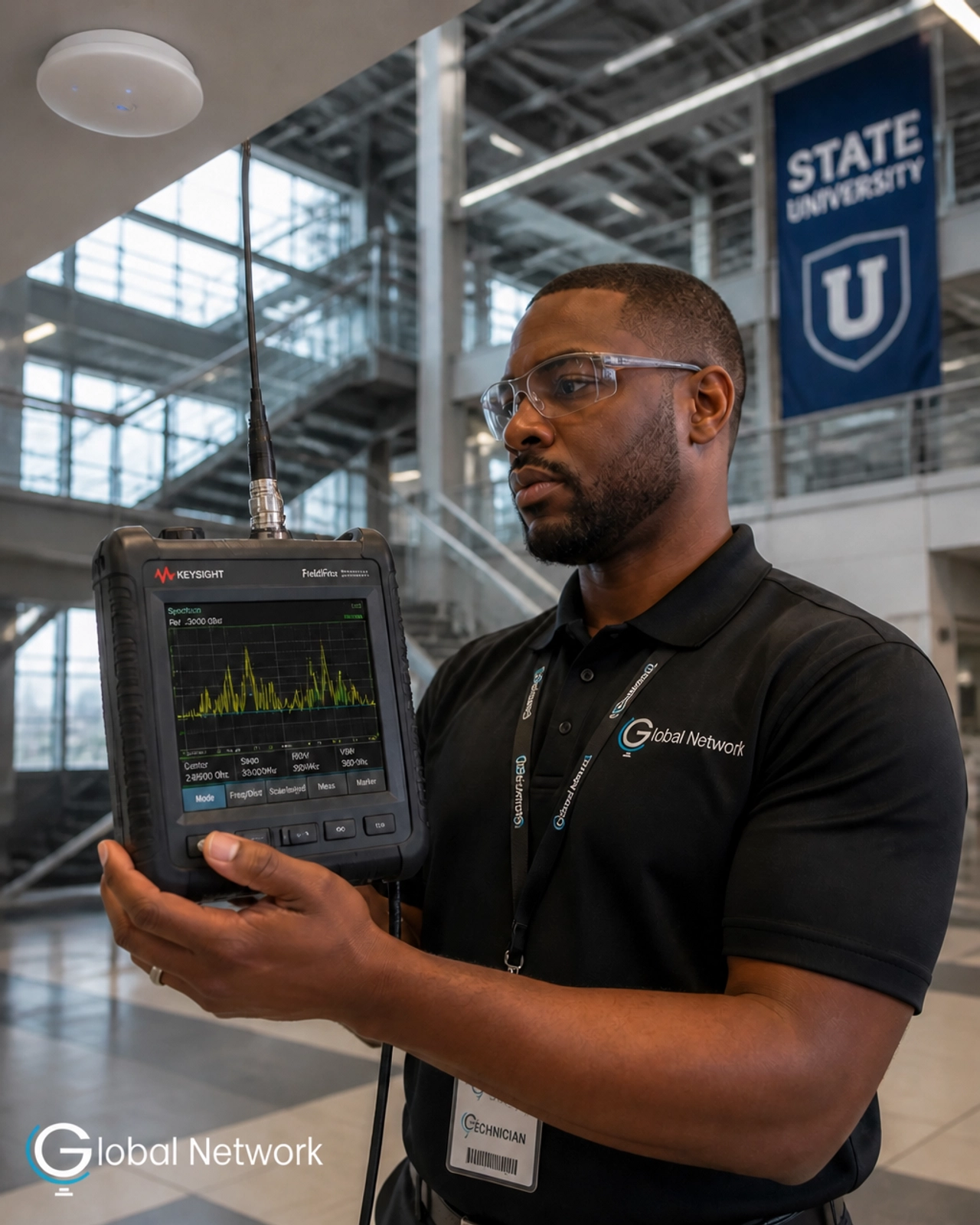

The New Georgia Building Codes Are Here: What Your Property’s ERCES Needs to Change
Georgia’s building-code landscape changed on January 1, 2026. The Georgia Department of Community Affairs (DCA) adopted new mandatory editions of several State Minimum Standard Codes, including the 2024 International Building Code (IBC) and the 2024 International Fire Code (IFC) as adopted by the Safety Fire Commissioner.
For building owners, developers, facility managers, and public agencies, the practical question is not simply, “Which code edition is new?” The more important question is:
What does the applicable code edition: and the local Authority Having Jurisdiction (AHJ): require for emergency responder radio coverage inside this property?
An Emergency Responder Communication Enhancement System (ERCES): also called an ERRCS, Public Safety DAS, or BDA system: may be necessary when concrete, steel, low-E glass, below-grade construction, or other materials weaken public safety radio signals. The system must be designed, installed, tested, monitored, and maintained according to the requirements that govern your specific jurisdiction.
0% Guesswork. 0% Missed Deadlines.
What Changed in Georgia’s Building-Code Framework?
The DCA’s current code listing identifies the following as mandatory construction codes:
- 2024 International Building Code with Georgia Amendments
- 2024 International Residential Code with Georgia Amendments
- 2024 International Fire Code
- 2024 International Plumbing, Mechanical, Fuel Gas, and Swimming Pool and Spa Codes with Georgia Amendments
- 2023 National Electrical Code with Georgia Amendments
The DCA’s current State Minimum Standard Codes page provides the adopted editions and amendment packets. Its January 1, 2026 code-adoption announcement also advises cities and counties with local amendments to review those amendments against the new state codes.
That distinction matters because construction-code adoption and fire-code enforcement are related but not identical processes. The State Fire Marshal’s Office administers fire-code matters, while local fire officials often establish project-specific procedures for public safety radio coverage.
The Code Edition Is Only the Starting Point
A property’s ERCES obligations may depend on:
- The permit application date
- Whether the project is new construction, renovation, or a change of occupancy
- The building’s height, area, occupancy, and below-grade spaces
- The local fire department’s radio system and technical criteria
- Local ordinances, amendments, policies, and submission requirements
- Whether the property is seeking a new or amended Certificate of Occupancy
- Whether an existing ERCES has undergone structural or system changes
The applicable answer must be confirmed with the project’s AHJ, not assumed from a generic national checklist.

Georgia’s IFC 510 Approach: Local AHJ Requirements Matter
Georgia’s published Safety Fire Commissioner rules include a state-specific modification addressing IFC Section 510, In-Building Emergency Responder Communications Enhancement Systems.
The published modification states that, in new and existing buildings, the minimum radio signal strength for emergency-services communications is determined by the local Fire Chief and/or Fire Code Official responsible for emergency response to the building. It also requires in-building ERCES to comply with the applicable design, installation, testing, inspection, and maintenance provisions of NFPA 1225 Chapter 18, where adopted through the governing rules.
You can review the state’s published Section 510 modification document. Because code packages and amendments can be updated, your project team should also confirm the current requirements directly with the Georgia State Fire Marshal’s Office.
Why You Should Not Rely on a Generic “95/99 and -95 dBm” Rule
Many jurisdictions use familiar performance criteria such as:
- Approximately 95% coverage in general floor areas
- Approximately 99% coverage in designated critical areas
- Minimum received signal levels around -95 dBm
- Two-way verification of uplink and downlink performance
- Delivered Audio Quality (DAQ), Bit Error Rate (BER), or other intelligibility criteria
However, those numbers are not automatically interchangeable across every Georgia jurisdiction. A local AHJ may define:
- The required signal threshold
- The coverage percentage
- The testing grid size
- Critical areas requiring enhanced coverage
- Required radio frequencies and donor-site information
- Battery standby duration
- Fire alarm supervisory interfaces
- Documentation and engineer-stamping requirements
- Acceptance, annual, and periodic retesting procedures
The local policy controls the practical test. Obtain it in writing before finalizing the design.
What New Construction Projects Need to Do
1. Identify the Applicable Code and AHJ Early
At the beginning of design, identify:
- The local Fire Marshal or Fire Code Official
- The building official and permitting authority
- The responding public safety communications agency
- The project’s code edition based on permit and construction status
- Any local IFC 510, ERCES, or radio-coverage policy
- Whether the project requires AHJ pre-approval before equipment is ordered or installed
Do not wait until the building is enclosed or the Certificate of Occupancy inspection is imminent.
2. Perform Preconstruction Planning
A preconstruction survey and predictive design model can identify coverage risks before walls, ceilings, roofing systems, and low-E glazing are complete.
Planning should account for:
- Rooftop donor antenna placement
- Coaxial cable pathways and penetrations
- Distributed antenna locations
- BDA head-end and remote equipment locations
- Fire-rated pathways and equipment enclosures
- Grounding, bonding, and lightning protection
- Standby power and battery access
- Fire alarm monitoring connections
- Maintenance access for future inspections
Savannah’s published ERRCS requirements for new and remodeled commercial construction illustrates why early planning is important. The document calls for radio signal studies, qualified personnel, grid-based testing, AHJ coordination, equipment approval, monitoring, and annual inspections.
3. Design the System as Life-Safety Infrastructure
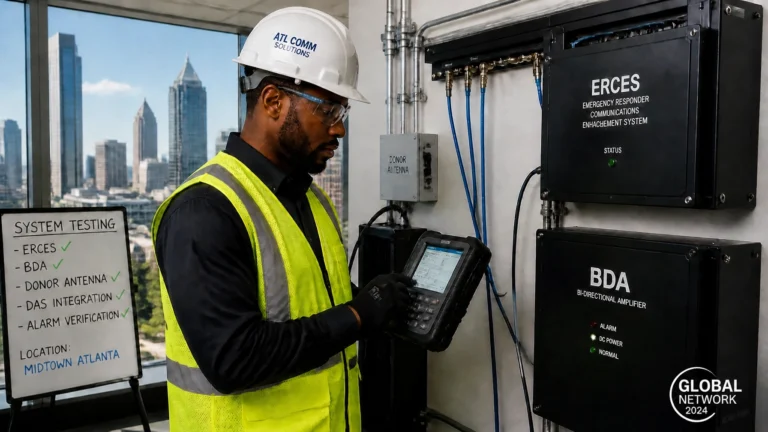
A compliant ERCES commonly includes:
- An outdoor donor antenna
- FCC-compliant signal booster or BDA
- Coaxial cable, fiber, couplers, splitters, and passive components
- A ceiling-mounted or distributed antenna network
- Supervised power supplies and battery backup
- Fire alarm interface and supervisory monitoring
- Fault annunciation for power, battery, donor, and amplifier conditions
- NEMA-rated or otherwise AHJ-approved equipment enclosures
- Required labeling and shutdown or override provisions
The system must not create harmful interference or unauthorized retransmission. Public safety spectrum coordination and FCC requirements under 47 CFR §90.219 must be addressed by qualified professionals.
4. Commission and Document Before Turnover
A complete closeout package may include:
- Approved design drawings
- RF coverage maps and grid results
- Equipment schedules and serial numbers
- Antenna and cable-loss documentation
- BDA gain settings
- Battery calculations and load-test results
- Fire alarm monitoring verification
- FCC compliance documentation
- Engineer certifications or stamps, where required
- AHJ approval and authorization documentation
- Maintenance and annual-testing instructions
A system is not complete simply because the BDA powers on. It is complete when the coverage, supervision, documentation, and AHJ acceptance requirements are satisfied.
What Existing Buildings Need to Review
Existing properties should not assume that an old approval guarantees future compliance. Building conditions and regulatory expectations can change.
Conduct a new review when:
- The property is undergoing a substantial renovation
- Floor layouts or occupancy classifications change
- New walls, glass, mechanical rooms, or shielding materials are added
- A below-grade area is expanded
- The fire alarm system is modified
- The BDA, antenna network, or battery system is replaced
- The public safety radio system or frequencies change
- Annual testing identifies degraded performance
- The property is seeking a new or amended Certificate of Occupancy
Start with a current radio signal strength study. A professional survey can determine whether the existing public safety radio system meets the AHJ’s requirements or whether an ERCES upgrade is necessary.

A Practical Georgia ERCES Compliance Checklist
Use this sequence for a new or existing facility:
- Confirm the governing code edition.
- Identify the local AHJ and responding radio agency.
- Request the current local ERCES or IFC 510 policy.
- Perform a qualified preconstruction or existing-building RF survey.
- Map general and critical areas.
- Model or design the Public Safety DAS/ERCES system.
- Coordinate frequencies, donor sites, and retransmission authorization.
- Submit plans for AHJ review before installation.
- Install FCC-compliant, code-appropriate BDA and DAS hardware.
- Complete acceptance testing using calibrated equipment.
- Verify fire alarm supervision, standby power, and fault reporting.
- Deliver the closeout package and obtain approval.
- Schedule annual inspection and performance testing.
Why Local Expertise Protects Your Schedule
Georgia’s statewide framework establishes the obligation to maintain reliable emergency responder communications. The local AHJ determines how that obligation is evaluated in the building.
That is why an Atlanta-area property needs more than equipment procurement. It needs local design judgment, disciplined RF testing, code coordination, and documentation that aligns with the reviewing authority.
Global Network LLC provides Public Safety DAS/ERCES design, installation, commissioning, compliance testing, and annual performance support for commercial, government, healthcare, hospitality, educational, and institutional facilities. Our systems are designed for dependable first responder communication and FirstNet-compatible infrastructure where applicable.
Our mission also includes workforce development and community safety. Technical competence, nondiscrimination, equal opportunity, and fair access to training and employment are operational obligations: not optional statements. Every project should be executed with respect for the workforce, the occupants, the responding agencies, and the public entrusted to the facility.
When it matters most, communication cannot depend on assumptions.
Take Action Before the Next Inspection
If your Georgia property is entering design, renovation, permitting, or occupancy review, confirm the applicable code edition and AHJ requirements now.
Request a professional radio coverage assessment or ERCES compliance consultation from Global Network LLC:
- Office: 770.520.7633
- Toll Free: 877.231.1084
- Website: globalnetworkco.com
- Services: Public Safety DAS and ERCES services
- Compliance guidance: The Public Safety DAS/BDA compliance checklist
- Consultation request: Get a compliance consultation
Confirm the code. Test the building. Coordinate with the AHJ. Protect the Certificate of Occupancy: and the people who respond when it matters most.