Fire Prevention Isn’t Just for October: Why ERCES Compliance Matters Year-Round in Atlanta
Every October, communities across the United States observe Fire Prevention Week. Public campaigns remind citizens about smoke alarm batteries, kitchen safety, and home escape routes. For homeowners, this annual observance serves as a helpful, timely reminder. However, for commercial real estate owners, developers, and facility managers in Metro Atlanta, treating fire safety and code compliance as a seasonal checklist item is a critical and legally perilous mistake.
Life-safety regulations: specifically those governing indoor emergency communication: do not expire on November 1st, nor do they pause between annual municipal inspections. Emergency Responder Communication Enhancement Systems (ERCES), Bi-Directional Amplifiers (BDAs), and Public Safety Distributed Antenna Systems (DAS) demand rigorous, year-round vigilance. Ensuring uninterrupted two-way radio coverage for firefighters, police officers, and emergency medical services (EMS) is an absolute, non-negotiable legal and ethical obligation.
When building occupants face an emergency, every second counts, and reliable radio communication is the lifeline that protects lives and structural assets. Understanding why ERCES compliance matters every single day of the year is essential for safeguarding your investment, avoiding steep municipal penalties, and securing your Certificate of Occupancy.
The Illusion of Seasonal Compliance: Beyond the Annual Inspection
It is easy for property managers to fall into the trap of reactive compliance: scrambling to review life-safety systems only when the local fire marshal's annual inspection notice arrives. This approach invites catastrophic failure. A building's internal radio frequency (RF) environment is dynamic, shifting with structural alterations, tenant build-outs, and even changes in exterior cellular and public safety tower footprints.
"0% Defects, 0% Missed Deadlines." That is the standard required when lives depend on in-building emergency radio communication.
When an ERCES installation is treated as a one-time box-checking exercise during initial construction, hidden vulnerabilities inevitably develop. A newly installed interior wall, replacement energy-efficient low-E glass windows, or altered mechanical rooms can instantly create a severe RF dead zone. If your BDA system or public safety DAS is not continuously monitored, maintained, and tested, these failures remain hidden until first responders enter your building during an active emergency: when finding out a radio doesn't work is fatal.
Maintaining compliance year-round guarantees that your facility operates with absolute reliability. For a comprehensive breakdown of what inspectors look for, review our guide on The Ultimate Public Safety DAS & BDA Compliance Checklist.
Navigating the Regulatory Framework: IFC 510, NFPA 72, and UL 2524
To appreciate why compliance must be maintained continuously, one must examine the strict regulatory architecture governing commercial facilities in Atlanta and surrounding jurisdictions. Local Authorities Having Jurisdiction (AHJs) enforce rigorous model codes that mandate reliable in-building public safety radio coverage:
- International Fire Code (IFC) Section 510: Mandates emergency responder radio coverage in new and existing buildings where radio signal strength falls below required thresholds. It specifies minimum inbound and outbound signal levels across at least 95% of critical areas (such as stairwells, elevator lobbies, and fire pump rooms) and 90% of general building areas.
- NFPA 72 (National Fire Alarm and Signaling Code): Governs the testing, supervision, and alarm integration of ERCES equipment. It dictates how system faults, power losses, and antenna malfunctions must report directly back to the Fire Alarm Control Panel (FACP).
- NFPA 1225 (Standard for Emergency Services Communications): The current benchmark standard aligning system design, installation, and ongoing maintenance protocols.
- UL 2524 (Standard for In-Building Two-Way Emergency Radio Communication Enhancement Systems): Requires that all BDA hardware, signal boosters, and power supplies carry certified listing credentials proving they can withstand extreme thermal and mechanical stress during a fire event.

Adhering to these standards requires technical precision and deep domain expertise. For deeper insights into code adherence, consult our technical resource on Compliance with Fire and Safety Regulations: Understanding IFC 510 & NFPA 72.
Proactive Maintenance vs. Reactive Panic: Protecting Your Occupancy Status
Waiting for an inspection failure before addressing your ERCES infrastructure can paralyze business operations. An uncertified building faces severe consequences:
- Delayed Certificates of Occupancy (CO): Commercial tenants cannot move in, retail spaces cannot open, and revenue streams stall.
- Municipal Fines and Stop-Work Orders: AHJs in Atlanta possess the legal authority to issue heavy citations or shutter non-compliant facilities.
- Exponential Remediation Costs: Emergency upgrades required under duress are invariably more expensive than scheduled, proactive maintenance programs.
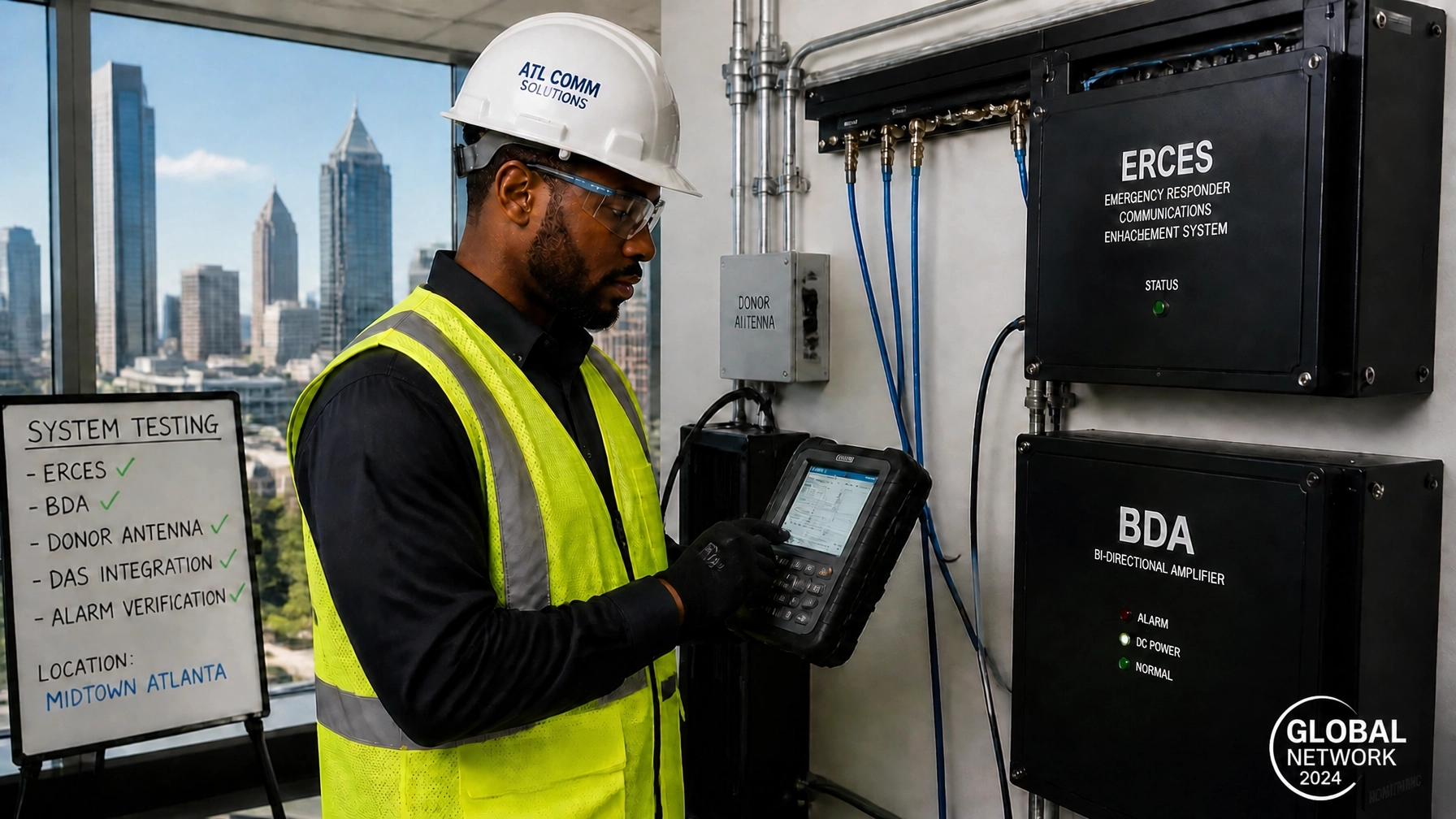
Proactive maintenance programs encompass annual signal grid testing, battery backup load testing, donor antenna alignment verification, and active monitoring of supervisory alarm points. As detailed in our analysis on 7 Mistakes You're Making With NFPA 72 Compliance and How to Fix Them, addressing minor system degradations early prevents costly overhauls.
The Human Element: Uninterrupted Communication When It Matters Most
Beyond legal mandates and financial risk lies the fundamental ethical responsibility of modern corporate stewardship: protecting human life.
When a smoke-filled high-rise or a sprawling commercial complex requires emergency evacuation, firefighters and police officers must maintain crystal-clear radio communication with incident commanders outside. Concrete structures, subterranean parking decks, and thick metallic shielding create impenetrable barriers for standard radio waves without an engineered BDA and DAS solution.

By maintaining robust, fully powered, and compliant in-building wireless systems year-round, you provide your tenants, employees, and visiting the public with ultimate peace of mind. Every square foot of your property remains blanketed by reliable signal strength, ensuring first responders can coordinate rescues swiftly and safely.
To explore why achieving strict coverage thresholds is vital for life safety, read our dedicated feature on Reliable Coverage in Critical Areas: Why the 99% Requirement Saves Lives.
Your Year-Round Action Plan for Atlanta Commercial Properties
Maintaining unbroken ERCES compliance requires partnering with local experts who understand Atlanta’s specific municipal codes and AHJ expectations. To ensure your facility remains audit-ready every day of the year, follow this structured action plan:
- Audit Your Current Standing: Verify the expiration date of your last annual BDA test report and ensure your system is actively supervised by your FACP.
- Partner with Certified Specialists: Engage experienced local professionals for comprehensive annual testing, commissioning, and acceptance surveys.
- Coordinate Building Modifications: Inform your life-safety partner whenever major interior renovations or glass replacements are planned.
- Schedule Routine Maintenance: Implement quarterly and annual service agreements to test battery backups, signal boosters, and donor antennas before problems arise.

Secure Your Building's Compliance Today
Do not wait for Fire Prevention Week or an urgent fire marshal notice to evaluate your building's emergency radio coverage. Whether you manage a high-rise office tower, a healthcare facility, a hospitality property, or a sprawling educational campus in Metro Atlanta, Global Network LLC delivers turnkey BDA design, professional installation, and rigorous compliance testing.
Ensure your property achieves 0% Defects and complete peace of mind. Contact our expert engineering team today to schedule your annual ERCES inspection or custom system design consultation.
- Office: 770.520.7633
- Toll-Free: 877.231.1084
- Website: globalnetworkco.com