Beyond the World Cup: 10 ERCES Design Ideas for Large-Scale Property Safety
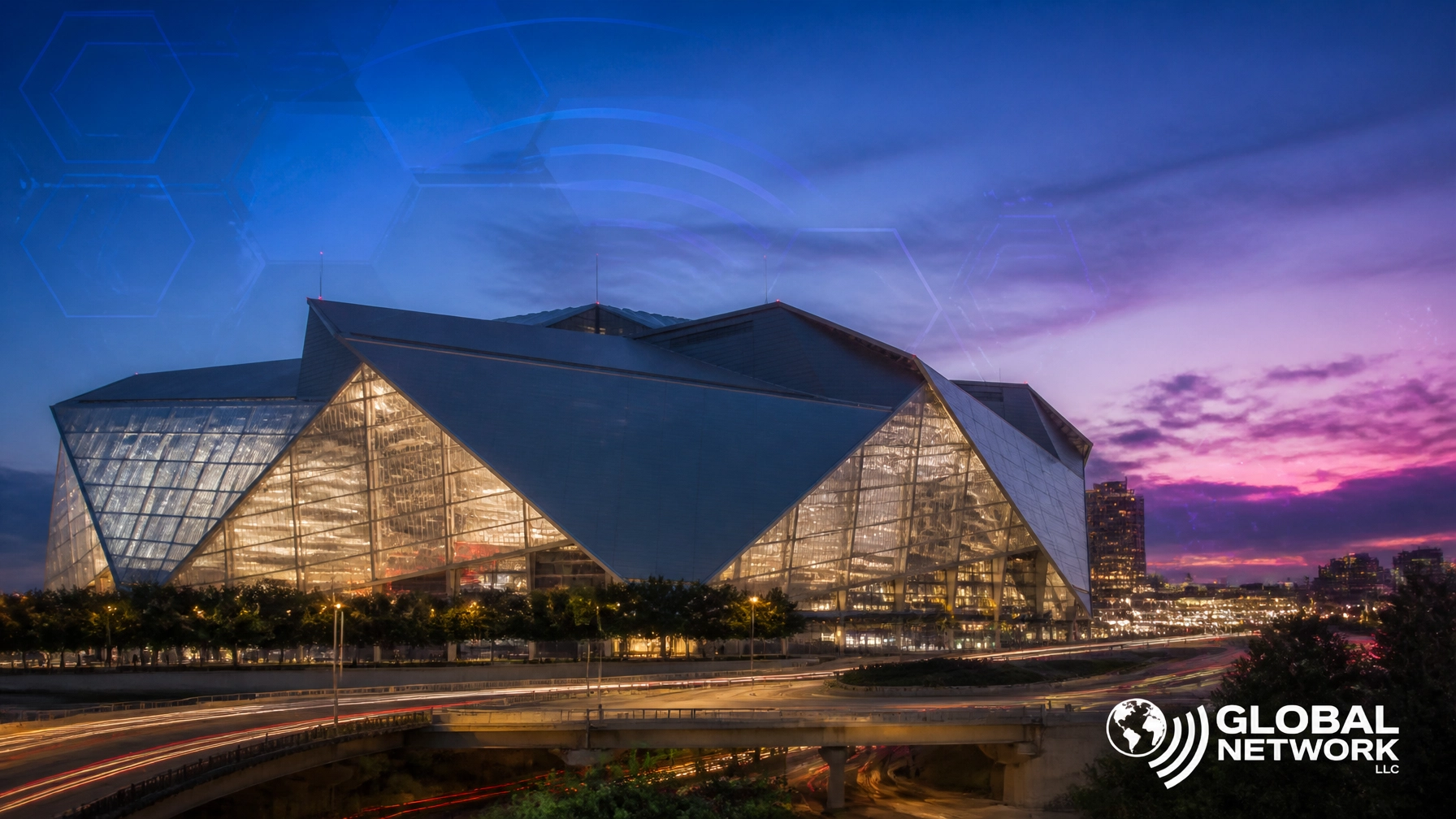
As Atlanta prepares to take the global stage for the 2026 World Cup, the eyes of the world are not just on the pitch at Mercedes-Benz Stadium, but on the infrastructure that keeps millions of fans, athletes, and officials safe. For property owners and facility managers of stadiums, arenas, convention centers, and large-scale mixed-use developments, the tournament represents a critical deadline for life-safety compliance.
In the high-stakes environment of international soccer, unbroken communication for first responders is non-negotiable. Whether it is a routine crowd management scenario or a high-priority emergency, police, fire, and EMS personnel must have 100% reliable radio coverage inside your facility. This is achieved through an Emergency Responder Communication Enhancement System (ERCES).
At Global Network LLC, we specialize in the design and installation of these life-saving systems, ensuring that large-scale properties move from inspection failures to first-pass approval. Here are 10 essential ERCES design ideas to ensure your property is safe, compliant, and ready for 2026 and beyond.
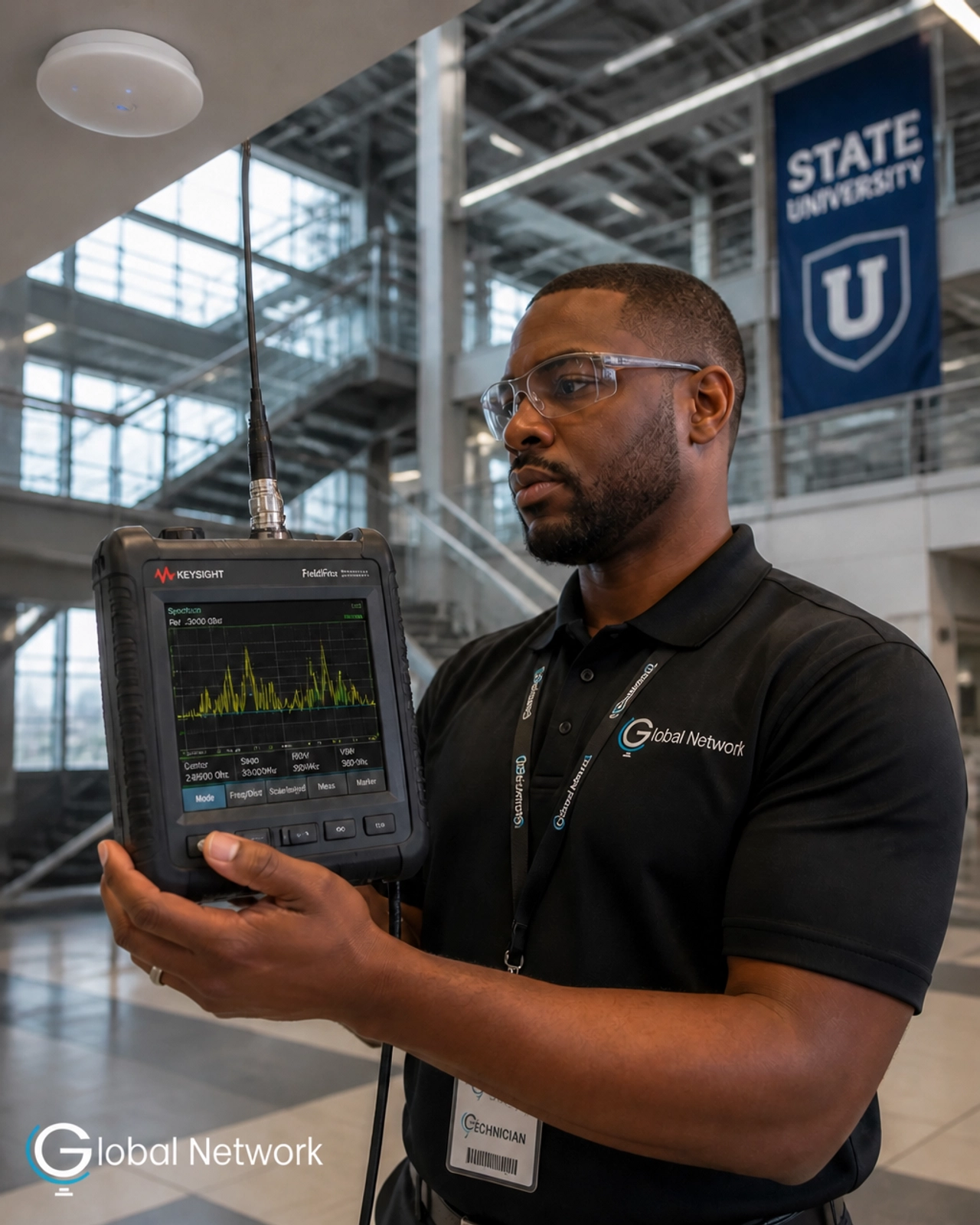
1. Capacity-First RF Modeling
Traditional ERCES designs often focus solely on signal "strength." However, for large venues like stadiums and convention centers, density is the real challenge. When thousands of fans occupy a space, the RF environment shifts.
- The Design Shift: Move beyond simple signal "bars" and focus on Delivered Audio Quality (DAQ) 3.0 or higher.
- Actionable Idea: Utilize 3D RF propagation modeling that accounts for structural materials (concrete, steel, and low-E glass) and the expected crowd density during a match.
2. Implement Fiber-Fed DAS Architectures
For large-scale properties or multi-building campuses, a passive BDA system often lacks the power to cover massive square footage without significant signal loss.
- The Solution: A Public Safety DAS installation utilizing a fiber-optic backbone allows for long-distance signal distribution from a central head-end to remote units without degradation.
- The Benefit: This architecture ensures uniform coverage across sprawling fan zones, underground parking, and high-rise hotel towers.
3. Prioritize Pathway Survivability
A communication system is only as good as its weakest link. During a fire or structural emergency, your ERCES must remain operational.
- Regulatory Standard: Adherence to NFPA 1225 and IFC 510 requires 2-hour fire-rated cables or protected raceways for all riser and backbone circuits.
- The Goal: Ensure that first responders can communicate from the 50th floor or the deepest basement even if the primary power or structural integrity is compromised.

4. Full Integration with FirstNet Standards
As the nation’s only high-speed, nationwide wireless broadband network dedicated to first responders, FirstNet integration is becoming a staple for large-scale property safety.
- Modern Design: Ensure your ERCES testing and certification includes FirstNet-compatible frequencies.
- The Impact: Providing first responders with both mission-critical voice (LMR) and high-speed data (LTE/FirstNet) ensures they have every tool needed to manage a large-scale incident.
5. Mitigate the "Near-Far" Effect in High-Density Areas
In a stadium seating bowl, a responder’s handheld radio near an antenna can inadvertently "desensitize" the system, making it harder to pick up signals from responders further away.
- Design Tactic: Use more antennas at lower power levels (high-density layout) rather than a few high-power antennas.
- Compliance Focus: This is essential for meeting IFC 510 compliance in assembly areas where dozens of first responders may be operating in close proximity.
6. Utilize UL 2524 Listed Hardware
The industry has moved toward rigorous standards for the hardware itself. At Global Network LLC, we advocate for 0% Defects in equipment selection.
- Mandatory Requirement: Many Atlanta AHJs (Authorities Having Jurisdiction) now require all BDA components to be UL 2524 listed.
- Value Proposition: This certification guarantees that the hardware was specifically built and tested for public safety use, ensuring it won't fail "when it matters most."
7. Strategic Zoning for Multi-Building Campuses
For properties like the Gulch or entertainment districts surrounding Mercedes-Benz Stadium, a one-size-fits-all approach is inefficient.
- The Idea: Segment the system into logical zones (e.g., Stadium Bowl, Hotel Tower, Parking Deck).
- Operational Advantage: Zoning allows for easier maintenance and ensures that a technical fault in one area does not bring down the entire district’s communication network.

8. Battery Backup & Environmental Hardening
Atlanta’s summer heat and high humidity can be brutal on electronics.
- Design Detail: All critical ERCES active components must be housed in NEMA 4 or 4X enclosures to protect against water, dust, and heat.
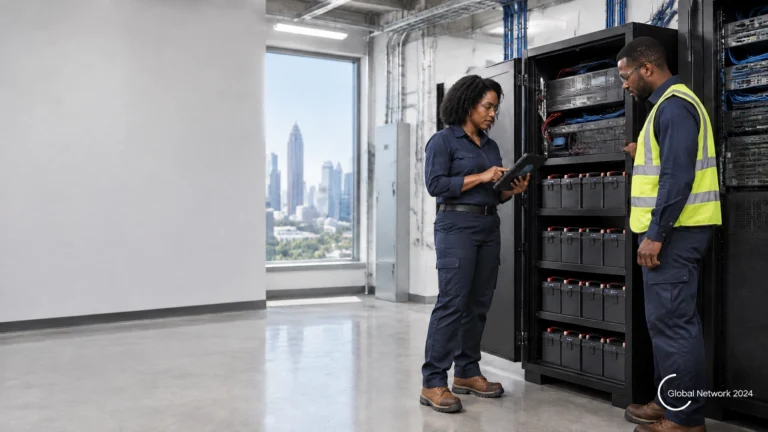
- Reliability: Systems must include battery backups capable of at least 24 hours of autonomous operation, ensuring 100% uptime even during a city-wide power outage.
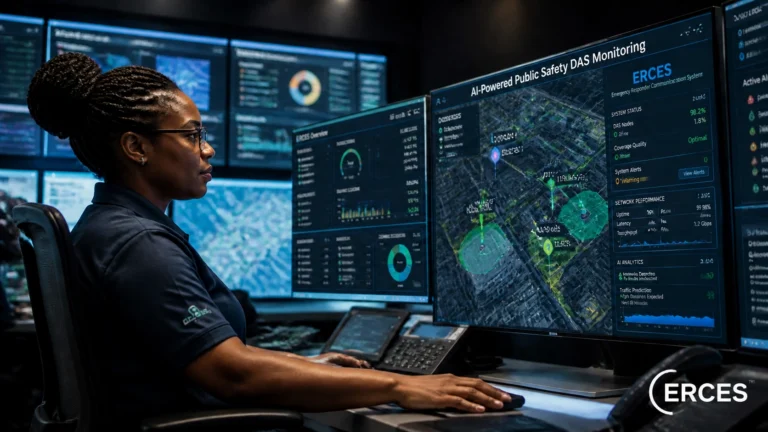
9. Real-Time Supervisory Monitoring
An ERCES that fails silently is a liability. Under NFPA 72, your system must be monitored by the building’s fire alarm control panel (FACP).
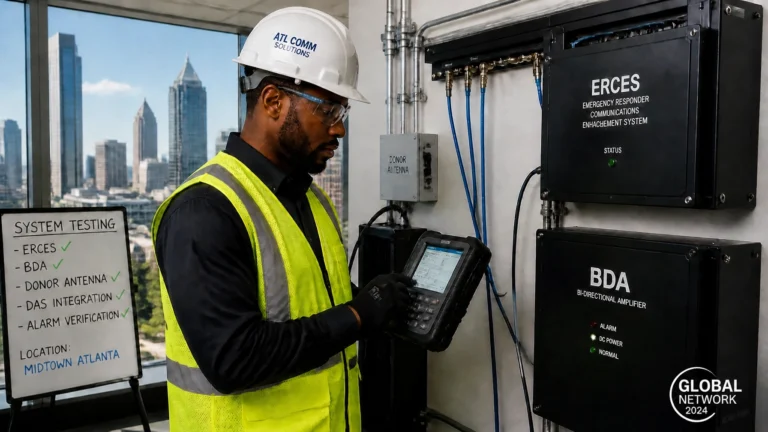
- Automated Alerts: Your system should trigger immediate supervisory signals for BDA malfunctions, antenna failure, low battery, or loss of AC power.
- Expert Oversight: Our Atlanta BDA specialist team provides ongoing annual performance tests to ensure these monitoring pathways remain active.
10. Future-Proofing for Post-World Cup Scalability
The infrastructure built for 2026 should serve your property for the next decade.
- Flexible Design: Choose systems that are software-defined, allowing for the addition of new channels or frequency bands without replacing expensive hardware.
- Long-Term Compliance: Ensure your system can adapt to evolving NFPA and IFC codes to avoid future costly retrofits.
Why Large-Scale Properties Trust Global Network LLC
Managing a project of this magnitude requires more than just a contractor; it requires a partner with Local Expertise. As Atlanta's premier DAS and ERCES specialist, we bring a commitment to excellence that includes:
- 0% Missed Deadlines: We understand the pressure of fixed dates like the World Cup.
- 0% Defects: Our systems are designed for high-availability and mission-critical reliability.
- Full Lifecycle Support: From initial RF surveys to final testing and certification, we handle every detail.

The safety of your tenants, guests, and the first responders who protect them is our highest priority. Don't wait for a failed inspection to realize your building has radio dead zones.
Contact Atlanta's BDA Specialists Today
Whether you are managing a stadium, a high-rise, or a campus-wide development, ensure your property is at the forefront of safety advancements.
Global Network LLC
Office: 770.520.7633
Toll Free: 877.231.1084
Visit our Services Page to schedule your initial consultation and RF survey.
Ensure your property is world-class ready. Compliance is peace of mind.