NFPA 1225 vs IFC 510: What’s the Difference and Which Standard Applies to Your Building?
For commercial real estate developers, property owners, and facility managers navigating life-safety compliance, regulatory terminology can often feel like a maze of overlapping acronyms. When securing a Certificate of Occupancy or executing a major facility upgrade, two primary documents invariably dominate the conversation: IFC 510 and NFPA 1225.
Misunderstanding how these two benchmarks interact can lead to catastrophic inspection failures, costly construction delays, and severe liability exposure. For a comprehensive overview of how these frameworks integrate, explore our ERCES and DAS category page.
Achieving 0% Defects and 0% Missed Deadlines requires a clear, authoritative understanding of the distinct roles that IFC 510 and NFPA 1225 play in modern telecommunications infrastructure and public safety technology.
1. The Core Distinction: Code Trigger vs. Technical Standard
The fundamental confusion surrounding these regulations stems from a failure to distinguish between a model fire code and a technical engineering standard.
- IFC 510 (International Fire Code, Section 510) acts as the legal trigger. Adopted into local ordinances by state and municipal governments across the country, IFC 510 dictates when and where an in-building emergency responder communication enhancement system is legally mandated. It establishes the legal framework for permitting, initial acceptance testing, and mandatory annual re-certification.
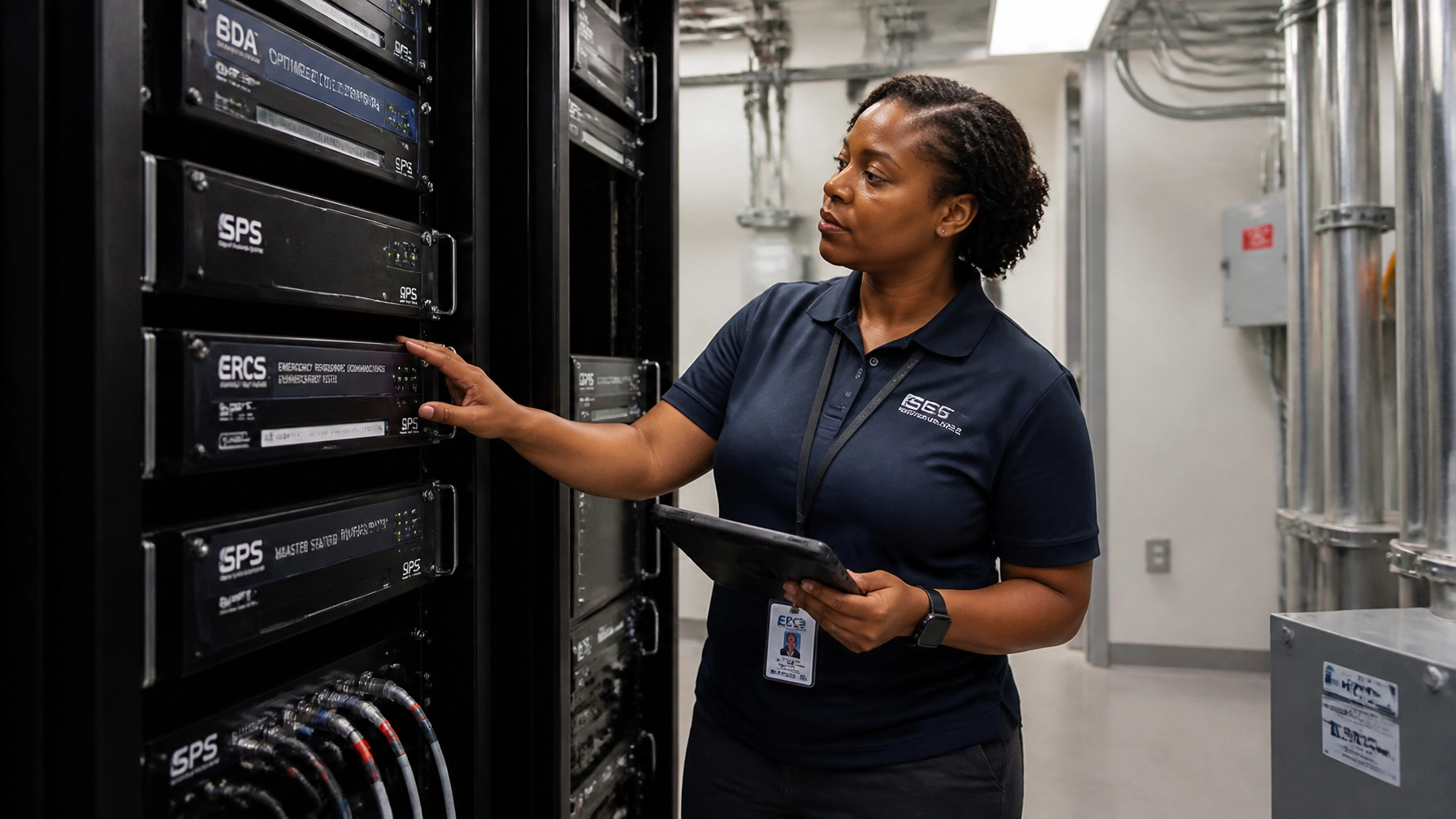
- NFPA 1225 (Standard for Emergency Services Communications) serves as the rigorous technical blueprint. Consolidating previous standards like NFPA 1221 and NFPA 1061, NFPA 1225 defines how the Emergency Responder Communication Enhancement System (ERCES) must be engineered, installed, powered, and maintained to guarantee absolute operational reliability during a crisis.
When local Authorities Having Jurisdiction (AHJs) inspect a facility, they enforce both standards simultaneously. You look to IFC 510 to determine if your building requires a system, and you rely on NFPA 1225 to build and test that system to perfection. Learn more about our specialized engineering methodologies on our services page.
2. Terminology Breakdown: ERCES vs. ERRCS
As you review architectural drawings, RFP documents, and fire marshal submittals, you will encounter two primary terms that are frequently used interchangeably:
- ERRCS (Emergency Responder Radio Coverage Systems): Traditionally emphasized within the International Fire Code framework, this term focuses primarily on Land Mobile Radio (LMR) frequencies utilized by local police, fire, and emergency medical personnel inside commercial structures.
- ERCES (Emergency Responder Communication Enhancement Systems): Adopted prominently within NFPA 1225, ERCES represents a broader, future-proof nomenclature. It encompasses traditional repeater-based Distributed Antenna Systems (DAS) as well as advanced public safety broadband integration, such as FirstNet compatibility and emergency cellular enhancements.

Navigating these definitions correctly ensures that your engineering submittals align precisely with what your local fire marshal evaluates during plan review. To understand how achieving compliance protects your operational continuity, review our guide on achieving IFC 510 and NFPA 72 compliance with ERCES.
3. Performance, Coverage, and Signal Criteria
Both standards establish strict performance thresholds to eliminate radio dead zones, but their specifications work in tandem to define success:
Floor Area Coverage Mandates
- General Building Areas: Both NFPA 1225 and IFC 510 mandate a minimum of 95% signal coverage across all general floor areas within a structure.
- Critical Areas: High-risk functional zones: including fire command centers, fire pump rooms, exit stairwells, elevator lobbies, and standpipe cabinet locations: require 99% signal coverage.
Signal Strength and Audio Quality
- Signal Thresholds: Systems must deliver a minimum inbound and outbound signal strength of -95 dBm throughout designated coverage zones.
- Delivered Audio Quality (DAQ): NFPA 1225 explicitly enforces a minimum DAQ 3.0 performance standard, ensuring speech transmitted over the bi-directional amplifier (BDA) network is fully intelligible without requiring frequent repetition.

Failing to meet these rigorous criteria during acceptance testing will halt your occupancy timeline. For actionable insights on passing inspection on the first attempt, read our detailed breakdown on how to pass your next fire marshal radio inspection.
4. Power, Survivability, and Monitoring Requirements
While IFC 510 outlines the general mandate for system supervision, NFPA 1225 provides exhaustive technical specifications governing physical survivability and system monitoring:
- Secondary Power Duration: Both codes mandate robust secondary battery backup systems capable of supporting 100% system operation for a minimum of 12 hours upon primary AC power failure.
- Pathway Survivability & Enclosures: NFPA 1225 requires fire-rated pathway cabling, protected routing, and NEMA 4/4X enclosures to shield active electronic components against water intrusion, dust, and thermal degradation during an active fire event.
- Continuous Monitoring: Critical system faults: including amplifier failure, low battery voltage, AC power loss, and antenna malfunction: must be continuously supervised and reported directly to the building’s Fire Alarm Control Panel (FACP) in accordance with NFPA 72 guidelines.

Adhering to these strict survivability mandates guarantees that first responders maintain uninterrupted communications when it matters most.
5. Local Enforcement and Atlanta Jurisdictional Realities
Regulatory compliance is never one-size-fits-all. In the metropolitan Atlanta area, local AHJs enforce model codes with specific regional amendments. Building owners must account for:
- Local Fire Marshal Amendments: Municipalities may require extended battery backups (such as 24 hours) or mandate specific public safety frequencies unique to regional emergency dispatch networks.
- FirstNet Readiness: Modern emergency communication systems must integrate seamlessly with national broadband public safety networks. Discover our advanced capabilities in FirstNet 5G Atlanta upgrades.
- Proactive Engineering: Waiting until the final architectural walk-through to test signal strength introduces catastrophic financial risk. Partnering with local specialists guarantees that your DAS and BDA infrastructure satisfies both IFC 510 legal triggers and NFPA 1225 technical standards from day one.
6. Securing Your Certificate of Occupancy with Absolute Compliance
Navigating the intersection of IFC 510 and NFPA 1225 demands specialized engineering expertise, rigorous commissioning protocols, and deep familiarity with local AHJ expectations. At Global Network LLC, we specialize in turning complex regulatory hurdles into seamless, first-pass inspection approvals.

We remain steadfastly committed to upholding the highest standards of corporate responsibility, ethical compliance, and life-safety excellence. Whether you are developing a new commercial high-rise, a sprawling educational campus, or a multi-unit hospitality venue, our certified engineers deliver 0% Defects and 0% Missed Deadlines.
Protect your occupants, eliminate regulatory liabilities, and secure your Certificate of Occupancy with confidence.
Contact Global Network LLC Today:
- Office: 770.520.7633
- Toll-Free: 877.231.1084
- Website: globalnetworkco.com