2027 Compliance Outlook: What Atlanta Building Owners Need to Know About Emergency Communication Codes
As the commercial real estate and institutional sectors in Metro Atlanta look toward the 2027 regulatory horizon, building owners, facility directors, and general contractors face an increasingly rigorous enforcement landscape. Ensuring absolute life-safety compliance is no longer just a routine step in the development process: it is a mandatory legal prerequisite for securing and maintaining your Certificate of Occupancy (CO). With local municipalities and the Atlanta Fire Rescue Department (AFRD) strictly enforcing IFC 510, NFPA 72, and NFPA 1225, staying ahead of these codes is critical.
At Global Network LLC, we specialize in cutting-edge in-building wireless solutions, ensuring that your facility achieves 0% Defects and 0% Missed Deadlines. Below is your comprehensive 2027 compliance outlook detailing the exact regulatory expectations, engineering standards, and proactive strategies required to protect your asset and first responders.
1. The 2027 Regulatory Landscape: Understanding the Trifecta of Codes
Navigating municipal fire codes requires a thorough understanding of the primary standards governing Emergency Responder Communication Enhancement Systems (ERCES) and Emergency Responder Radio Coverage (ERRC).
IFC Section 510: The Foundation of In-Building Wireless
Adopted across Georgia with stringent state and local amendments, International Fire Code (IFC) Section 510 mandates that all new and existing buildings maintain reliable two-way radio coverage for emergency personnel. When interior construction: such as Low-E glass, thick concrete cores, and subterranean parking structures: attenuates outside signals, building owners are legally obligated to deploy engineered Distributed Antenna Systems (DAS) and Bi-Directional Amplifiers (BDA).
NFPA 1225: The New Benchmark for Emergency Communications
Replacing older standards like NFPA 1221, NFPA 1225 governs the rigorous design, installation, pathway survivability, monitoring, and ongoing maintenance of in-building emergency communications systems. Compliance with NFPA 1225 ensures that your BDA hardware and cabling infrastructure can withstand extreme thermal and mechanical stress during an active emergency.
NFPA 72: National Fire Alarm and Signaling Code
Where authorities having jurisdiction (AHJs) approve wired fire department communication systems in lieu of wireless ERCES, compliance with NFPA 72 is mandatory. This includes strict specifications for emergency voice/alarm communication systems across fire command centers, elevator lobbies, stairwells, and pump rooms.
2. Why Atlanta Building Owners Must Act Early

Failing to address public safety communication requirements until the final stages of construction creates catastrophic delays. In Atlanta, AFRD guidelines dictate that initial RF signal strength testing must be completed before site plan approval for new developments.
Avoiding the 11th-Hour Certificate of Occupancy Trap
We frequently encounter developers who treat wireless infrastructure as an afterthought. Waiting until the final fire marshal walkthrough to test signal strength leads to severe financial liabilities:
- Costly Redesigns: Retrofitting cabling and antenna placement in finished drywall introduces massive labor expenses.
- Occupancy Delays: Delayed CO issuance prevents tenant move-ins, resulting in millions of dollars in lost revenue and breached lease agreements.
- Legal Liability: Operating a commercial facility without verified emergency communication compliance exposes ownership entities to severe municipal penalties and liability negligence claims.
By partnering with Atlanta's premier local DAS specialists at Global Network LLC, you establish a bulletproof compliance pathway from day one.
3. Core Technical Specifications for 2027 Compliance
To pass AFRD and AHJ inspections on the first attempt, your in-building wireless installation must meet exact engineering parameters:
- Signal Strength Thresholds: Inbound and outbound signals must achieve a minimum of –95 dBm throughout the facility.
- Coverage Percentages: General building areas must demonstrate at least 95% coverage, while critical areas: such as fire command centers, exit stairwells, elevator lobbies, and emergency power rooms: require 99% coverage.
- Pathway Survivability & Secondary Power: Systems must incorporate UL 2524-listed BDA hardware backed by dedicated secondary power sources capable of operating for at least 24 hours during primary power failures.
4. Annual Testing and Ongoing Recertification Mandates

Compliance does not end once the initial Certificate of Occupancy is issued. Under IFC 510 and NFPA standards, building owners are legally mandated to conduct annual performance testing and recertification.
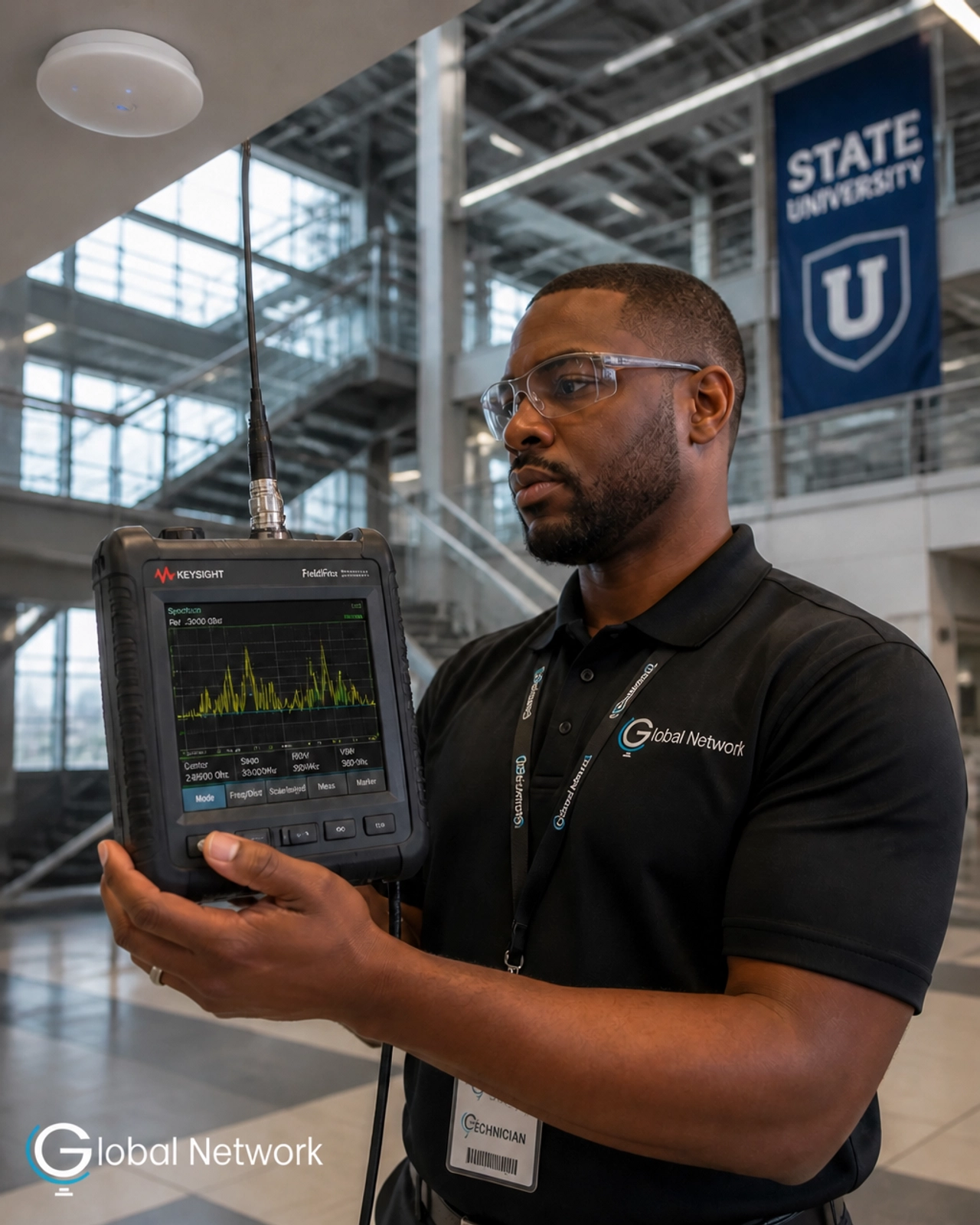
Structural alterations, tenant build-outs, and neighboring urban developments can alter radio frequency propagation over time, creating sudden dead zones. Our certified engineers perform comprehensive annual commissioning, grid testing, and DAQ/SINR measurements to ensure uninterrupted system reliability.
5. How Global Network LLC Delivers Absolute Peace of Mind

At Global Network LLC, we recognize that your facility represents a significant capital investment and a profound duty of care to its occupants. We maintain an uncompromising commitment to corporate responsibility, technical excellence, and regulatory mastery.
When you partner with our team, you gain:
- Unmatched Local Expertise: Deep familiarity with AFRD protocols, Georgia building codes, and municipal AHJ expectations across Metro Atlanta.
- FirstNet Compatibility: Advanced engineering designed to seamlessly integrate with FirstNet standards for primary public safety responders.
- Turnkey Execution: Comprehensive design, installation, commissioning, and annual compliance testing managed by certified industry professionals.
Secure Your Building's Future Today
Do not let radio dead zones jeopardize your project timeline or compromise first responder safety. At Global Network LLC, we deliver 0% Defects and 0% Missed Deadlines when it matters most.
Contact our expert engineering team today to schedule your initial RF site evaluation and ensure seamless 2027 compliance.
- Office: 770.520.7633
- Toll-Free: 877.231.1084
- Website: globalnetworkco.com