Below Grade and Beyond: Covering Underground Spaces Where First Responder Radios Fail
A building can have excellent radio coverage at street level and still contain dangerous communication dead zones below grade. Subgrade parking garages, basements, elevator shafts, stairwells, tunnels, and mechanical rooms are often the first places where public-safety radio signals weaken or disappear.
That creates a serious life-safety concern. When firefighters, police officers, or emergency medical personnel move underground, they must be able to communicate with dispatch and with one another when it matters most.
For building owners, developers, and facility managers, reliable underground coverage is not simply a convenience. Depending on the local authority having jurisdiction (AHJ), it may be a condition of approval, fire-code compliance, or a Certificate of Occupancy.
Why Below-Grade Spaces Are So Difficult to Cover
Public-safety radio systems typically depend on signals transmitted from outdoor radio sites. Those signals may penetrate an above-ground building only with significant attenuation. Below grade, the challenge becomes more severe.
Several construction and environmental factors contribute to radio-frequency (RF) loss:
- Earth and surrounding soil absorb and block RF energy.
- Reinforced concrete creates substantial signal attenuation.
- Steel reinforcement and structural columns interfere with propagation.
- Low-E glass, metal doors, and mechanical equipment create additional barriers.
- Long corridors, ramps, and vertical shafts produce inconsistent RF paths.
- Multiple basement levels compound signal loss from floor to floor.
A radio that works reliably outside the building may fail only a few feet inside a basement or garage. Cell-phone bars are not an acceptable measure of public-safety radio performance. Compliance testing requires calibrated instruments, defined test procedures, and verification of both inbound and outbound communication.
A strong signal above grade does not guarantee a usable signal below grade.
The Highest-Risk Underground Areas
Subgrade Parking Garages
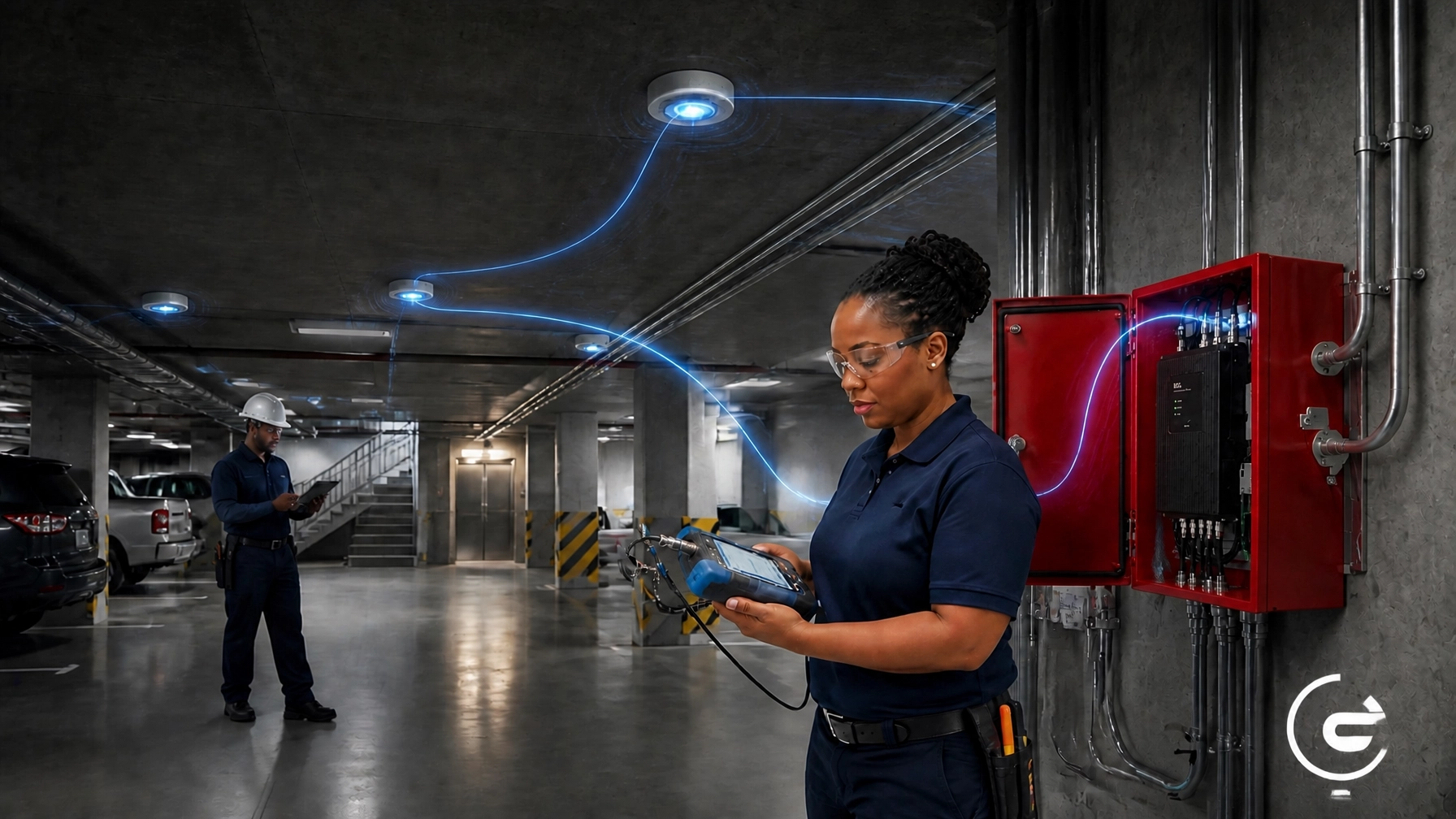
Underground parking garages are among the most common locations for public-safety radio failure. Large concrete slabs, dense structural elements, enclosed ramps, and multiple levels can isolate the garage from outdoor radio sites.
Coverage must be evaluated throughout more than the driving lanes. A complete assessment should include:
- Parking stalls and pedestrian paths
- Vehicle ramps and turning areas
- Stairwell landings
- Elevator lobbies
- Security and equipment rooms
- Fire pump and sprinkler valve rooms
- Storage and loading areas
- Mechanical and electrical rooms
A garage may pass in one section and fail in another. RF conditions can change around ramps, corners, fire doors, electrical rooms, and heavily reinforced structural zones. A public-safety DAS or ERCES design must account for those variations rather than relying on a few strategically placed antennas.
Basements and Lower-Level Mechanical Rooms
Basements frequently contain the infrastructure that supports the building’s fire and life-safety systems. Fire pump rooms, standpipe equipment, sprinkler sectional valves, emergency power rooms, and fire command functions may all be located below grade.
These are not areas where coverage can be treated as optional. Many jurisdictions identify these locations as critical areas, which may carry higher coverage requirements than general occupiable spaces.
A basement design should consider:
- The full floor area, including service corridors
- Fire command centers
- Fire pump rooms
- Standpipe and sprinkler valve locations
- Utility and electrical rooms
- Emergency generator rooms
- Storage rooms and janitorial spaces
- Connections to stairs, elevators, and tunnels
The system must also be protected from physical damage, water exposure, heat, and unauthorized access. Equipment placement, pathway protection, grounding, fire-rated construction, and backup power all matter.

Elevator Shafts and Lobbies
Elevators create unique RF challenges because the shaft is a deep, enclosed vertical structure surrounded by concrete, steel, machinery, and fire-rated assemblies. Elevator lobbies can also become isolated from the main floor area, particularly on lower levels.
Coverage should be evaluated in:
- Elevator cabs, where required by the AHJ
- Elevator lobbies on every below-grade level
- Elevator machine and control areas
- Adjacent corridors
- Connecting exit stairs
- Areas near elevator recall and firefighter access routes
The appropriate solution may include strategically placed antennas, radiating cable, or other engineered components. The final approach depends on the building configuration, local code, system architecture, and AHJ requirements.
The important point is simple: testing the main floor does not prove that the elevator path works.
Stairwells and Exit Passageways
Stairwells are essential firefighter access and egress routes, but they are often difficult RF environments. Thick walls, fire doors, concrete construction, and continuous vertical separation can create signal shadows.
A responder may enter a stairwell with clear communications, descend several floors, and then lose contact at a landing or transition point. For this reason, exit stairs and passageways are commonly treated as critical coverage areas.
Coverage continuity should be evaluated from the roof or upper floors through the lowest occupied and service levels. A system that covers the basement but fails at the connecting stairwell is not providing reliable operational communications.
IFC 510 and NFPA 1225: What Owners Need to Understand
IFC Section 510 is a primary regulatory driver for in-building emergency responder radio coverage. Local jurisdictions may adopt the code with amendments, different thresholds, or additional documentation requirements. The AHJ determines how the provisions apply to a specific property.
NFPA 1225 provides technical guidance for emergency responder communications systems, including system performance, installation, survivability, and testing. NFPA 72 may also apply where the system interfaces with fire alarm and signaling infrastructure.
Commonly referenced performance targets may include:
- Approximately 95% coverage in general areas
- Approximately 99% coverage in designated critical areas
- Minimum received signal strength targets such as -95 dBm, depending on local requirements
- Delivered Audio Quality (DAQ) criteria for intelligible radio communications
- Grid-based testing, often using a 20-foot by 20-foot test grid
- Backup power and system monitoring
- Fire-rated pathways, enclosures, and survivability measures
These values are not a substitute for jurisdiction-specific requirements. A building owner should confirm the adopted code edition and AHJ standards before design or construction begins.
The International Code Council’s code resources and NFPA standards information provide useful background. For project-specific compliance, however, the governing fire marshal or AHJ remains the final authority.
How a Public-Safety DAS/ERCES Restores Coverage
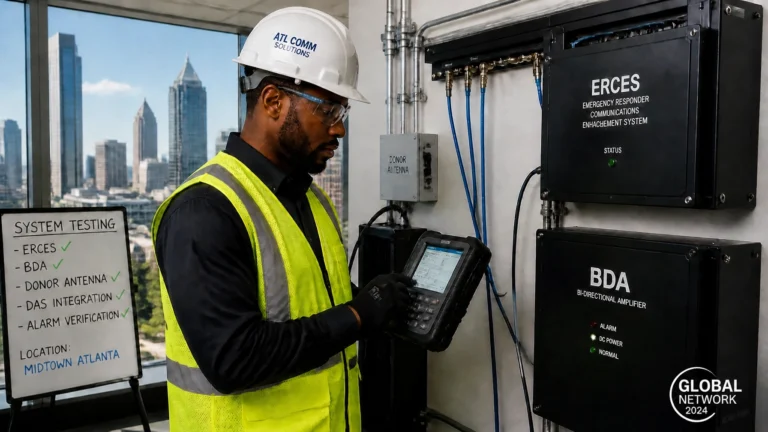
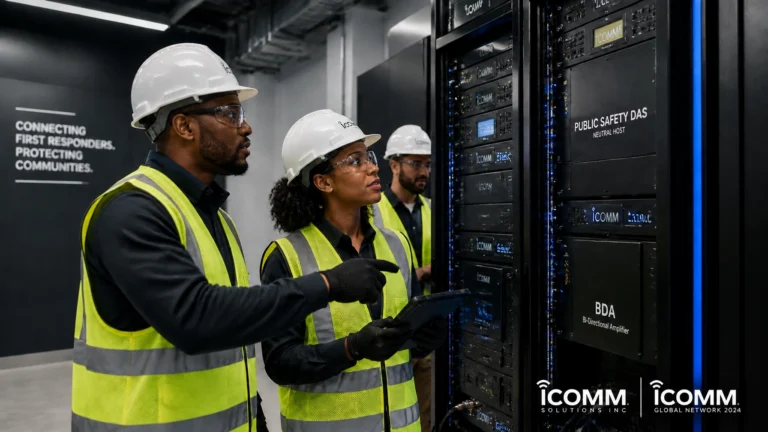
An Emergency Responder Communication Enhancement System (ERCES): also referred to in many jurisdictions as an ERRCS: uses active and passive RF components to extend public-safety radio coverage into areas that outdoor signals cannot reliably reach.
A typical system may include:
- Donor antennas that receive the public-safety radio signal
- A Bi-Directional Amplifier (BDA) that amplifies inbound and outbound signals
- Coaxial cable or radiating cable
- Distributed indoor antennas
- Splitters, couplers, and other passive components
- Fire-rated equipment enclosures
- Primary and secondary power
- Alarm and remote-monitoring interfaces
The BDA is not a substitute for engineering. Excessive gain, poor isolation, cable losses, oscillation, and improperly balanced RF paths can create system problems. A compliant design must be based on measured conditions, RF modeling, equipment specifications, and field verification.
Global Network LLC provides public-safety DAS and ERCES services, including design, installation, compliance testing, commissioning, and annual performance testing.
The Testing Process: Find Dead Zones Before the Fire Marshal Does
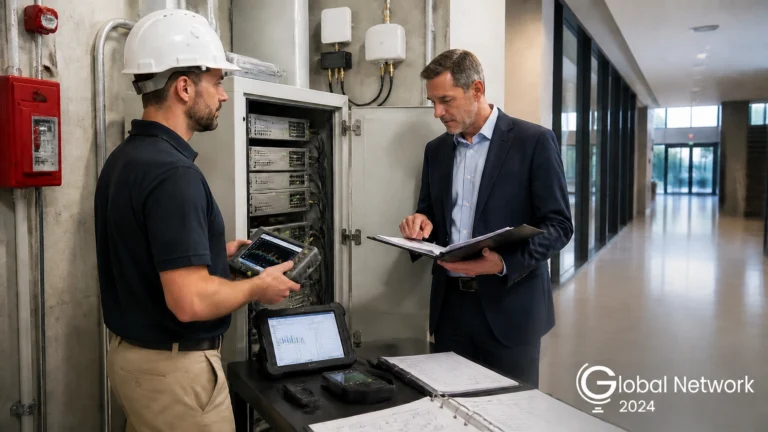
Professional RF testing should begin as early as possible. Pre-construction testing can identify whether below-grade spaces are likely to require an ERCES. Post-construction testing verifies how walls, doors, equipment, and finishes affect actual performance.
A thorough assessment typically includes:
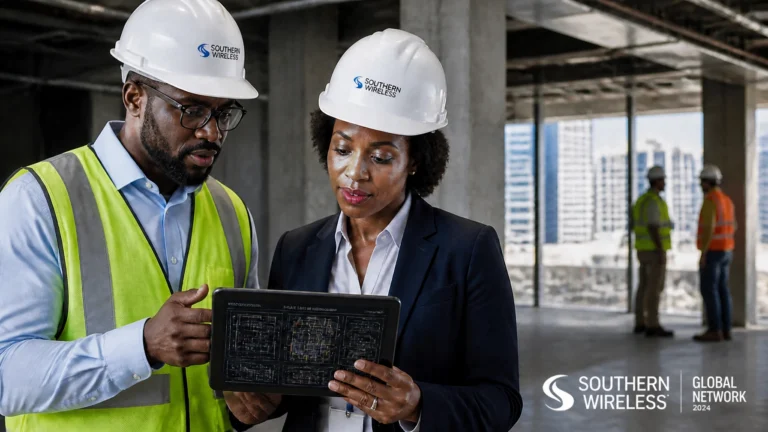
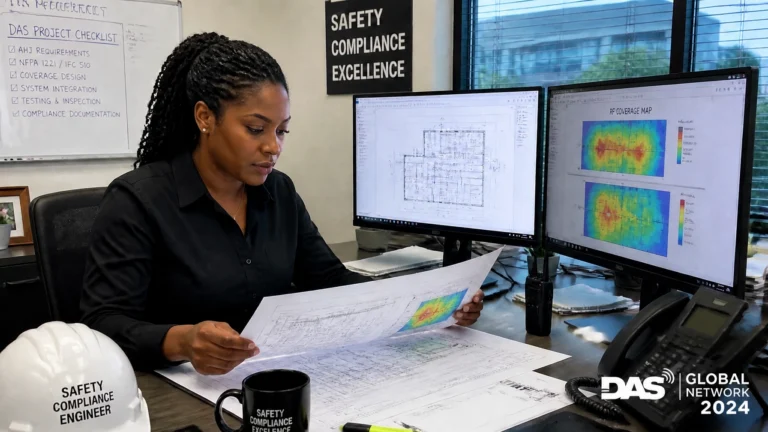
- Reviewing architectural, structural, and life-safety plans
- Identifying all below-grade and critical areas
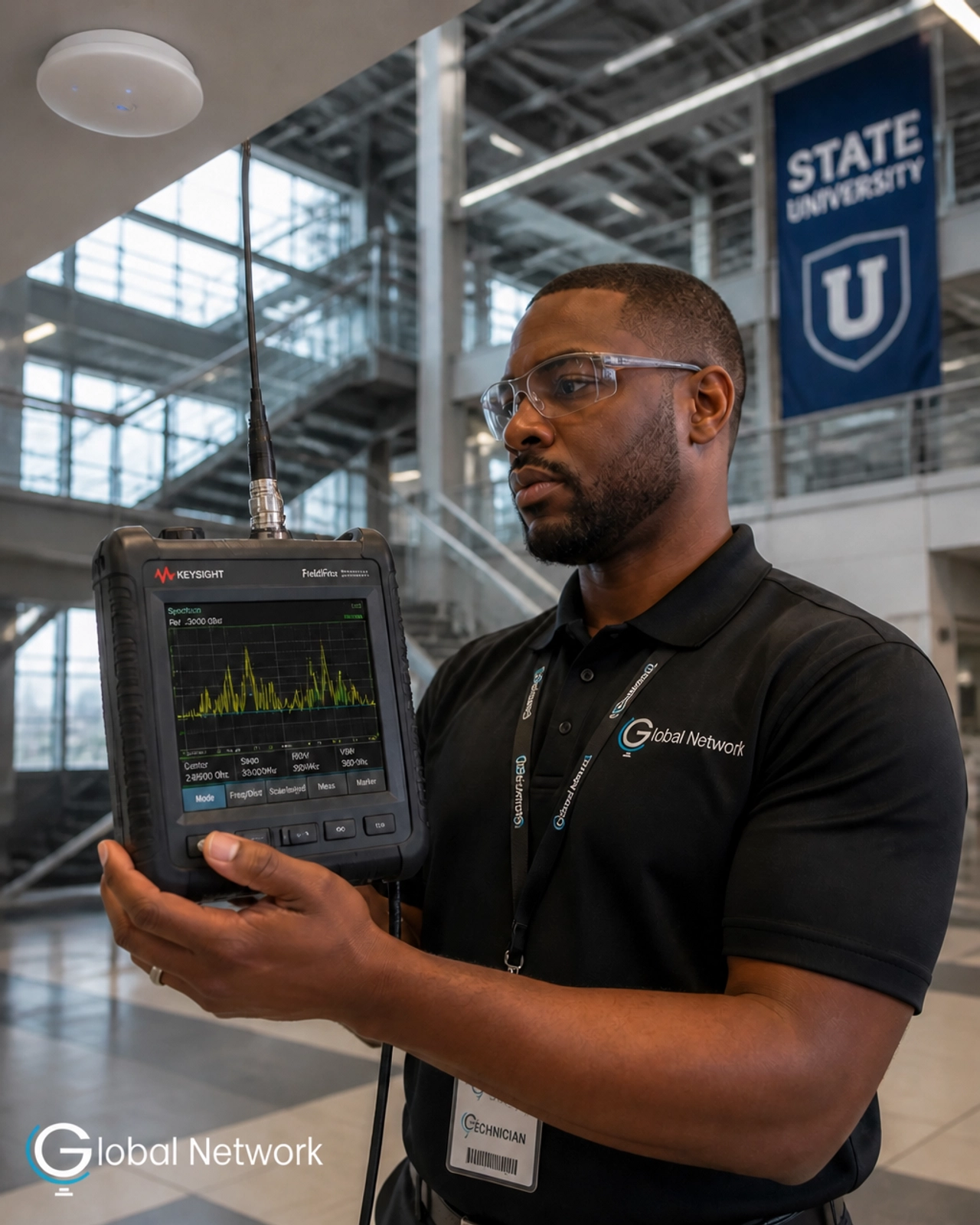
- Performing calibrated signal-strength measurements
- Testing inbound and outbound radio performance
- Measuring audio quality where required
- Mapping failures on a defined grid
- Documenting stairwells, elevators, garages, and mechanical rooms
- Designing a targeted DAS/ERCES solution
- Completing acceptance testing and AHJ documentation
- Establishing an annual inspection and maintenance schedule
Annual testing is essential. Renovations, new partitions, damaged antennas, cable work, and changes to building systems can affect RF performance over time.
0% Missed Deadlines. 0% Unverified Critical Areas.

A Practical Checklist for Building Owners
If your property includes underground or below-grade space, take these steps:
- Confirm which edition of IFC 510, NFPA 72, and NFPA 1225 has been adopted locally.
- Ask the AHJ whether underground parking, basements, elevators, or tunnels trigger testing.
- Schedule a professional RF coverage survey before final construction.
- Identify all critical areas on the floor plans.
- Confirm requirements for fire-rated pathways and equipment.
- Verify backup power duration and monitoring requirements.
- Require acceptance testing after installation.
- Maintain records of test results, deficiencies, repairs, and annual inspections.
- Use a qualified local specialist familiar with the jurisdiction’s fire marshal requirements.
Global Network LLC is an Atlanta-based specialist in public-safety DAS, BDA systems, ERCES design, installation, and compliance testing. The objective is more than passing an inspection. It is ensuring that first responders can communicate through the entire structure: above grade, below grade, and everywhere in between.
Protect the Spaces Where Communication Matters Most
Underground areas are often the most difficult parts of a building to cover and the most dangerous places to lose communications. A failed radio connection in a basement, garage, elevator, or stairwell can delay coordination at the exact moment responders need reliable information.
Do not wait for a failed acceptance test or an occupancy delay. Review Global Network LLC’s compliance resources, or request a compliance consultation for your property.
Office: 770.520.7633
Toll Free: 877.231.1084
Website: globalnetworkco.com
Reliable coverage is a life-safety responsibility. Design for it before an emergency demands it.