Carrier Coordination and FirstNet: The Behind-the-Scenes Work That Makes Public Safety DAS Work
When a first responder enters a high-rise, hospital, campus, stadium, or parking structure, reliable communication cannot depend on luck. It depends on careful RF engineering, code compliance, equipment coordination, and a clear understanding of which wireless networks the building must support.
That is where carrier coordination and FirstNet planning become essential.
A public safety DAS or Emergency Responder Communication Enhancement System (ERCES) may appear to be a straightforward collection of antennas, coaxial cable, fiber, and a Bi-Directional Amplifier (BDA). Behind the scenes, however, the system must be designed around local Land Mobile Radio (LMR) channels, commercial wireless bands, building materials, Authority Having Jurisdiction (AHJ) requirements, and: when applicable: FirstNet Band 14.
0% Guesswork. 0% Missed Deadlines. Reliable communication when it matters most.
Public Safety Frequencies and Commercial Carrier Frequencies Are Not the Same
One of the most important distinctions in in-building wireless design is the difference between public safety LMR frequencies and commercial cellular frequencies.
Public safety LMR frequencies
Fire, police, and EMS agencies commonly use LMR systems for mission-critical voice communications. Depending on the local jurisdiction, those systems may operate across:
- VHF
- UHF
- 700 MHz public safety channels
- 800 MHz public safety channels
- P25, analog, or other digital radio technologies
A code-required public safety DAS is typically designed to extend these local radio channels throughout a building. The objective is to ensure that responders can use handheld radios in areas where concrete, steel, low-emissivity glass, elevators, mechanical rooms, and below-grade construction weaken outdoor signal strength.
This is the foundation of an ERRCS.
The system is engineered around the frequencies used by the local public safety radio network: not around whichever commercial cellular carriers occupants happen to use.
Commercial carrier frequencies
Commercial wireless networks support cellular voice, data, video, messaging, and connected devices. These networks are operated by Mobile Network Operators (MNOs) such as AT&T, Verizon, and T-Mobile.
A commercial cellular DAS or signal booster may distribute selected LTE and 5G bands inside a building. It can improve connectivity for:
- Employees and visitors
- Tenants and residents
- Mobile phones and tablets
- Building operations systems
- IoT devices
- First responder broadband applications
These are different technical and regulatory environments. A building may need both systems, but one does not automatically replace the other.

Why FirstNet Is Important: but Does Not Replace an ERRCS
FirstNet is a nationwide broadband network built specifically for public safety through a public-private partnership involving the First Responder Network Authority and AT&T.
FirstNet uses Band 14, a portion of the 700 MHz spectrum dedicated to public safety. Its network architecture provides first responders with specialized capabilities, including priority and preemption. During congestion or an emergency, eligible public safety communications receive preferential network access.
The FirstNet Authority explains that the network is designed to provide resilient, interoperable broadband connectivity for public safety. FirstNet’s official Band 14 overview also describes the spectrum as dedicated for public safety when it is needed most.
FirstNet supports broadband applications such as:
- Live video and imagery
- Computer-aided dispatch access
- Mapping and location services
- Incident documentation
- Secure messaging
- Situational awareness tools
- Connected sensors and operational applications
However, FirstNet broadband is not the same as the local LMR radio system used for mission-critical voice communication.
That means FirstNet coverage alone generally does not satisfy a jurisdiction’s requirement for an ERCES or public safety DAS. Building owners must evaluate both needs:
- LMR coverage for emergency responder handheld radios and code compliance.
- FirstNet and commercial cellular coverage for broadband data, applications, and operational connectivity.
For a detailed comparison, review Global Network LLC’s guide to FirstNet indoor coverage versus public safety DAS.
What Carrier Coordination Actually Means
Carrier coordination is the process of working with the affected MNOs and technical stakeholders before a cellular DAS or active signal enhancement system is installed.
It is necessary because an active in-building system is not merely receiving a signal. It may be transmitting within licensed cellular spectrum. If that equipment is poorly designed, improperly filtered, overloaded, or insufficiently isolated from the donor antenna, it can create harmful interference.
Carrier coordination helps verify that the proposed system will:
- Operate on approved frequency bands
- Meet the carrier’s technical requirements
- Maintain adequate donor signal quality
- Avoid excessive noise or oscillation
- Protect neighboring networks
- Support the intended LTE or 5G technologies
- Maintain proper uplink and downlink performance
- Avoid passive intermodulation (PIM)
- Integrate with the MNO’s network strategy
When MNO approval is generally required
MNO coordination or approval is typically required when the in-building system will rebroadcast commercial cellular spectrum, including:
- AT&T LTE or 5G bands
- Verizon LTE or 5G bands
- T-Mobile LTE or 5G bands
- FirstNet Band 14
- Other carrier-specific frequencies or technologies
For Band 14, the applicable coordination path involves AT&T/FirstNet or an approved equipment and deployment channel. The system must be evaluated for Band 14 compatibility, RF performance, interference protection, and carrier requirements.
When MNO approval is generally not required
A public safety DAS that only amplifies the local public safety LMR channels does not normally require commercial carrier approval because it is not rebroadcasting AT&T, Verizon, or T-Mobile cellular spectrum.
That does not mean the system can be installed without coordination.
An LMR-only ERCES still requires appropriate engagement with:
- The local AHJ
- The fire marshal or public safety communications authority
- The radio system owner
- Applicable frequency coordination resources
- The building’s design and construction teams
The exact approval process varies by jurisdiction and adopted code edition. The project must also meet applicable requirements under IFC 510, NFPA 72, NFPA 1225, and local amendments where adopted.
How FirstNet Band 14 Fits Into an In-Building System
Band 14 can be incorporated into an in-building wireless strategy, but it should not be treated as a substitute for the public safety LMR path.
A facility may use a hybrid design that includes:
1. Public safety DAS/ERCES pathway
This pathway supports local LMR channels used by fire, police, and EMS. It may include:
- Donor antenna or approved signal source
- Public safety BDA
- Fiber or coaxial distribution
- Remote units
- Indoor antennas
- Fire-rated pathways
- Battery backup
- NEMA-rated equipment enclosures
- Supervisory and alarm monitoring
2. Cellular DAS or FirstNet enhancement pathway
This pathway may support Band 14 and other commercial bands for broadband connectivity. Depending on the design, it may include:
- Carrier-approved active equipment
- Small cells
- Band-selective signal boosters
- Fiber DAS head-end equipment
- Remote radio units
- Donor antennas
- Carrier-specific integration
- RF filtering and isolation measures
These pathways may share physical infrastructure in some designs, but they must be engineered carefully. Shared cable trays or equipment rooms do not mean the systems are electrically interchangeable.
Frequency separation, equipment compatibility, grounding, monitoring, antenna placement, and interference control must all be evaluated by qualified professionals.

The Behind-the-Scenes Coordination Process
A successful project typically follows a disciplined sequence.
Step 1: Define the communications objectives
The project team must identify:
- Which public safety agencies operate in the area
- Which LMR channels must be supported
- Whether FirstNet Band 14 is required
- Which commercial MNOs must be supported
- Whether the building requires cellular DAS, small cells, or both
- Which spaces are considered critical areas
Step 2: Complete the RF survey
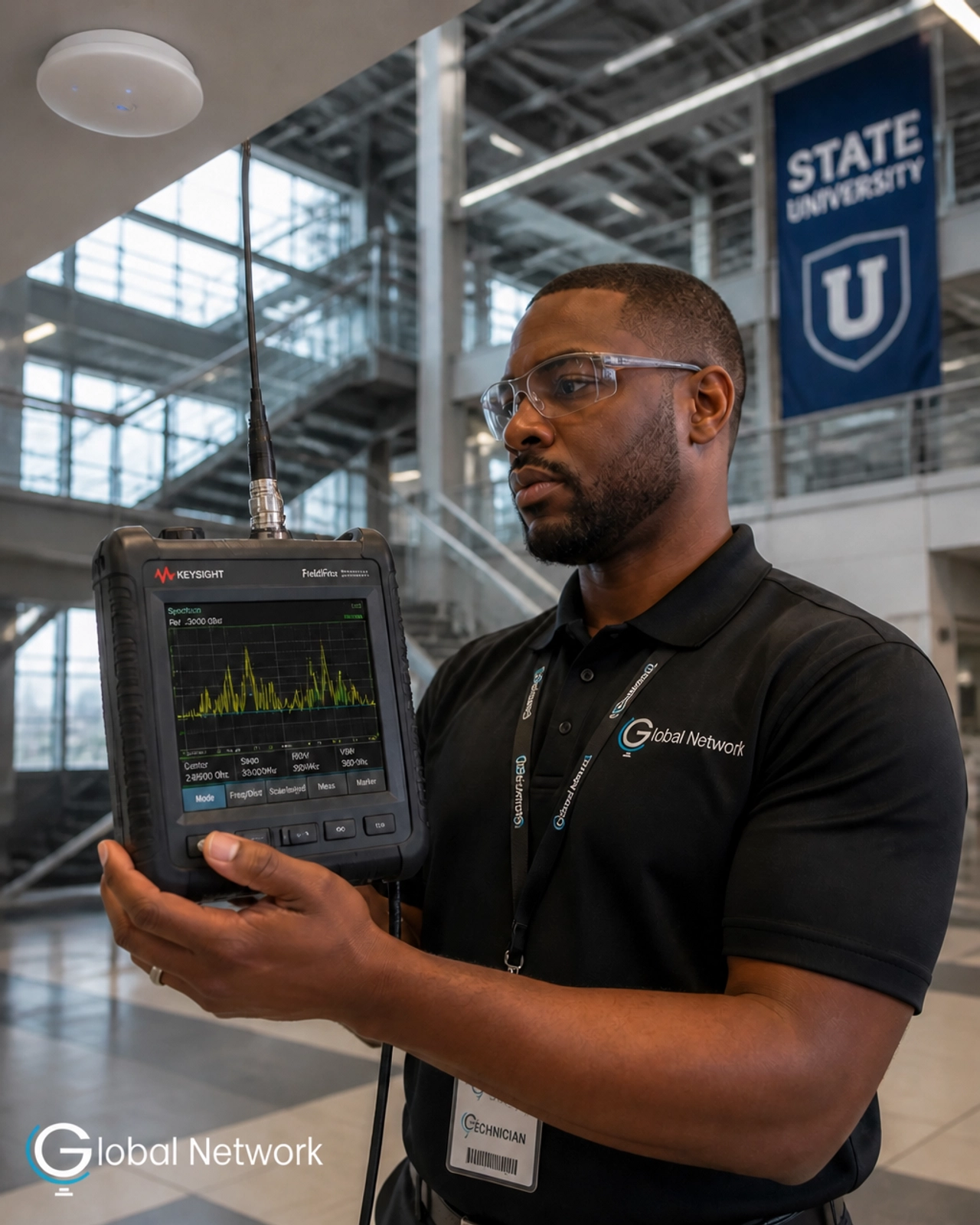
A professional survey measures outdoor donor signal, indoor signal levels, noise floor, isolation, and coverage conditions. Testing should account for stairwells, elevator lobbies, basements, parking areas, mechanical spaces, and other locations where radio performance commonly fails.
Step 3: Develop the RF design
The design must establish antenna locations, cable pathways, splitters, couplers, gain settings, equipment locations, battery capacity, and monitoring requirements.
Step 4: Coordinate with the appropriate stakeholders
For LMR, this may involve the AHJ and public safety radio authority. For cellular and FirstNet systems, it may involve the applicable MNO, carrier integrator, or approved technology partner.
Step 5: Install, commission, and test
Installation is followed by commissioning, acceptance testing, alarm verification, and documentation. For code-required systems, ongoing annual performance testing is also critical.
Global Network LLC provides public safety DAS design, installation, compliance testing, and related services for building owners and facility managers throughout Atlanta and surrounding markets.

Compliance Is the Deliverable
A functioning wireless system is important. A documented, tested, AHJ-accepted system is the deliverable that protects your project.
Property owners should retain records covering:
- RF survey results
- Frequency plans
- Equipment specifications
- Carrier correspondence
- AHJ submittals
- Installation documentation
- Acceptance test results
- Alarm and monitoring verification
- Annual test reports
- Corrective action records
A failed test can delay a Certificate of Occupancy, disrupt opening schedules, and create serious safety and liability concerns. Proactive coordination reduces those risks before they become costly project problems.
Plan First. Install Once.
FirstNet Band 14, commercial cellular bands, and public safety LMR channels each serve an important purpose. The engineering challenge is understanding how they interact inside a structure: and ensuring every system is designed for its intended mission.
For building owners, developers, facility managers, and government agencies, the right approach is clear:
- Confirm the AHJ requirements.
- Identify the local public safety frequencies.
- Determine whether commercial MNO bands are needed.
- Include FirstNet Band 14 in the design discussion.
- Obtain carrier coordination when cellular spectrum is being rebroadcast.
- Complete documented acceptance and annual performance testing.
Peace of mind comes from preparation.
To discuss an ERCES, public safety DAS, FirstNet-ready design, or carrier coordination requirement, contact Global Network LLC:
- Office: 770.520.7633
- Toll Free: 877.231.1084
- Website: globalnetworkco.com
When communication matters most, your building should be ready.