Keeping Students Safe: Why Every Atlanta School Campus Needs ERCES Compliance
When emergency responders arrive at an educational campus during a crisis, every single second dictates the margin between safety and catastrophe. For school administrators and facility managers across Metro Atlanta, ensuring that students, faculty, and staff are protected extends far beyond standard fire alarms and locked perimeter doors. Today, regulatory bodies enforce strict life-safety mandates requiring absolute radio frequency (RF) reliability inside every structure. If your campus suffers from radio "dead zones," your facility is operating out of alignment with mandatory codes.
As an established Atlanta BDA specialist, Global Network LLC partners with educational institutions to deploy robust in-building wireless infrastructure. Achieving compliance is not merely an administrative checkbox: it is a moral and legal imperative.
The Regulatory Framework: Understanding IFC 510 and NFPA Standards
Educational facilities are held to rigorous standards under modern building and fire codes. The primary benchmarks governing first responder radio coverage include:
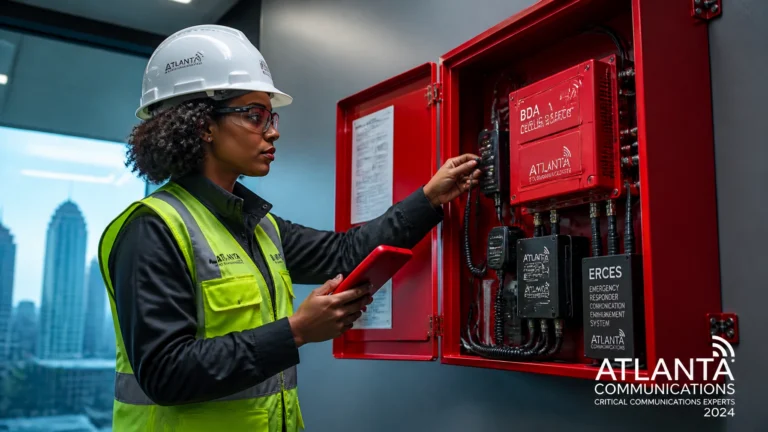
- IFC §510 (International Fire Code): Mandates approved in-building emergency responder communication coverage across buildings. If signal strength tests fall below statutory thresholds, an Emergency Responder Communication Enhancement System (ERCES) must be installed.
- NFPA 72 & NFPA 1225: Define the stringent design, survivability, battery backup, and 24/7 monitoring criteria for life-safety communication infrastructure.
- UL 2524 Certification: Requires that all Bi-Directional Amplifiers (BDAs) and head-end equipment meet certified safety and performance benchmarks.
Failure to meet these mandates creates severe operational liabilities. Without proper certification, schools risk failing local Authority Having Jurisdiction (AHJ) inspections, delaying Certificates of Occupancy, or facing costly regulatory fines. 0% Tolerance for Non-Compliance and 0% Missed Deadlines govern our engineering methodology.
The Unique Challenges of Multi-Building Campuses

Atlanta school campuses are rarely monolithic. They typically feature sprawling, multi-building architectural layouts combining historical brick structures, high-density residence halls, athletic complexes, and underground utility tunnels. Each architectural typology presents distinct RF propagation challenges:
1. Dormitories and Residential Halls
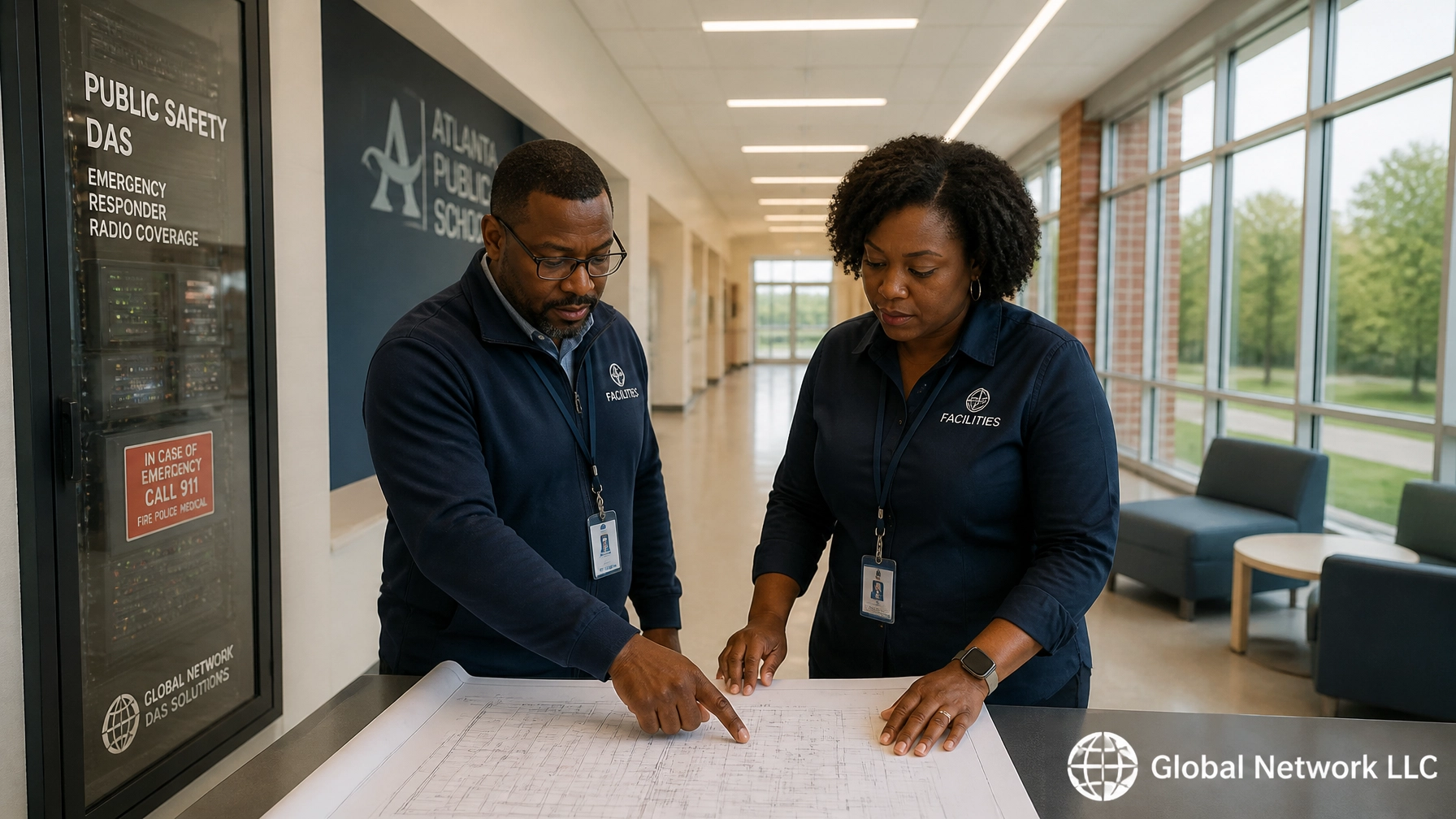
Modern student housing often incorporates energy-efficient Low-E glass, reinforced concrete, and heavy insulation. These materials severely attenuate 700/800 MHz public safety frequencies. Executing a professional Public Safety DAS installation ensures that resident assistants and campus police maintain uninterrupted radio links to local emergency dispatchers, even from lower-level residence suites.
2. Administration and Academic Blocks
Multi-story classroom buildings feature interior stairwells, elevator shafts, and deep core rooms where wireless signals degrade rapidly. Under IFC 510 compliance frameworks, critical areas such as fire command rooms and stairwells must maintain a minimum of 99% RF coverage, while general areas must achieve at least 95% coverage.
Securing Athletic Stadiums and Large Assembly Spaces

High school and university stadiums, gymnasiums, and performing arts centers are high-occupancy environments where thousands of students and community members gather. During a major event, cellular and public safety radio traffic spikes exponentially.
Concrete seating bowls, steel superstructures, and subterranean locker rooms create severe signal shadows. First responders cannot afford communication blackouts when coordinating crowd management or medical responses in packed venues. Our custom-engineered ERCES testing and certification protocols verify that your campus stadiums and assembly halls deliver flawless, two-way communication when it matters most.
Rigorous ERCES Testing and Certification
Installing hardware is only the first phase of ensuring absolute campus safety. Regulatory bodies mandate rigorous, ongoing validation to guarantee system reliability under extreme operational stress.

Our comprehensive testing methodology includes:
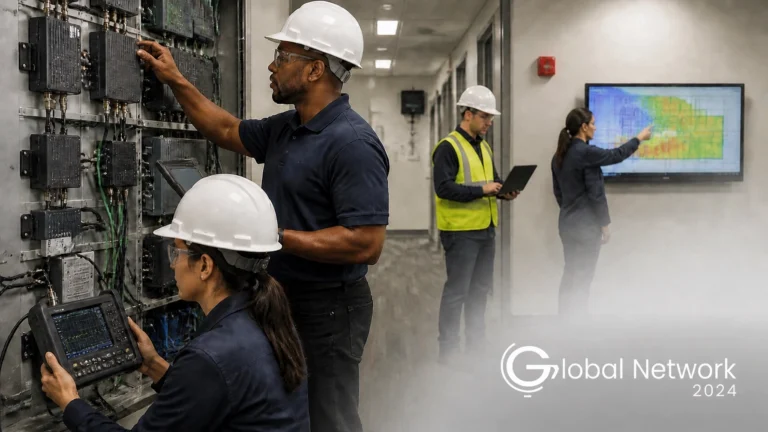
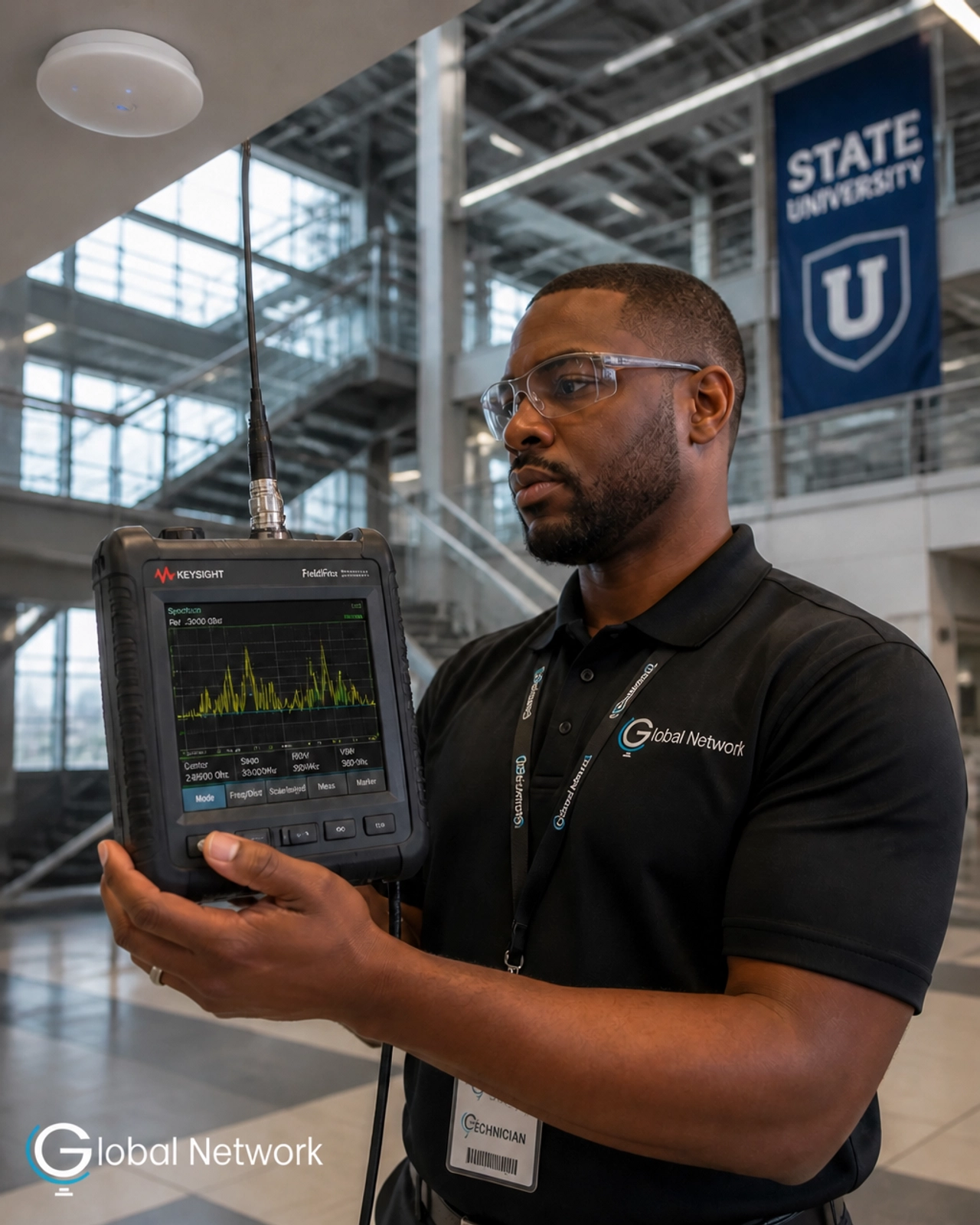
- Grid-Based Signal Strength Mapping: Measuring downlink and uplink RSSI (Received Signal Strength Indicator) across every floor, stairwell, and basement.
- Delivered Audio Quality (DAQ) Verification: Confirming that voice transmissions meet minimum DAQ 3.0 intelligibility standards without distortion or interference.
- Battery Backup & Survivability Audits: Testing 24-hour dedicated auxiliary power supplies and fire-rated pathways to ensure uninterrupted operation during grid failures.
- Annual Commissioning & AHJ Re-Certification: Providing complete documentation packages required by local fire marshals to maintain active compliance.
Partner with Atlanta’s Trusted In-Building Wireless Experts
Navigating complex municipal fire codes requires specialized engineering expertise, local jurisdiction familiarity, and strict adherence to federal standards including FirstNet compatibility. At Global Network LLC, we deliver end-to-end solutions: from initial RF site surveys and custom system design to turnkey installation and annual certification.
Protect your students, secure your facilities, and eliminate regulatory vulnerabilities today.
Contact our expert team at 770.520.7633 or toll-free at 877.231.1084 to schedule your comprehensive campus compliance evaluation. Visit globalnetworkco.com to learn more about our advanced public safety solutions.
Stay connected. Stay compliant.