
Selling Your Building? Here Are 10 ERCES Documents Buyers and Lenders Will Ask For
Selling a commercial building in Atlanta or anywhere in Georgia involves more than financial statements, leases, and title documents. Buyers, lenders, insurers, and their technical consultants may also examine the property’s Emergency Responder Communication Enhancement System (ERCES), often called a Public Safety Distributed Antenna System (DAS) or BDA system.
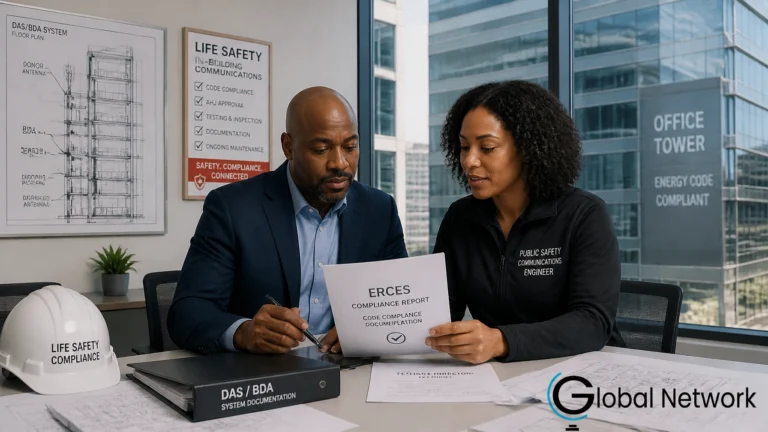
For life-safety infrastructure, documentation is evidence. It demonstrates that the system was properly designed, approved, commissioned, maintained, and tested to support first responder communications when it matters most.
A missing report or unresolved deficiency can delay closing, trigger lender conditions, create post-closing liability, or reduce the perceived value of the property. A complete ERCES file, by contrast, gives buyers and lenders confidence that the building’s public safety communications infrastructure is operational and compliant.

Why ERCES Documentation Matters During Due Diligence
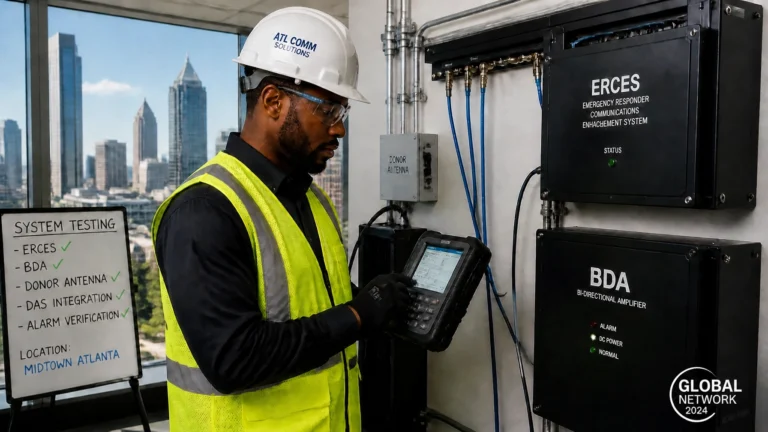
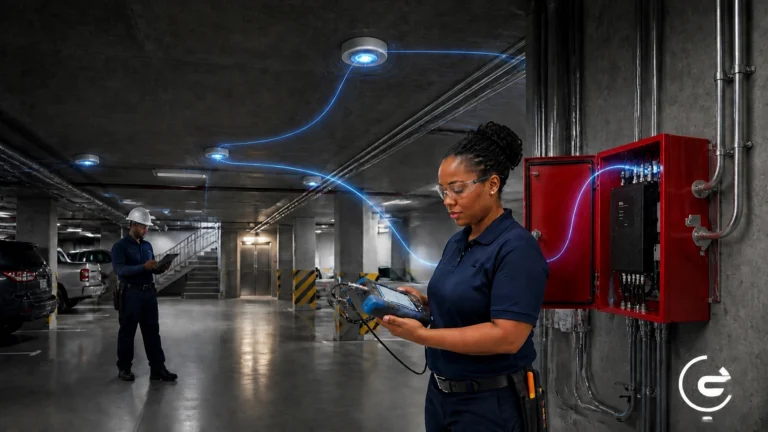
Modern commercial buildings can obstruct public safety radio signals because of reinforced concrete, structural steel, Low-E glass, below-grade parking, elevator shafts, and dense mechanical systems. Where coverage is inadequate, an ERCES uses a BDA, donor antenna, coaxial or fiber distribution, and interior antennas to improve two-way radio communications.
The applicable Authority Having Jurisdiction (AHJ) may require documentation showing compliance with IFC 510, NFPA 72, NFPA 1225, and locally adopted amendments. Buyers and lenders want to know:
- Is the system approved and operational?
- Does the installed system match the approved design?
- Are annual tests current?
- Are batteries, alarms, and monitoring functional?
- Are there open violations, failed tests, or unresolved deficiencies?
- Will the system remain compliant after ownership changes?
A transaction-ready file should answer these questions before they become closing obstacles.
The 10 ERCES Documents Buyers and Lenders Will Request
1. Original System Design Drawings and RF Coverage Study
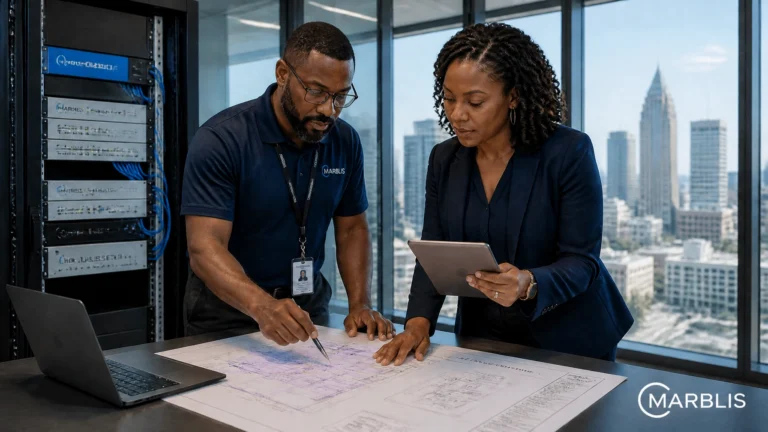
The original design package establishes what the ERCES was intended to accomplish and where the equipment was installed.
Request copies of:
- Original RF survey or site survey
- Pre-installation signal strength measurements
- RF propagation or coverage study
- Floor plans showing antenna locations and coverage zones
- BDA, head-end, remote-unit, donor-antenna, and cable locations
- Riser diagrams and single-line schematics
- Battery and standby-power calculations
- Design assumptions, frequency bands, and system specifications
The design should identify critical areas such as stairwells, elevator lobbies, fire command centers, fire pump rooms, and generator rooms. If the property has been renovated, reconfigured, or expanded, the buyer may compare the original study with current conditions.
A design that cannot be reconciled with the installed system is a warning sign.
2. AHJ Permits and Fire Marshal Approvals
The transaction file should include every relevant permit and approval issued by the applicable AHJ, such as the City of Atlanta Fire Rescue or the appropriate county or municipal fire authority.
Look for:
- Approved ERCES or Public Safety DAS plans
- Building and fire permits
- Fire Marshal review comments
- Inspection records
- Final approval or acceptance documentation
- Approved revisions and field changes
- Variances, notices, violations, or correction orders
Requirements can vary between Atlanta-area jurisdictions. The responsible fire official determines how local code provisions are administered, including coverage thresholds, test procedures, equipment requirements, and closeout documentation.
A permit number alone is not enough. Buyers and lenders typically want evidence of final acceptance.
3. Commissioning and Acceptance Test Reports
The commissioning and acceptance report documents whether the system performed correctly when it was placed into service.
A complete report may include:
- Floor-by-floor RF coverage results
- Grid-test data
- Uplink and downlink measurements
- Critical-area test results
- Test frequencies and channels
- Antenna and zone identification
- DAQ or Delivered Audio Quality scores
- Oscillation and interference testing
- Battery and power-failure testing
- Calibrated test-equipment information
- Technician signatures and credentials
Many AHJs use DAQ scoring to evaluate speech intelligibility. A report may identify whether the system achieved the required DAQ level for the jurisdiction and system design.
If the seller cannot produce a signed acceptance report, the buyer may require a new independent RF survey and functional test before closing.
4. Annual Performance and Inspection Test Records
ERCES compliance does not end when the Certificate of Occupancy is issued. The system must remain functional, monitored, and maintained.
Request annual records showing inspection and performance testing under the applicable editions of:
- NFPA 72
- NFPA 1225
- IFC 510
- Local fire and building code amendments
Annual records should identify test dates, deficiencies, corrective actions, alarm results, battery condition, coverage findings, and final status.
The buyer may also request records covering the prior several years. Missing annual reports can suggest that maintenance was inconsistent or that the system has not been evaluated after tenant improvements, structural changes, or equipment failures.
0% Missed Deadlines. A current report is valuable. A documented history is stronger.
5. Equipment Documentation and UL 2524 Records
The equipment file should establish exactly what is installed and whether it is appropriate for the ERCES application.
Include:
- BDA manufacturer, model, and serial number
- Donor antenna and interior antenna information
- Remote-unit and head-end specifications
- Cable, coupler, splitter, and filter data
- Battery manufacturer and installation date
- Charger and power-supply information
- Backup-power calculations and discharge results
- Equipment warranties
- UL 2524 listing or certification documentation, where applicable
UL 2524 provides a technical basis for in-building two-way emergency radio communication enhancement equipment. UL Solutions also emphasizes the importance of installation, testing, service, and maintenance records under NFPA 1225.
Equipment that is obsolete, improperly listed, unsupported, or missing documentation may become a lender reserve item or a negotiated repair.

6. Maintenance and Service Contracts
A current ERCES service contract demonstrates that responsibility for life-safety communications has been assigned to a qualified provider.
The buyer may request:
- Current maintenance agreement
- Inspection and testing scope
- Emergency response terms
- Service-level commitments
- Warranty and renewal information
- Repair history and service tickets
- Open work orders
- Contractor qualifications
- Contract assignment requirements
The transaction team should determine whether the agreement automatically transfers to the new owner. Some contracts require written consent before assignment.
A documented maintenance program supports operational continuity and gives the buyer peace of mind after closing.
7. Monitoring and Alarm Connectivity Records
ERCES equipment must report certain failures and supervisory conditions through the building’s fire alarm or approved monitoring arrangement.
Request evidence showing supervision and alarm reporting for conditions such as:
- Loss of primary power
- Battery or charger failure
- Low battery capacity
- BDA malfunction
- Donor signal loss
- Amplifier or remote-unit failure
- Communication path failure
The file should include fire alarm shop drawings, sequence-of-operation documents, monitoring information, recent alarm tests, and alarm history.
Under applicable NFPA 72 requirements, the buyer needs to understand how ERCES trouble conditions are annunciated, transmitted, received, and addressed. A system that works technically but is not properly supervised may still create a compliance problem.
8. Carrier, FirstNet, and Signal Source Coordination Records
The system’s signal source and operating frequencies must be documented. Depending on the design, the package may include coordination with public safety frequency license holders, carrier representatives, or other authorized signal sources.
Look for:
- Frequency coordination records
- Signal-source authorization
- Public safety agency correspondence
- FCC-related documentation, where applicable
- Donor-site or signal-source agreements
- FirstNet compatibility information
- Records of approved system changes
FirstNet compatibility is particularly relevant for owners who want their communications infrastructure to remain aligned with modern public safety requirements. It should not, however, be confused with proof that an ERCES meets every local fire-code requirement.
The buyer should verify that the system is authorized to operate on the frequencies serving the property and that no consent or coordination agreement will expire at closing.
9. Compliance Certifications and Certificate of Occupancy Approvals
The seller should provide records connecting ERCES approval to the building’s occupancy status.
These may include:
- Certificate of Occupancy
- Temporary Certificate of Occupancy
- Fire inspection approval
- ERCES installation certification
- Final acceptance letter
- AHJ closeout correspondence
- Documentation of approved alternatives or variances
In many projects, public safety radio coverage must be installed, tested, and operational before final occupancy approval. If the building’s Certificate of Occupancy references an ERCES condition, that condition becomes part of the buyer’s risk assessment.
An unresolved occupancy issue can delay financing, tenant turnover, refinancing, or closing.
10. Spare Parts and As-Built Documentation
The final package should show what exists today, not only what was designed years ago.
Request:
- Current as-built drawings
- Updated floor plans and riser diagrams
- Equipment inventory
- Spare BDA modules, power supplies, fuses, and batteries
- Tooling and test equipment information
- Current programming files, where transferable
- Keys, access instructions, and cabinet locations
- Document-box contents and emergency contacts
As-built documentation reduces troubleshooting time and helps a new owner manage future renovations. Spare parts can also protect against extended outages when replacement equipment has long lead times.
When critical information is missing, the buyer may need to commission a new survey, trace cabling, identify equipment, or reconstruct the system design.
How Missing Documents Can Derail a Deal
Incomplete ERCES records can affect a transaction in several ways:
- Closing delays: The lender may withhold approval until technical conditions are satisfied.
- Price reductions: Buyers may deduct the estimated cost of testing, repair, replacement, or redesign.
- Escrow requirements: The parties may establish a repair reserve for unresolved deficiencies.
- Insurance concerns: Insurers may request proof that life-safety systems are maintained and monitored.
- Operational liability: A new owner may inherit an undocumented system that fails during an emergency.
- Occupancy complications: Open AHJ issues may affect tenant improvements or future approvals.
- Post-closing disputes: Inaccurate seller representations can create contractual and legal exposure.
A compliant ERCES is not merely an expense. It is a documented life-safety asset that supports continuity, reduces uncertainty, and can strengthen the property’s market position.

Prepare the ERCES File Before Listing the Property
Do not wait until a buyer’s consultant identifies missing records. Before listing, engage a qualified ERCES specialist to review the documentation and compare it with field conditions.
A pre-listing review should include:
- Document inventory and gap analysis
- Physical inspection of BDA, batteries, antennas, and pathways
- Verification of monitoring and alarm connectivity
- Review of annual testing history
- Confirmation of AHJ approvals
- Independent RF coverage testing when records are outdated
- Corrective-action planning for deficiencies
Global Network LLC provides Public Safety DAS/ERCES design, installation, commissioning, compliance testing, monitoring, and maintenance for Atlanta-area commercial properties and facilities.
Our approach is built around IFC 510, NFPA 72, NFPA 1225, UL 2524, AHJ coordination, and reliable first responder communication. The objective is straightforward: 0% Defects, 0% Missed Deadlines, and peace of mind when it matters most.
Protect Your Closing Timeline
If you are selling, refinancing, acquiring, or lending on a commercial building, organize the ERCES file now, not after the due-diligence request arrives.
Contact Global Network LLC for an ERCES documentation review, RF assessment, or compliance consultation.
- Office: 770.520.7633
- Toll Free: 877.231.1084
- Website: globalnetworkco.com
- Explore Public Safety DAS and ERCES services
- Review the Public Safety DAS/BDA compliance checklist
When buyers and lenders ask for proof, be ready with a complete, defensible, and current ERCES record.