
ERCES Commissioning vs. Acceptance Testing: What Happens at Each Stage
For building owners, facility managers, and general contractors, ERCES delivery has two milestones that are often treated as one: contractor commissioning and formal acceptance testing. They are related, but they do different jobs.
Commissioning is the project team’s documented verification that the installed public safety DAS/BDA system is configured and performing as designed. Acceptance testing is the formal test required for AHJ approval. In Atlanta and across Georgia, the applicable code edition, local amendments, test protocol, and approval process depend on the project and jurisdiction. Confirm them before construction and before scheduling final inspections.
The distinction matters: passing commissioning does not automatically mean the system has passed AHJ acceptance.
First, define the milestones
IFC 510 establishes the fire-code framework for in-building emergency responder radio coverage. Georgia’s adoption of NFPA 1225 identifies Chapters 1–3 and Chapter 18 as the standard for in-building ERCES; enforcement is handled by the AHJ designated by the local governing authority. NFPA 1225 separately requires initial acceptance testing and recurring system tests.
In practice, “commissioning” is often used for the contractor-led verification and optimization process before the AHJ’s formal acceptance test. It is a valuable project milestone, but should not be mistaken for the AHJ’s approval. UL 2524 is relevant to the listing and labeling of specified active system components; a listing does not replace performance testing or acceptance.
For Atlanta-area work, verify the required process with the local fire official and frequency license holder. Georgia’s adopted requirements and Atlanta’s code information can be reviewed through the Georgia NFPA 1225 adoption rule and the City of Atlanta construction codes page.
Stage 1: Design validation and RF site survey
Who performs it: The RF designer or ERCES integrator, with review by the AHJ and frequency license holder as required.
Before equipment is installed, the design team validates the building’s radio environment and the proposed solution. This stage may include a pre-installation RF survey, donor signal measurements, and comparison of existing signal conditions with predicted coverage. The goal is to establish what the system must accomplish, not to certify an installed system.
Typical design-validation work includes:
- Confirming building plans, floor areas, occupancy and critical areas.
- Identifying required frequencies, talk paths, and public safety radio-system requirements.
- Measuring donor signal levels and evaluating the proposed donor antenna location.
- Reviewing RF link budgets, antenna isolation, coverage predictions, backup power, monitoring, and cable routing.
- Confirming the proposed test grid or walk-test method with the AHJ.
Documentation: Approved design documents, survey results, frequency and license-holder information, RF coverage predictions, test-grid plans, equipment submittals, and any required authorization to proceed.
If it fails: Weak donor signal, inadequate predicted coverage, interference risk, or an incomplete submittal can require design changes or a different system approach before installation. Resolving these issues on paper is generally less disruptive than discovering them after ceilings and walls are finished.

Stage 2: Installation verification
Who performs it: The installing contractor or integrator, with coordination from the GC, electrical contractor, and fire-alarm contractor.
Once hardware is installed, the team checks whether the system was built in accordance with the approved drawings and product requirements. This is a physical and configuration review, not yet the final proof of coverage throughout the building.
Installation verification commonly includes checking:
- BDA, donor antenna, distribution antennas, cabling, and component locations against approved plans.
- Cable routing, labeling, grounding, surge protection, and any required pathway protection.
- Primary and secondary power connections, batteries, supervisory interfaces, and annunciation.
- Equipment identification and documentation for UL 2524-listed components where applicable.
- Whether field conditions or construction changes require revised drawings or AHJ review.
Documentation: Installation checklists, equipment and listing information, test-equipment calibration records, updated drawings, and a punch list of incomplete or changed work.
If it fails: The contractor corrects workmanship issues, missing components, wiring or monitoring problems, or deviations from approved plans. Significant design changes should be reviewed through the required approval process rather than simply reflected in a test report.
Stage 3: Contractor commissioning
Who performs it: Qualified ERCES technicians or engineers accepted by the AHJ, as applicable. The owner’s representative should be kept informed, and the frequency license holder may participate where required.
Commissioning moves from “installed as drawn” to “configured and verified to perform.” It is the practical pre-acceptance stage when the contractor calibrates the system, checks operation, identifies weak areas, and prepares the evidence package for the AHJ.
The work typically includes:
- Pre-acceptance functional checks. Verify BDA operation, alarms and supervisory signals, monitoring connections, and primary and secondary power operation.
- RF calibration and configuration. Set and document channel or band parameters, filters, gain, and automatic gain control settings. Confirm that settings align with the approved design and equipment limits.
- Isolation and noise checks. Verify donor-to-distribution antenna isolation and evaluate uplink noise/interference conditions in coordination with the relevant radio-system stakeholders.
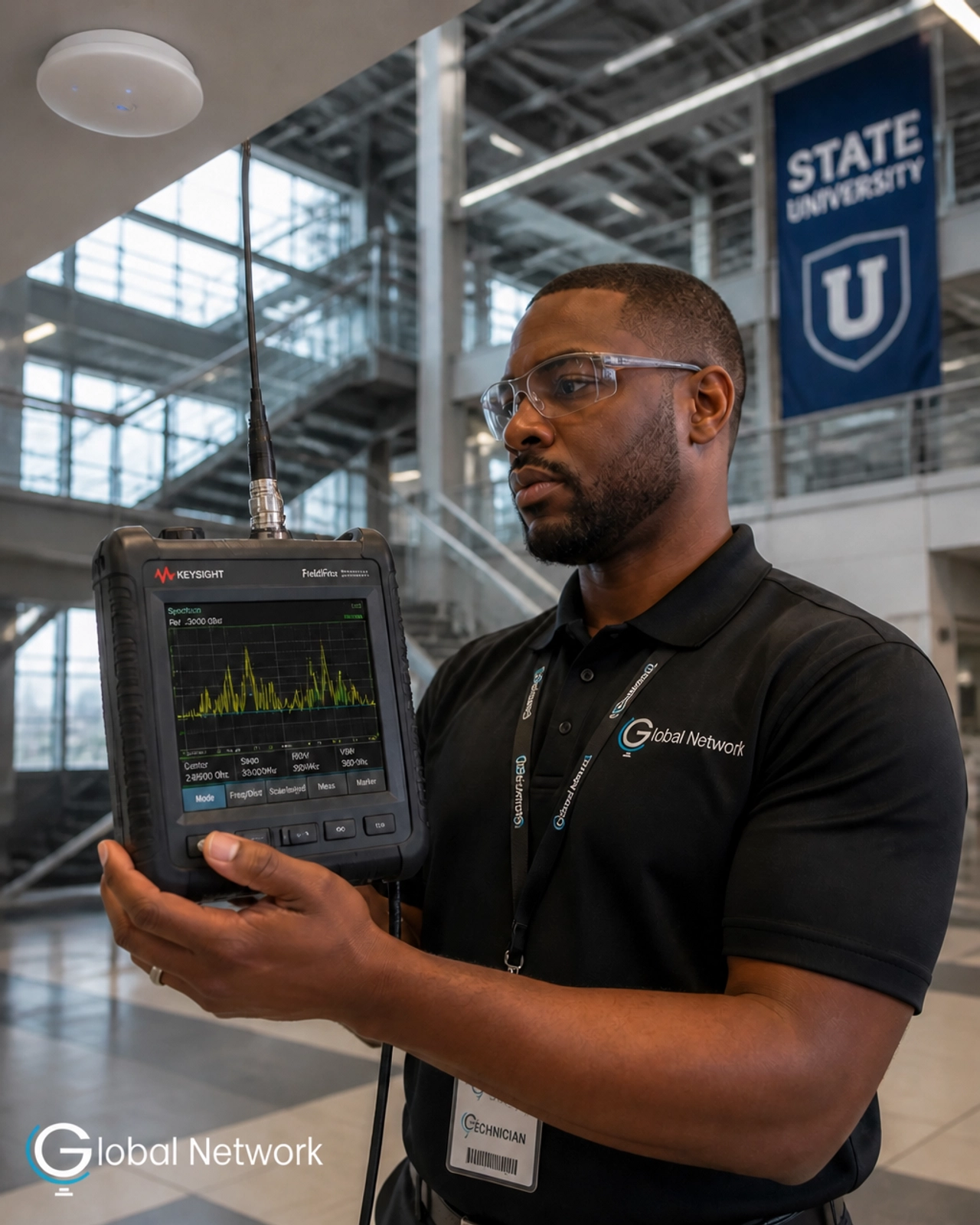
- Coverage and audio-quality testing. Conduct grid-based measurements and DAQ tests according to the approved test plan. NFPA 1225 calls for 95% floor-area radio coverage in general areas and 99% in critical areas; the minimum voice quality is generally DAQ 3.0, subject to the AHJ’s approved criteria and test method.
- Deficiency correction and retest. Adjust the system or address installation issues, then repeat affected measurements and functional checks.
Documentation: A commissioning report with measurement results, test locations, equipment settings, alarm and power checks, deficiencies and corrections, calibration details, and updated as-built drawings. NFPA 1225’s initial acceptance documentation requirements also include equipment information, assigned frequencies, secondary-power calculations, signal-source measurements, isolation results where boosters are used, and configurable system settings.

If it fails: Commissioning is the opportunity to fix problems before the official witness test. Poor results can lead to antenna or gain adjustments, additional coverage equipment, corrections to alarms or backup power, revised settings, and repeat testing. Do not schedule formal acceptance until deficiencies are resolved and records are complete.
Stage 4: Formal acceptance testing with the AHJ
Who performs it: Testing personnel whose qualifications are submitted for AHJ approval. The AHJ conducts or witnesses the formal acceptance process; the frequency license holder may also have a role under local requirements.
Acceptance testing is not merely a second contractor walk-through. It gives the AHJ an opportunity to confirm that the installed system meets required performance criteria and that the documentation supports the results. The AHJ may review the commissioning package and witness the approved grid test or other field checks.
The test plan should identify coverage areas, grid locations, the applicable quality threshold, test method, and critical areas. Those areas commonly include fire command centers, fire pump rooms, exit stairs and passageways, elevators and lobbies, standpipe cabinets, sprinkler sectional-valve locations, and other areas designated by the AHJ. For Georgia projects, the state-adopted NFPA 1225 provision specifies 99% floor-area coverage in critical areas and 95% in general areas. DAQ is a measure of audio quality, not a percentage of floor area, and the approved test method should establish how coverage and quality are recorded.

Documentation: The acceptance record typically consolidates approved plans and as-builts, commissioning results, system and equipment details, test locations and readings, settings, power calculations, and required sign-offs. The project team should confirm the precise certificate or acceptance form required by its AHJ.
If it fails: The AHJ may withhold approval and require corrective work and a retest of affected areas or system functions. Depending on the project, unresolved acceptance can delay final approval or occupancy. The owner and GC should allow time in the schedule for corrections and retesting; a contractor’s commissioning report alone is not a substitute for AHJ acceptance.
Why these are legally distinct milestones
Commissioning establishes that the integrator has checked, tuned, and documented the delivered system. Acceptance testing establishes that the system has met the jurisdiction’s approval process. NFPA 1225 separately requires a test upon acceptance and recurring testing at least every 12 months, with documentation signed by a person approved by the AHJ. That makes clear why one milestone cannot stand in for the other.
A complete handoff also supports long-term accountability. Preserve approved plans, as-builts, settings, test data, and operating and maintenance information so future testing can be compared against the accepted baseline. For additional context on local project preparation, see Global Network’s services and Atlanta fire-marshal inspection guidance.
Plan both milestones before the final inspection
For a smoother closeout, coordinate the sequence at project kickoff: confirm the applicable Georgia and local requirements, secure design review, complete installation verification, commission and correct deficiencies, then schedule AHJ acceptance with the required documentation ready. Clear records, properly tuned equipment, and a coordinated witness test help protect your schedule and support reliable responder communications when it matters most.
For ERCES design, installation, commissioning, and compliance support in the Atlanta area, contact Global Network LLC.
Office: 770.520.7633
Toll Free: 877.231.1084
globalnetworkco.com