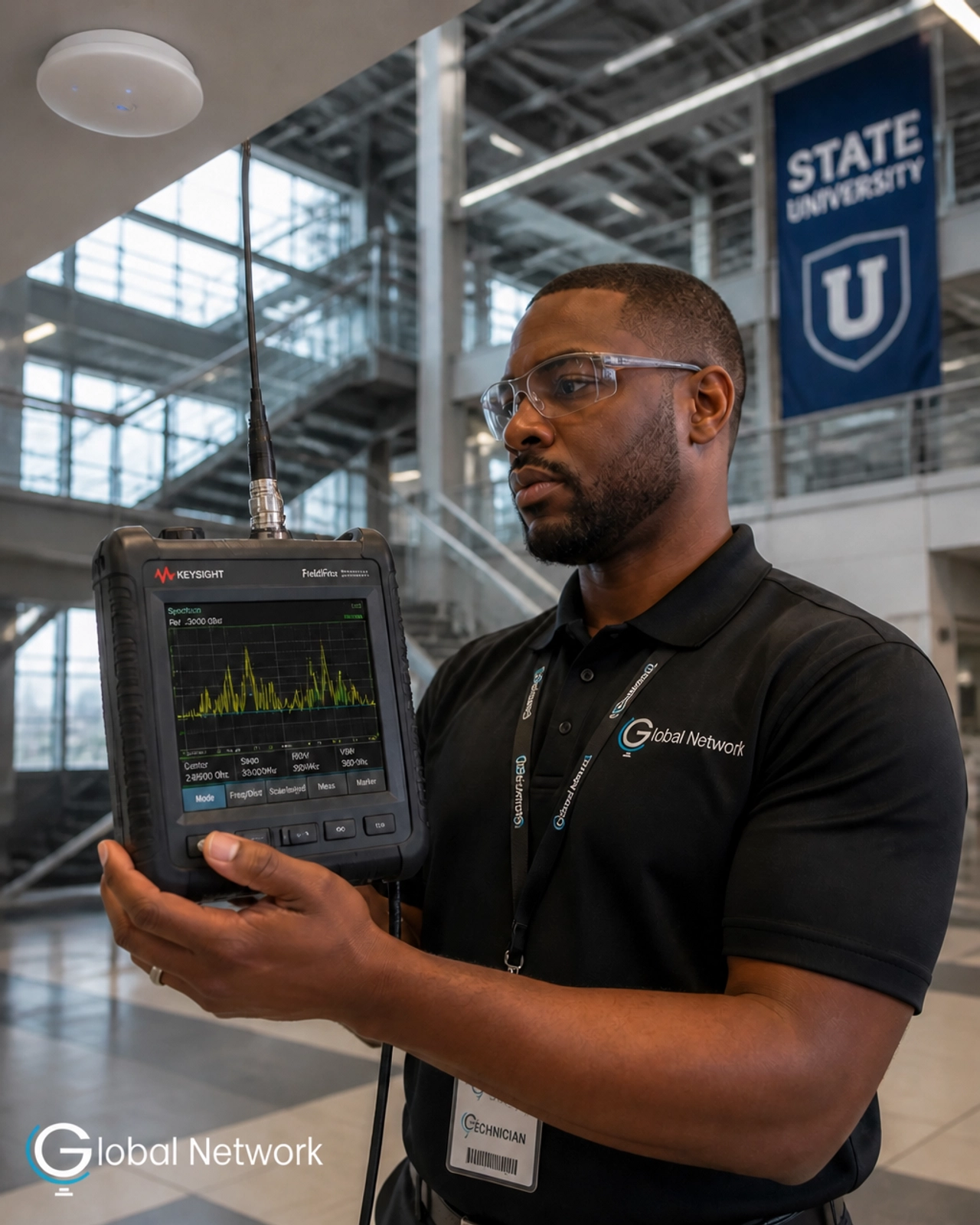

Fire Marshal Inspection Survival Guide: Your 10-Step ERCES Compliance Checklist
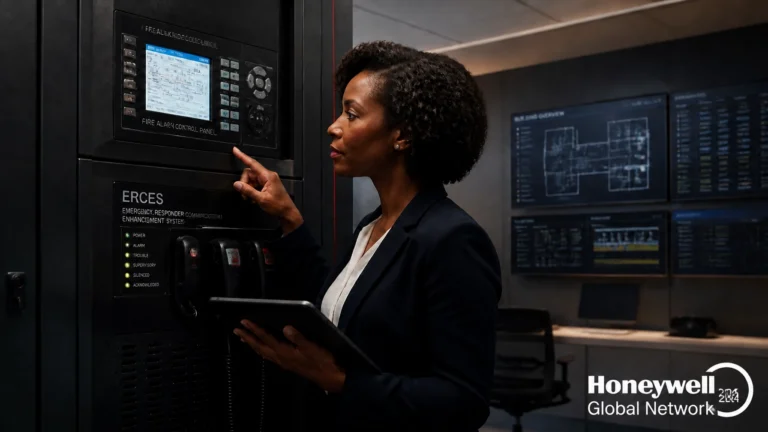
A Fire Marshal inspection should confirm that your building’s Emergency Responder Communication Enhancement System (ERCES) performs when first responders need it most. It should not be the first time anyone reviews the system’s coverage, batteries, alarms, drawings, or maintenance records.
For building owners and facility managers, preparation is a compliance responsibility and an operational safeguard. A properly maintained Public Safety DAS/BDA system supports reliable two-way radio communication throughout areas where concrete, steel, below-grade construction, and modern building materials can weaken radio signals.
Use this 10-step checklist to prepare for an ERCES inspection under applicable requirements, including IFC 510, NFPA 72, and NFPA 1225 where adopted. Local amendments and Authority Having Jurisdiction (AHJ) requirements always control.
1. Confirm the applicable codes and AHJ requirements
ERCES requirements vary by jurisdiction, building type, system design, and adopted code edition. Begin by confirming exactly what your local AHJ expects.
Review:
- The adopted edition of IFC 510
- Applicable requirements from NFPA 72
- Applicable provisions of NFPA 1225 or other locally adopted public-safety communications standards
- Local fire department ERCES or BDA permitting guidelines
- Required acceptance, annual, recertification, or deficiency-retest procedures
- Required coverage percentages, test grids, DAQ thresholds, and reporting formats
Do not rely solely on a manufacturer’s standard checklist. Your fire marshal, fire department, building department, or communications authority may impose additional requirements.
For background, review Global Network LLC’s guide to compliance with IFC 510 and NFPA 72.
2. Assemble one complete inspection packet
Create a single digital and printed inspection packet. The goal is to ensure that the inspector, facility representative, and ERCES technician can quickly access the same accurate information.
Include:
- ERCES or BDA permit documentation
- Approved plans and prior AHJ correspondence
- Rebroadcast authorization or radio system owner approval, when applicable
- Original acceptance test report
- Most recent annual performance test
- Maintenance and service records
- Battery test and replacement records
- Alarm and monitoring test logs
- Current equipment inventory
- Manufacturer data sheets and configuration information
- Calibration certificates for RF test equipment
- Open and closed deficiency reports
The packet should clearly identify the system’s Bi-Directional Amplifier (BDA), donor antenna, coaxial distribution network, remote units, interior antennas, power supplies, backup batteries, fire alarm interface, and monitoring connection.
A complete record set demonstrates control. Missing documentation can delay approval even when the equipment itself is functioning properly.

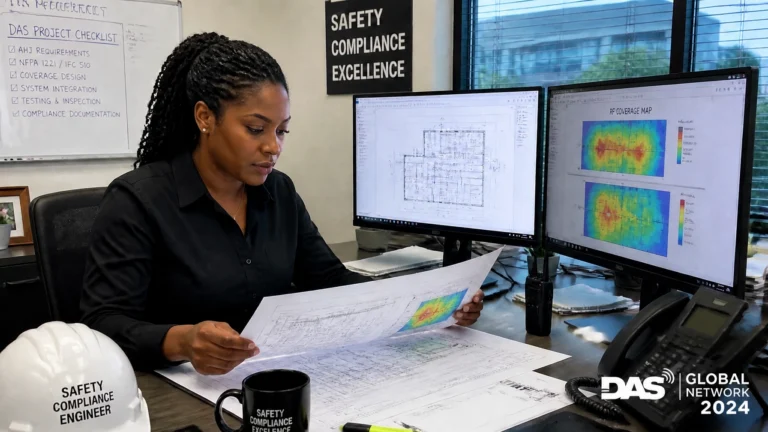
3. Verify that as-built drawings match the building
Drawings must reflect the system that is actually installed: not the system originally proposed.
Review the current as-built package for:
- BDA and equipment cabinet locations
- Donor antenna location and orientation
- Interior antenna locations
- Cable pathways and riser diagrams
- Splitters, couplers, combiners, and passive components
- Grounding and bonding details
- Backup power equipment
- Fire alarm connection points
- Critical areas and required test locations
Compare the drawings against the physical installation floor by floor. Construction changes, tenant improvements, new walls, relocated equipment, and ceiling modifications can create discrepancies.
Coverage maps should identify test grids and critical areas such as:
- Fire command centers
- Fire pump rooms
- Exit stairwells
- Exit passageways
- Elevator lobbies and elevator cabs, where required
- Basements
- Mechanical and electrical rooms
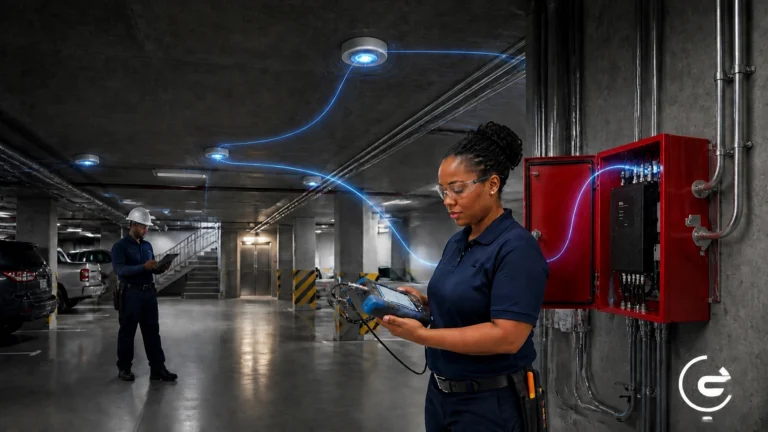
- Parking structures
- Other areas designated by the AHJ
If the drawings are outdated, update them before the inspection and preserve the revision history.
4. Complete a documented pre-inspection coverage test
A pre-inspection test gives you an opportunity to identify failures before the official walk-through.
Perform or review a full building coverage test consistent with your jurisdiction’s requirements. Depending on the AHJ, each floor may need to be divided into a defined number of test areas or grid points.
Record:
- Uplink and downlink signal levels
- Delivered Audio Quality (DAQ)
- Frequency bands tested
- Test equipment identification
- Test equipment calibration status
- Date, time, and technician
- Floor and grid location
- Pass/fail result
- Corrective action, if needed
Many jurisdictions use thresholds such as 95% coverage in general areas and 99% coverage in critical areas, with DAQ 3.0 or better commonly used as an intelligibility benchmark. These values are not universal; verify the requirements with your AHJ.
Compare current results with the original acceptance test. A significant change may indicate cable damage, antenna displacement, equipment degradation, new construction, radio-system changes, or interference.
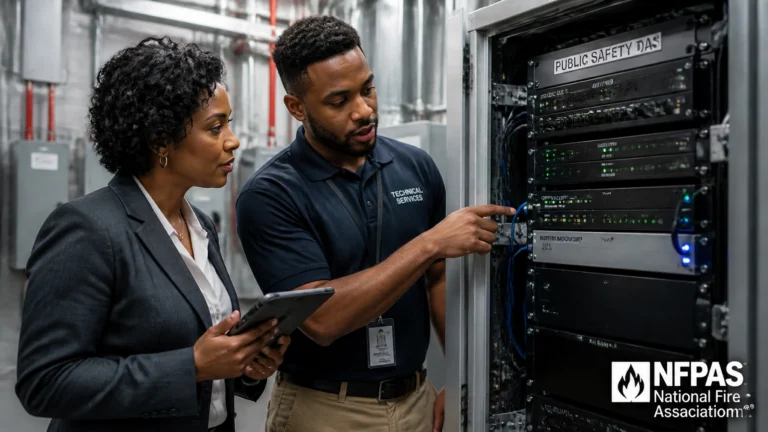
5. Inspect the BDA, DAS, batteries, and physical installation
The system should be physically accessible, orderly, labeled, and free from visible damage.
Inspect:
- BDA and remote amplifier enclosures
- Donor and interior antennas
- Coaxial cable, connectors, and terminations
- Splitters, couplers, and other passive components
- Grounding and bonding
- Equipment-room environmental conditions
- Water intrusion, corrosion, dust, and overheating
- Cabinet access and working clearances
- Fire-stopping at penetrations
- Unapproved modifications or disconnected components
Pay special attention to backup power. Depending on the adopted code and local requirements, ERCES systems may need to operate on standby power for a specified period, commonly 12 hours at full system load, followed by a required alarm or load test.
Verify:
- Battery age and installation date
- Battery condition and terminal integrity
- Charger operation
- Power-supply status
- Battery capacity
- Documented discharge or load testing
- Replacement history
- Alarm response during loss of normal power
Replace batteries that fail capacity testing, show abnormal voltage drop, or exceed the manufacturer’s service life.

6. Test all ERCES supervisory and trouble alarms
The fire marshal will want to know that the ERCES can report failures: not merely operate under normal conditions.
Test each required supervisory and trouble condition, including applicable signals for:
- AC power failure
- Battery trouble or low battery
- Charger failure
- Amplifier failure
- System fault
- Donor signal loss
- Oscillation or interference
- Remote unit failure
- Antenna or cable fault
- Normal and standby status
Confirm that signals appear correctly at the Fire Alarm Control Panel (FACP), dedicated annunciator, remote display, or other required monitoring point.
Where required, verify transmission to the central station or monitoring provider. Record the initiating condition, signal received, response time, restoration, and person performing the test.
The alarm interface must be tested as an integrated system. A BDA may function correctly while its monitoring pathway is miswired, improperly programmed, or unable to communicate with the FACP.
7. Prepare for the AHJ walk-through and spot checks
Assign an informed facility representative to meet the inspector. A qualified ERCES technician should also be available whenever possible.
Before the inspection:
- Confirm access to every equipment room
- Unlock fire command and communications spaces
- Provide keys, credentials, escorts, and roof access
- Identify all critical areas
- Mark test points on floor plans
- Have calibrated test equipment available
- Keep ladders and access equipment ready where appropriate
- Ensure building operations staff know the inspection schedule
During the walk-through, expect the AHJ to compare the installed system with the drawings and test selected areas. The inspector may request a radio test, review equipment settings, examine battery cabinets, or observe alarm activation.
Do not hide difficult areas. Proactively identify below-grade rooms, stairwells, elevator spaces, and heavily shielded locations. Transparency supports faster resolution and demonstrates responsible facility management.
8. Maintain a formal deficiency and corrective-action log
A deficiency log should show that problems are identified, assigned, corrected, and verified.
For each deficiency, document:
- Date discovered
- Building and exact location
- Component or test point
- Observed condition
- Applicable code or design requirement
- Assigned responsibility
- Corrective action
- Date corrected
- Retest result
- Supporting photographs or reports
- AHJ notification, when required
Typical ERCES deficiencies include failed coverage grids, low DAQ, loose coaxial connections, battery capacity failures, missing labels, damaged cable, improper grounding, alarm-interface faults, and drawings that do not match the installation.
When the AHJ identifies a deficiency, ask for precise documentation and the required correction path. If local policy permits conditional or partial approval, obtain that determination in writing. Never assume that verbal approval eliminates the need for corrective work.
9. Coordinate directly with the AHJ before inspection day
Early communication can prevent avoidable delays.
Provide the AHJ with the information required by local procedure and confirm:
- Inspection date and required attendees
- Required documents and report format
- Whether a radio system representative must participate
- Whether a rebroadcast authorization is required
- Required test equipment
- Coverage and DAQ criteria
- Battery-test expectations
- Alarm-monitoring requirements
- Deficiency correction deadlines
- Retest and resubmittal procedures
If construction, tenant improvements, roof work, mechanical changes, or major renovations have occurred, disclose them. Building modifications can alter RF propagation and invalidate previously accepted coverage.
Global Network LLC provides Public Safety DAS and ERCES design, installation, and compliance services for facilities that need reliable first-responder communications and a clear path to approval.
10. Establish an ongoing annual compliance program
Passing one inspection is not the same as maintaining compliance.
Create a recurring program that includes:
- Annual ERCES performance testing
- Coverage and DAQ verification
- Battery capacity and load testing
- Alarm and FACP interface testing
- Visual inspection of active and passive components
- Equipment-room and cable-pathway inspection
- Updated as-built drawings after approved changes
- Calibration tracking for test equipment
- Deficiency closeout and retesting
- AHJ coordination after major modifications
Assign ownership for every task. Facility managers should know when testing is due, where records are stored, which deficiencies remain open, and who is authorized to modify the system.
0% Missed Deadlines. 0% Unresolved Critical Deficiencies.
A documented maintenance cycle helps protect your Certificate of Occupancy, reduce inspection risk, and preserve reliable communications when it matters most.
Build inspection readiness before the fire marshal arrives
ERCES compliance is a continuing life-safety obligation. Testing records, accurate drawings, functioning batteries, reliable alarms, verified coverage, and timely deficiency correction must work together as one program.
For commercial properties, healthcare facilities, hotels, educational institutions, government buildings, parking structures, and other complex facilities, professional support can make the inspection process more predictable.
Review the ERCES/DAS resources from Global Network LLC, or learn how the company serves commercial, institutional, and public-sector facilities. To schedule an evaluation, pre-inspection test, system design review, or annual compliance service, call 770.520.7633. You may also reach the office toll-free at 877.231.1084 or visit globalnetworkco.com.
Reliable first-responder communication is not optional. Prepare early, document everything, and keep your ERCES ready for the moment it is needed most.