
Fiber-Fed DAS: The Backbone of Modern In-Building Public Safety Communication
In large-scale commercial real estate, high-rise towers, and sprawling multi-building campuses, maintaining uninterrupted two-way radio coverage for first responders is not merely a operational convenience: it is a mandatory legal requirement under strict life-safety codes such as IFC 510, NFPA 72, and NFPA 1225. When evaluating how to eliminate radio dead zones across millions of square feet of concrete, steel, and Low-E glass, building owners and facility directors face a critical architectural decision: choosing between a passive coaxial network and an advanced fiber-fed active Distributed Antenna System (DAS).
At Global Network LLC, Atlanta's premier DAS and ERCES (Emergency Responder Communication Enhancement Systems) specialist, we engineer enterprise-grade wireless infrastructure designed for zero failure. When emergency personnel enter your property, communication clarity translates directly to life preservation. This technical deep-dive explores fiber-fed DAS architectures, passive comparisons, fiber backbone advantages, and why scalable fiber infrastructure represents the gold standard for modern public safety compliance.
Understanding In-Building Public Safety Architecture: Passive vs. Active DAS
To appreciate the engineering superiority of fiber-fed systems, one must first understand the fundamental differences in how radio frequency (RF) signals are transported throughout a structure.
The Limitations of Passive DAS (Coaxial-Fed ERCES)
A passive DAS relies exclusively on coaxial cables, splitters, directional couplers, and passive antennas to distribute RF signals from a central Bi-Directional Amplifier (BDA) or repeater.
- Medium: Heavy-gauge coaxial cable (such as 7/8" or 1-5/8" HELIAX) running through vertical risers and horizontal cable trays.
- Electronics: No active components exist in the distribution path; signal amplification occurs solely at the master head-end BDA.
- Constraint: Coaxial cable suffers from significant signal attenuation (signal loss) over long distances, particularly at higher public safety frequencies (700/800 MHz bands). In buildings exceeding 150,000 square feet or standing taller than six stories, cumulative insertion and cable losses make passive distribution impossible without exceeding amplifier output limits or failing AHJ (Authority Having Jurisdiction) downlink thresholds.
The Power of Active Fiber-Fed DAS
An active fiber-fed DAS overcomes physical attenuation barriers by converting RF signals into optical signals at a central head-end master unit. These optical signals travel effortlessly over single-mode fiber optic strands across massive distances with virtually zero loss. At the coverage edge, powered Remote Units (RUs) convert the optical transmission back into clean RF signals, driving short, low-loss coaxial runs to local indoor antennas.

Key architectural components of a fiber-fed public safety DAS include:
- Central Master Head-End: Interfaces with off-air donor antennas or direct-connect base stations, digitizing and managing multiple public safety frequency bands.
- Fiber Optic Backbone: Single-mode fiber cables providing high-bandwidth, immune-to-interference transport across expansive architectural footprints.
- Remote Units (RUs): Distributed active electronic enclosures equipped with internal power amplifiers to guarantee uniform signal propagation in remote wings, parking structures, and sub-basements.
- Rigorous Compliance Testing: Ensuring all downlink power levels achieve the mandatory minimum of -95 dBm across 99% of critical coverage areas as mandated by model fire codes.
Why the Fiber Backbone is Crucial for Large Commercial Properties
For corporate headquarters, regional medical centers, massive retail hubs, and multi-tenant high-rises, the fiber backbone serves as the neural network of facility safety. Investing in a fiber-fed architecture delivers unmatched technical and operational advantages:
1. Superior Scalability and Future-Proofing
As building layouts evolve, tenant build-outs occur, or municipal radio frequencies expand, upgrading a passive coaxial network requires ripping out walls to replace thick cables. In contrast, a fiber-fed DAS offers infinite scalability. Adding coverage to a new wing or subterranean parking tier requires simply terminating a new fiber strand and provisioning a remote unit.
2. Elimination of Signal Attenuation and Distortion
Coaxial cable attenuation increases exponentially with frequency and run length. Fiber optic transport experiences negligible signal degradation over miles. This guarantees that first responders operating on FirstNet or local trunked radio systems experience crystal-clear audio fidelity whether they are standing twenty feet from the head-end or in the deepest sub-basement.
3. Centralized Monitoring and Battery Backup Integration
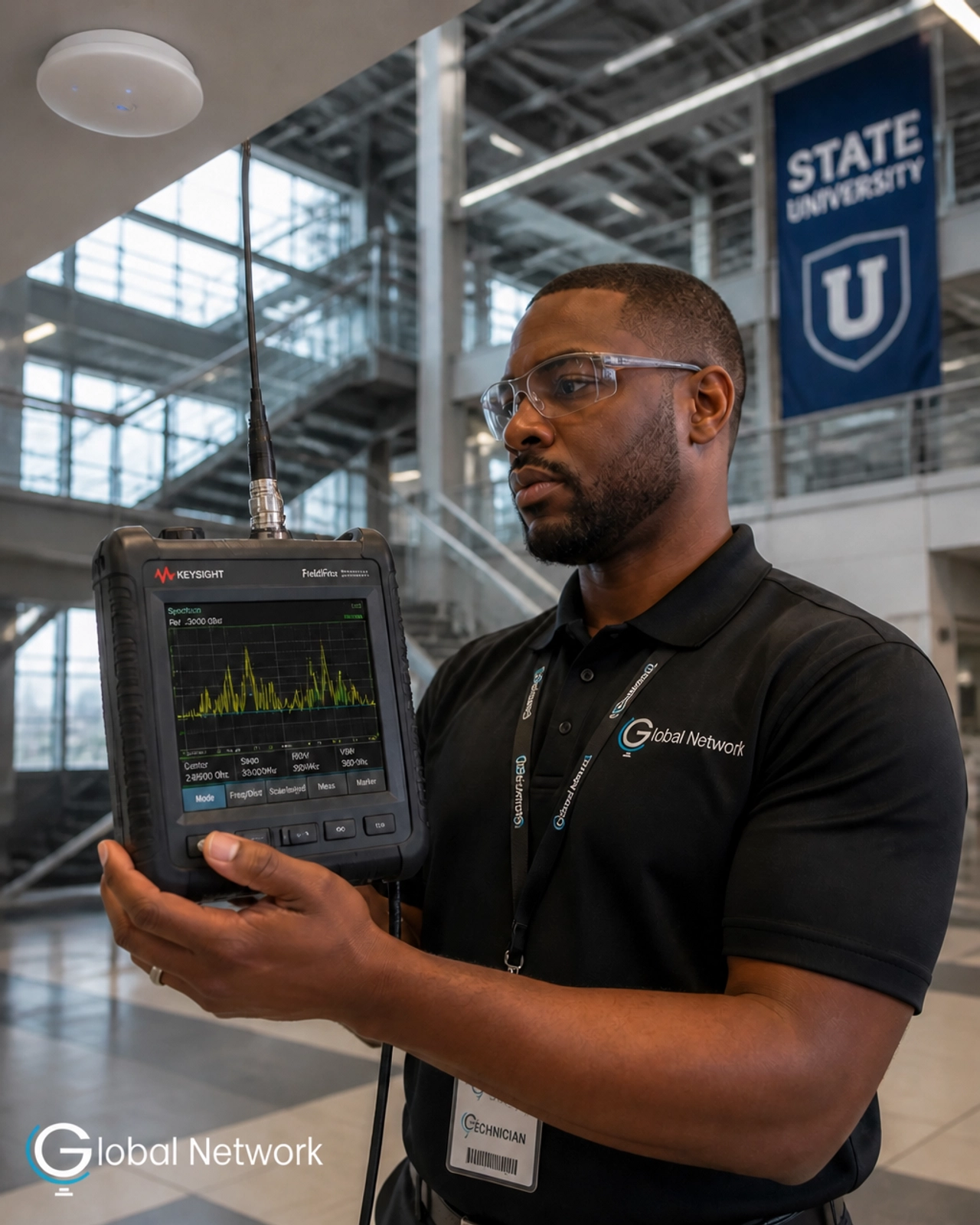
Modern life-safety codes mandate stringent secondary power provisions (typically 24-hour dedicated battery backup UPS systems). Centralized head-ends allow facility managers to monitor battery health, VSWR (Voltage Standing Wave Ratio) anomalies, amplifier status, and fiber link integrity from a single management interface, satisfying the strict automated monitoring requirements of NFPA 72.
When Is Fiber-Fed DAS the Right Choice?
Not every structure requires a fiber-fed system. Smaller low-rise buildings with straightforward layouts can often achieve compliance using standard BDA and coaxial passive systems. However, fiber-fed DAS is the mandatory engineering choice for specific property profiles:
- High-Rise Towers (10+ Stories): Vertical coax runs in tall towers create unacceptable cumulative link loss. Fiber risers eliminate vertical attenuation entirely.
- Sprawling Campuses and Hospitals: Facilities spanning multiple acres or connected buildings require long-distance signal transport that only optical fiber can deliver.
- Complex Architectural Shielding: Structures incorporating heavy reinforced concrete, structural steel framing, and Low-E energy-efficient window glass reflect and absorb RF signals aggressively, demanding the robust amplification control of distributed remote units.
- High-Density Public Venues: Stadiums, transportation hubs, and convention centers where thousands of concurrent devices create intense RF interference environments.
Discover more about our tailored solutions on our services page or review our detailed guide on achieving IFC 510 and NFPA 72 compliance.
Engineering Excellence: Zero Defects, Zero Missed Deadlines
Navigating municipal fire inspections and securing your Certificate of Occupancy requires absolute adherence to legal and technical standards. In public safety technology, there is no room for compromise. Our corporate ethos is anchored in rigorous legal compliance, uncompromising ethical standards, and a solemn commitment to community safety.
We maintain strict protocols to ensure:
- 0% Defects in installation quality, signal mapping, and component commissioning.
- 0% Missed Deadlines for building handover and Fire Marshal final inspections.
- Complete alignment with local AHJ ordinances, FirstNet compatibility standards, and national safety codes.

As stated in our corporate safety mandate, Global Network LLC operates at the forefront of advancements in wireless telecommunications infrastructure. When emergency responders step into your building when it matters most, their radios must function flawlessly.
To explore our client portfolio and institutional capabilities, visit our who we serve section or read our expert advice on how to pass your next Fire Marshal radio inspection.
Secure Your Building's Safety Compliance Today
Building owners and facility directors carry ultimate responsibility for occupant safety and regulatory compliance. Do not let radio dead zones delay your occupancy permit or jeopardize emergency response operations.
Partner with Atlanta’s premier DAS and ERCES experts at Global Network LLC. We deliver turnkey design, engineering, master installation, and rigorous commissioning testing tailored to your exact property requirements.
- Office: 770.520.7633
- Toll-Free: 877.231.1084
- Website: globalnetworkco.com