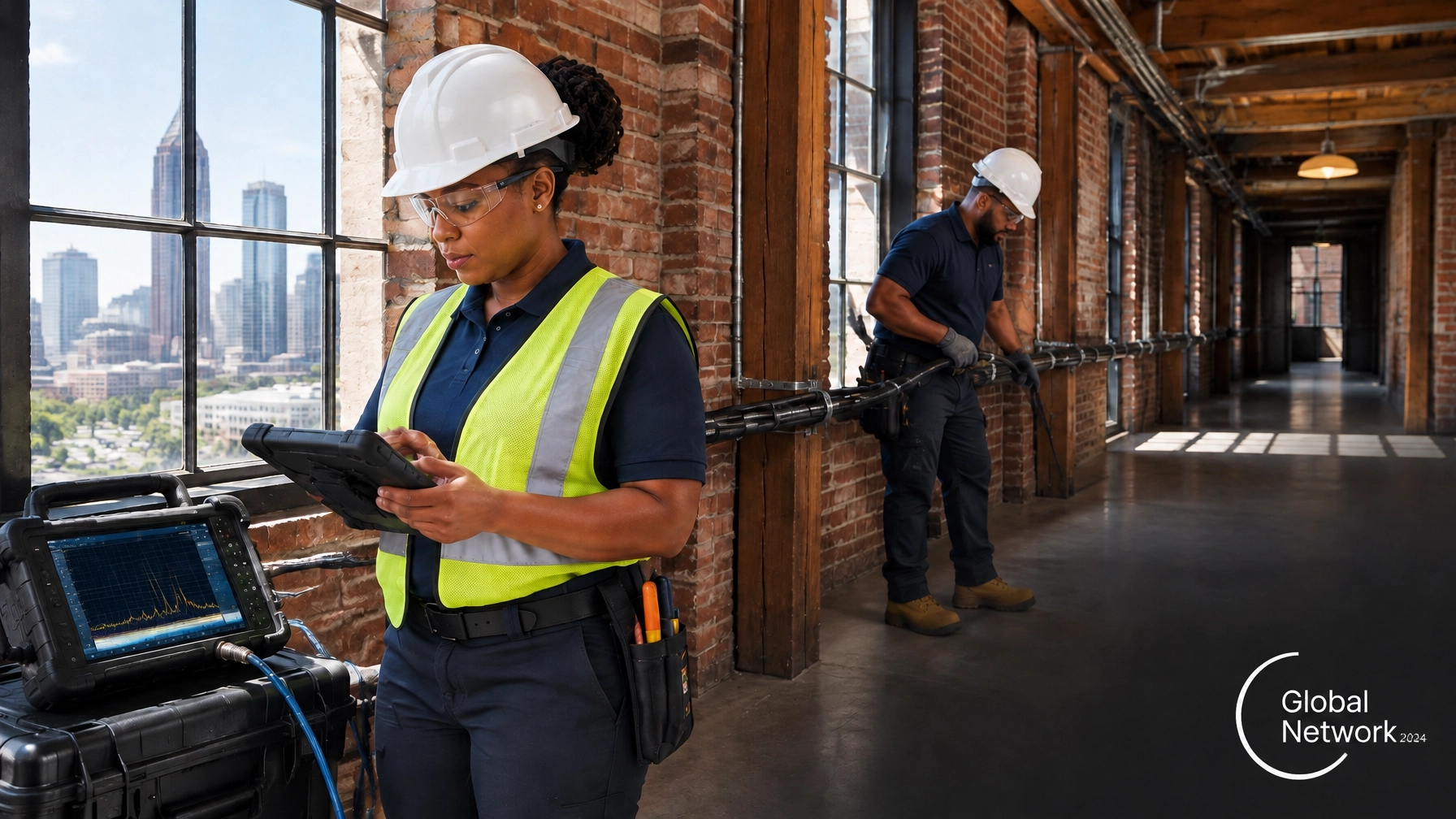
The Proven ERCES Retrofit Framework for Older Atlanta Buildings
Older Atlanta buildings present a distinct challenge for emergency responder communication. Historic brick, reinforced concrete, steel framing, below-grade areas, metalized low-E glass, and complicated floor plans can significantly weaken public-safety radio signals.
A building may appear to have adequate outdoor coverage while still containing interior areas where firefighters, police officers, and emergency medical personnel cannot reliably communicate. That is why an ERCES retrofit, also known as a Public Safety DAS or BDA system, must begin with measured RF conditions, not assumptions.
The proven approach is a structured framework that aligns engineering, permitting, historic preservation, installation, and testing. Done correctly, it provides compliance peace of mind, reliable in-building coverage, and fewer occupancy delays.
1. Establish the AHJ and Compliance Path First
Before selecting equipment, determine whether the retrofit is required by the local Authority Having Jurisdiction (AHJ) and identify the applicable code pathway.
Atlanta Fire Rescue requirements may apply to:
- New construction and substantial renovations
- Additions that affect an existing structure
- Buildings ordered to provide enhanced emergency responder coverage
- Existing facilities where the Fire Marshal determines that radio coverage is inadequate
- Projects requiring a new or amended Certificate of Occupancy
Under IFC 510 and applicable provisions of NFPA 1225, an addition may trigger requirements affecting the broader building rather than only the newly constructed area. However, maintenance work does not automatically create the same obligation. Obtain a written determination from the Atlanta Fire Rescue Office of the Fire Marshal when the project scope is unclear.
The system must be installed, tested, approved, and operational before occupancy when the AHJ requires an ERCES. Late design decisions can create avoidable rework, inspection failures, and schedule risk.
Coordinate the permitting sequence
A typical Atlanta retrofit may require coordination among:
- Atlanta Fire Rescue and the Fire Marshal’s Office
- Building, electrical, and fire permit reviewers
- The design professional and general contractor
- The property owner and facility manager
- Historic preservation or Urban Design Commission staff
- The public-safety radio system authority, where applicable
Review the Atlanta Fire Rescue IFC 510 and NFPA 1225 requirements and confirm the currently adopted code editions before submitting plans.
2. Perform a Baseline RF Site Survey and Grid Test
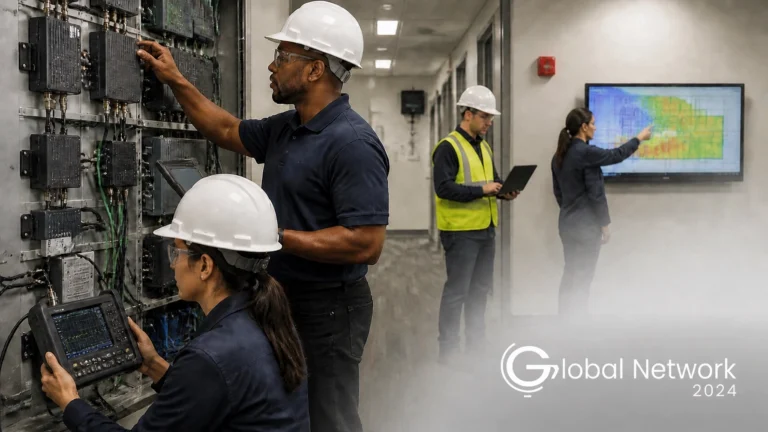
An ERCES design should be based on a documented radio-frequency (RF) survey. The objective is to determine where public-safety radio coverage is deficient, why it is deficient, and how much improvement the building requires.
The baseline survey should document:
- Outdoor donor signal strength and quality
- Uplink and downlink conditions
- Existing public-safety radio frequencies
- Floor-by-floor coverage
- Critical areas such as stairwells, fire command centers, elevator lobbies, and fire pump rooms
- Below-grade spaces, parking decks, mechanical rooms, and storage areas
- Construction materials and architectural obstructions
- Proposed donor antenna locations and cable pathways
Atlanta’s published approach commonly uses a test-cell grid, including approximately 40-foot-by-40-foot areas on qualifying floors. Large floors may require at least 20 test cells, while NFPA 72 critical areas are evaluated separately.
DAQ is more than signal strength
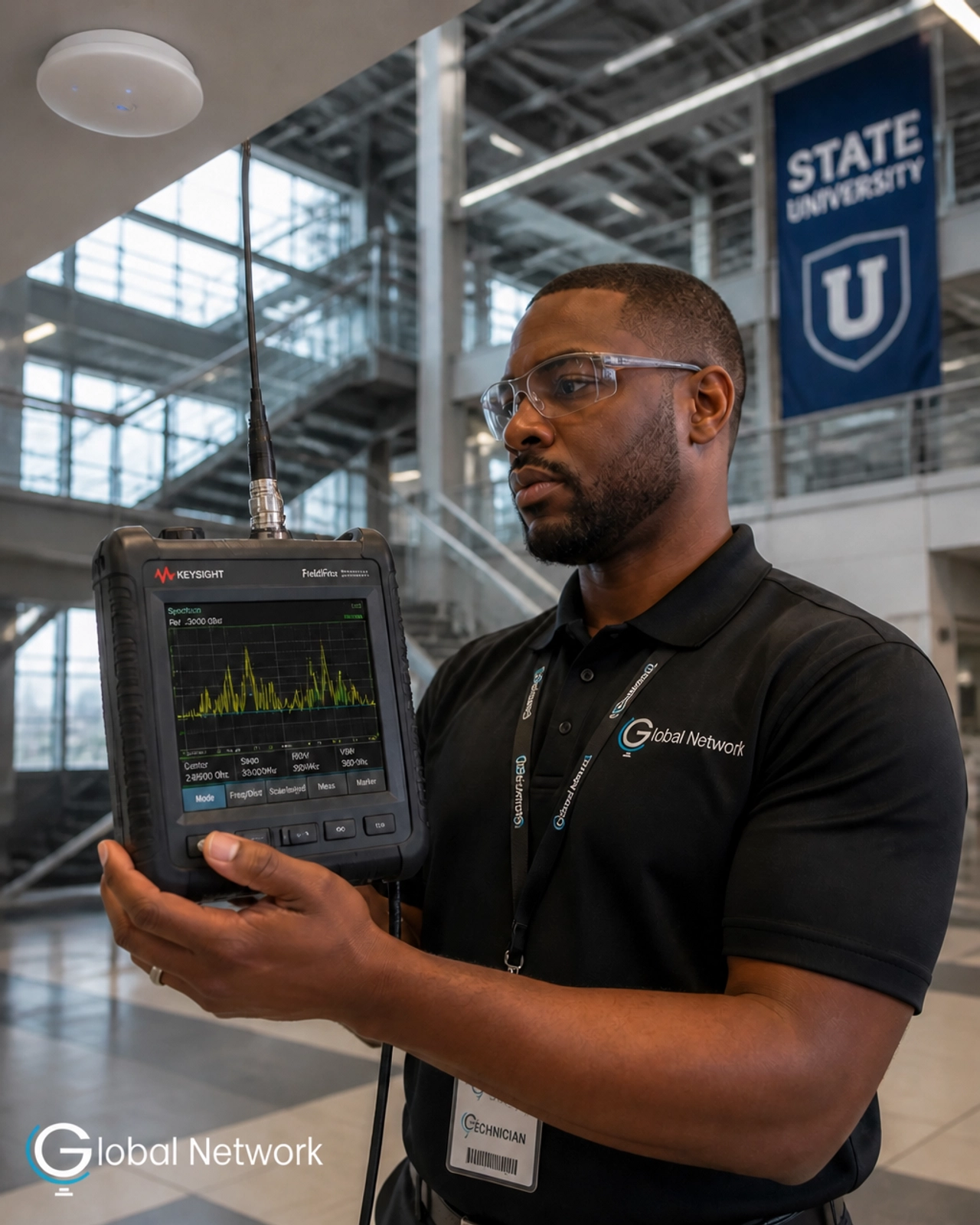
A strong RF power reading does not automatically equal intelligible emergency communication. Testing should include Delivered Audio Quality (DAQ) scoring, which evaluates voice clarity and intelligibility.
The target is commonly DAQ 3.0, or the level required by the AHJ. The final acceptance survey should be completed when the building is substantially complete and major signal-affecting features (such as doors, windows, partitions, and equipment) are in place.

3. Identify the Building Envelope’s RF Obstacles
Older Atlanta buildings often combine several signal-blocking conditions. Treating the envelope as an RF design issue is essential.
Common obstacles include:
- Low-E or metalized glass: Energy-efficient glazing can attenuate public-safety radio signals, particularly around perimeter offices and enclosed corridors.
- Thick masonry: Historic brick, stone, and block walls can create significant penetration loss.
- Reinforced concrete: Concrete slabs, shear walls, and structural cores may limit vertical signal propagation.
- Steel framing: Structural steel can reflect, absorb, or redirect RF energy.
- Below-grade construction: Parking decks, basements, tunnels, and underground service areas are often coverage dead zones.
- Metal-backed insulation and foil barriers: These materials may create unexpected attenuation between rooms or floors.
- Historic architectural details: Decorative metalwork, dense window assemblies, and protected walls may restrict pathway options.
Do not assume that replacing windows or modifying historic masonry is the best solution. A measured survey should establish whether an engineered BDA/DAS system can preserve the building envelope while providing the required coverage.
For additional background, review Global Network’s explanation of how RF signal levels are measured.
4. Select the Right Retrofit Architecture
The appropriate design depends on building size, floor plan, donor signal, construction materials, pathway availability, and the AHJ’s technical requirements.
Donor antenna and BDA placement
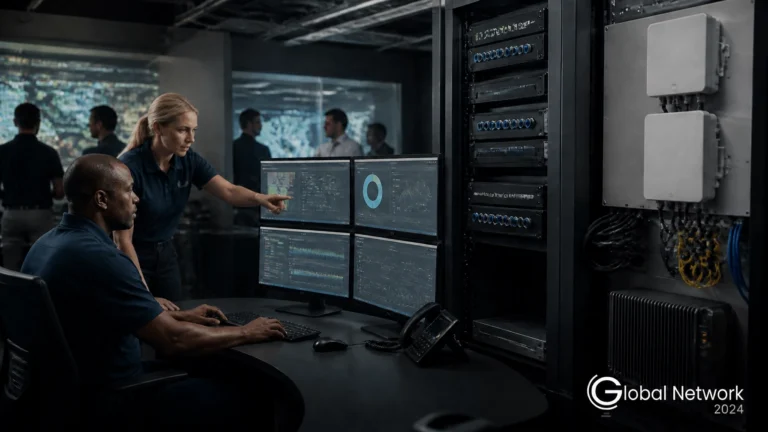
A rooftop or exterior donor antenna captures the public-safety signal outside the building. A channelized Bi-Directional Amplifier (BDA) then amplifies and manages the signal for distribution throughout the structure.
Design considerations include:
- Donor antenna height and line of sight
- Donor-to-service antenna isolation
- Separation from other rooftop radio systems
- Surge protection, grounding, and bonding
- Accessibility for inspection and maintenance
- Protection from weather and unauthorized access
- Avoidance of excessive gain or oscillation
Atlanta requirements may call for a Class A, channel-filtering BDA capable of operating with the local P25 public-safety radio system. A generic cellular booster is not an equivalent substitute.
Coaxial versus fiber-fed DAS
A smaller or compact building may use a coaxial distribution system with strategically located indoor antennas. Larger or vertically complex buildings may benefit from a fiber-fed DAS architecture.
Coaxial distribution
Coaxial systems can be effective where:
- Cable routes are relatively short
- Existing risers are available
- Signal loss remains within design limits
- The building has manageable floor-to-floor distances
Fiber-fed distribution
Fiber-fed systems may be preferable where:
- The building has multiple wings or towers
- Long horizontal or vertical runs are necessary
- Electrical closets provide distributed equipment locations
- Coaxial loss would require excessive amplification
- Historic finishes make smaller, more flexible pathways desirable
The design should map every antenna, cable run, riser, penetration, fire-rated assembly, and equipment location before installation begins.

5. Build the Compliance Stack Into the Design
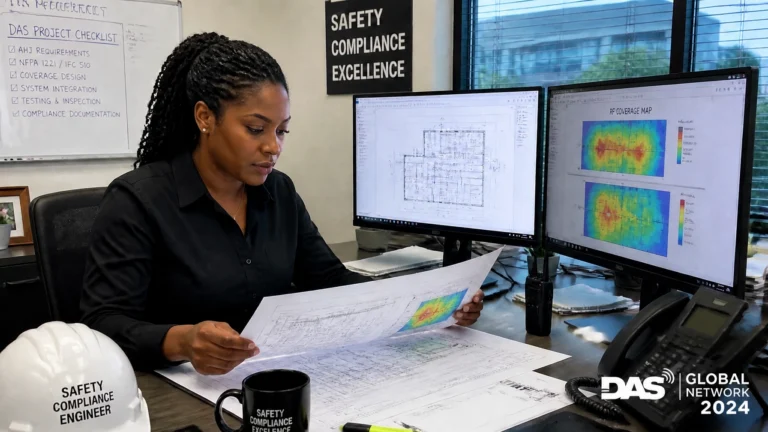
A successful retrofit is not only an RF project. It is a life-safety system that must integrate with the building’s power, fire alarm, and monitoring infrastructure.
Key requirements to address
- IFC 510: Emergency responder radio coverage and local fire-code requirements
- NFPA 72: Fire alarm monitoring, supervisory signals, interfaces, and critical-area considerations
- NFPA 1225: Emergency communications system design, installation, testing, maintenance, and documentation
- UL 2524: Listing and certification framework for ERCES equipment and system configurations
- FirstNet: Compatibility, filtering, and coexistence with Band 14 where required by the project
Specify equipment with appropriate UL 2524 listing for the intended ERCES application. Confirm that the listing applies to the complete configuration, not merely to an isolated BDA or power component.
The system design should also include:
- Fire-rated cable and pathway protection
- Dedicated primary power
- Code-compliant backup batteries
- Supervisory and trouble monitoring
- Battery calculations and transfer testing
- Alarm interface documentation
- Grounding and bonding
- Donor isolation verification
- Surge protection
- Accessible head-end and riser equipment
Address FirstNet deliberately
FirstNet compatibility should be treated as an engineered requirement, not a marketing assumption. Depending on the project, the ERCES may need to pass, filter, or intentionally reject FirstNet Band 14 while protecting the local P25 radio system from interference.
The final design may require:
- Band-specific filtering
- Notch filtering
- Spectrum analysis
- Multi-band equipment
- Written frequency approval
- Verification of adjacent-band performance
- Separate commissioning tests for LMR and FirstNet services
Review Global Network’s FirstNet guide and confirm requirements with the AHJ and radio-system stakeholders.
6. Navigate Historic District Requirements Early
Historic designation can affect donor antennas, rooftop equipment, visible conduit, wall penetrations, window assemblies, and exterior enclosures.
For buildings in an Atlanta historic or landmark district:
- Identify protected exterior and interior features.
- Screen every visible intervention with the appropriate preservation authority.
- Use existing shafts, risers, chases, and service spaces whenever possible.
- Favor reversible cable routes and concealed antenna locations.
- Avoid unnecessary drilling or cutting into significant masonry.
- Coordinate rooftop equipment with preservation, zoning, and building-permit requirements.
Early consultation is critical. A donor antenna redesign after historic review can affect structural work, procurement, and the overall occupancy schedule.
7. Minimize Tenant Disruption Through Phased Installation
Retrofitting an occupied building requires more than a technically correct drawing. The installation plan must protect tenants, operations, and sensitive historic finishes.
A practical phasing plan may include:
- Pre-installation access surveys
- Work-hour restrictions for occupied areas
- Advance tenant notifications
- Temporary protection for floors, walls, and furniture
- Night or weekend work in high-traffic spaces
- Floor-by-floor cable and antenna installation
- Separate commissioning windows
- Daily housekeeping and pathway restoration
- Coordination with security, IT, facilities, and fire-watch procedures
Where possible, complete head-end preparation and pathway work before entering tenant suites. This reduces repeat visits and keeps disruptions controlled.
0% Missed Deadlines. 0% Avoidable Rework. The earlier the pathway and access plan is developed, the more predictable the retrofit becomes.
8. Commission, Accept, and Maintain the System
Installation is not the finish line. The ERCES must be commissioned and accepted as a complete life-safety system.
Final testing should address:
- All required RF grid cells
- NFPA 72 critical areas
- DAQ scores
- Talk-in and talk-out performance
- Uplink and downlink levels
- BDA gain and isolation
- Donor signal quality
- Battery operation and backup duration
- Fire alarm supervisory points
- Trouble and alarm signals
- Grounding and bonding
- Cable integrity
- Spectrum performance and spurious emissions
- FirstNet and adjacent-band operation, where applicable
The acceptance package should include approved drawings, test maps, equipment documentation, battery calculations, alarm-interface records, permit information, and certified results for the AHJ.

Annual performance testing is mandatory maintenance
An ERCES can fall out of compliance after tenant renovations, low-E window replacement, new metal partitions, rooftop construction, or changes to interior layouts.
Schedule annual performance testing and reassess coverage after any major building change. Maintain onsite records for:
- Annual inspection results
- Battery testing
- DAQ and coverage measurements
- Alarm and supervisory testing
- Repairs and corrective actions
- Equipment changes
- Updated floor plans
- Service-provider documentation
See Global Network’s compliance testing and inspection resources for additional guidance.
Protect Your Atlanta Building From Coverage Gaps and Occupancy Delays
Older buildings do not have to compromise emergency communication. With a measured RF survey, code-driven engineering, historic-sensitive routing, phased installation, and documented acceptance testing, an ERCES/Public Safety DAS/BDA retrofit can deliver reliable coverage without unnecessary disruption.
Global Network LLC provides ERCES design, installation, commissioning, compliance testing, and annual performance testing for Atlanta-area facilities. The objective is clear: reliable communication for first responders when it matters most and confidence that your building is prepared for AHJ review.
Start with a site assessment before construction decisions limit your options.
Office: 770.520.7633
Toll Free: 877.231.1084
globalnetworkco.com