
NFPA 1225 vs. NFPA 72: Which Code Actually Governs Your ERCES: and Why It Matters for Your Next Inspection
For Atlanta building owners and facility managers, the question is rarely whether reliable in-building public-safety radio coverage matters. The more difficult question is which code applies to which part of an Emergency Responder Communication Enhancement System (ERCES).
NFPA 1225 and NFPA 72 both affect ERCES and Public Safety Distributed Antenna Systems (DAS), but they do not serve the same purpose. Treating them as interchangeable can create design gaps, inspection delays, or confusion during coordination with the Authority Having Jurisdiction (AHJ).
The practical distinction is straightforward:
- NFPA 1225 primarily addresses emergency services communications and the technical performance of an ERCES/Public Safety DAS.
- NFPA 72 primarily addresses fire alarm signaling, supervision, monitoring, and system integration.
- The locally adopted fire code, state amendments, city ordinances, and AHJ directives determine what is enforceable for a specific building.
There is no universal code rule that applies identically to every jurisdiction. For an Atlanta project, early coordination is essential.
The Core Difference Between NFPA 1225 and NFPA 72
NFPA 1225: The Emergency Communications Standard
NFPA 1225, Standard for Emergency Services Communications, provides the technical framework for emergency responder communication systems. It consolidated relevant emergency communication provisions previously associated with standards such as NFPA 1221 and NFPA 1061.
For ERCES and Public Safety DAS, NFPA 1225 may address topics such as:
- RF system design and engineering
- Donor antenna and signal-source configuration
- Uplink and downlink performance
- Signal strength and Delivered Audio Quality (DAQ)
- Antenna placement and coaxial distribution
- Isolation between donor and server antennas
- Pathway survivability
- Emergency power and battery capacity
- Equipment performance and environmental protection
- Acceptance testing and ongoing performance verification
In other words, NFPA 1225 is primarily concerned with whether the radio system performs as required throughout the building, including areas where emergency personnel must communicate during an incident.
That can include stairwells, elevator lobbies, fire command centers, pump rooms, parking structures, mechanical spaces, and other critical areas identified by the AHJ.
The NFPA 1225 standard development page is a useful starting point for understanding the standard’s role. However, the standard itself does not automatically become law merely because it has been published.
NFPA 72: The Fire Alarm and Signaling Standard
NFPA 72, National Fire Alarm and Signaling Code, governs fire alarm and signaling functions. In an ERCES installation, its relevance is generally centered on supervision, fault reporting, annunciation, and integration with the building’s fire alarm system.
Depending on the adopted edition and local requirements, NFPA 72 may affect:
- Fire alarm control panel interfaces
- Supervisory signals
- Trouble conditions
- Loss of normal AC power
- Battery or standby-power conditions
- Active equipment failure
- Signal-source failure
- Pathway monitoring
- Annunciation and notification
- Reset and control functions
- Integrated system testing
- Cybersecurity and remote-access considerations in newer editions
NFPA 72 generally does not establish the complete RF design criteria for an ERCES. It does not replace the need for signal surveys, coverage maps, DAQ testing, link-budget calculations, antenna isolation measurements, or other Public Safety DAS engineering documentation.
For a deeper explanation of the newer monitoring considerations, building owners can review Global Network LLC’s article, NFPA 72-2025 Explained: What Building Owners Need to Know About the New Monitoring Rules.
How the Two Standards Work Together
An ERCES is not only an RF distribution system. It is also a life-safety system that may need to communicate faults to the building’s fire alarm infrastructure.
That creates two connected compliance responsibilities.
The RF Side
The NFPA 1225 side asks questions such as:
- Does the building provide adequate public-safety radio coverage?
- Are critical areas identified and tested?
- Is the donor signal adequate and stable?
- Are uplink and downlink levels within acceptable limits?
- Is antenna isolation sufficient to prevent oscillation?
- Are the BDA, coaxial cable, splitters, and antennas installed correctly?
- Can the system continue operating under required emergency conditions?
The Monitoring Side
The NFPA 72 side asks questions such as:
- Does the fire alarm system receive required ERCES supervisory signals?
- Are system faults annunciated correctly?
- Is the loss of power reported?
- Are battery conditions supervised?
- Are active components monitored?
- Are signal pathways and interfaces tested?
- Can the system be maintained without creating an undocumented life-safety impairment?
A building can pass an RF coverage test and still have a problem with its fire alarm interface. It can also have a properly supervised interface while failing to deliver usable radio coverage in critical areas.
Compliance requires both sides to function together.
Why the Locally Adopted Edition Matters
NFPA standards are typically made enforceable through adoption by a state or local jurisdiction. They may be referenced by the International Fire Code (IFC), incorporated into state building regulations, modified by local amendments, or supplemented by an AHJ’s written requirements.
This means the newest edition is not automatically the enforceable edition for every project.
For example, a jurisdiction may be operating under an adopted IFC edition that references an earlier edition of NFPA 72. Another jurisdiction may require NFPA 1225, while a different jurisdiction may still reference NFPA 1221 or use local ERCES specifications.
The applicable requirements may depend on:
- The building permit date
- The code cycle governing the project
- State-adopted construction and fire codes
- City or county amendments
- Occupancy classification
- Building height and size
- Existing-versus-new construction status
- Fire alarm system requirements
- Public-safety radio system ownership
- Written AHJ direction
- Requirements for a Certificate of Occupancy
Do not assume that “current NFPA edition” and “adopted NFPA edition” mean the same thing.
What Atlanta Building Owners Should Confirm
Atlanta-area projects may involve several reviewing parties. The fire code official, building department, Georgia code authorities, and public-safety radio system stakeholders may each influence the project.
Before approving an ERCES design, ask the project team to confirm the following in writing:
- Which IFC edition governs the project?
- Which NFPA 72 edition is referenced or enforced?
- Does the jurisdiction require NFPA 1225, NFPA 1221, or a local ERCES standard?
- Which areas require enhanced or critical-area coverage?
- What signal strength, DAQ, coverage-percentage, and testing criteria apply?
- What equipment listings or certifications are required?
- How must the ERCES connect to the fire alarm control panel?
- What supervisory conditions must be annunciated?
- Who must witness acceptance testing?
- What documentation is required before inspection or occupancy approval?
The [City of Atlanta Fire Rescue Department or designated fire code official] should be treated as a key AHJ resource for project-specific direction. The public-safety radio system owner may also establish requirements for donor signal access, frequency bands, interference control, and network acceptance.
Local expertise can make this process substantially more efficient. Global Network LLC’s DAS and ERCES services include design, installation, commissioning, compliance testing, and coordination for Atlanta-area facilities.
Inspection Preparation: What Your Documentation Should Include
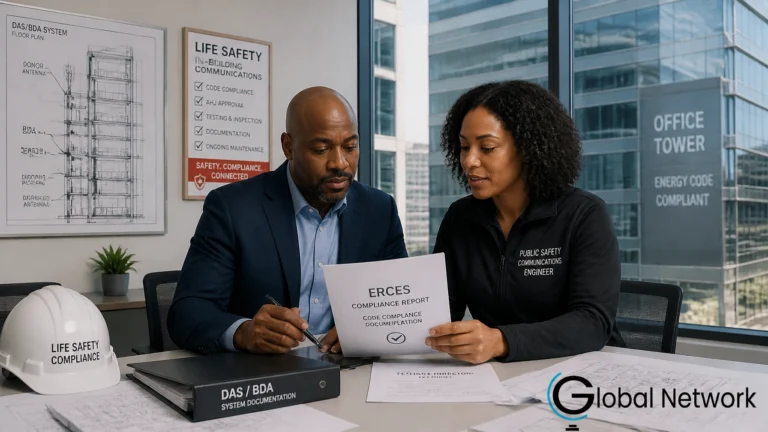
A successful inspection is supported by organized documentation: not only installed equipment.
Design and Engineering Records
Prepare documentation that demonstrates how the system was designed, including:
- Floor plans and riser diagrams
- RF coverage heat maps
- Antenna locations
- BDA and equipment-room locations
- Coaxial and fiber pathways
- Donor antenna information
- Link-budget calculations
- Isolation measurements
- Battery and standby-power calculations
- Critical-area designations
- Equipment data sheets and listings
Testing and Commissioning Records
Your acceptance package may need to include:
- Pre-installation signal survey results
- Post-installation signal survey results
- DAQ measurements
- Signal strength measurements
- Uplink and downlink readings
- Coverage-percentage calculations
- Critical-area test results
- Battery-load or standby-power documentation
- Alarm and supervisory-point verification
- Fire alarm interface testing
- Equipment programming records
- Deficiency-resolution documentation
The Global Network ERCES compliance checklist provides additional preparation guidance for owners working toward inspection and occupancy approval.
Maintenance and Annual Testing Records
An ERCES is not compliant simply because it passed its original acceptance test. Building renovations, generator work, roof repairs, cable damage, radio-network changes, and equipment aging can affect performance.
Maintain:
- Annual test reports
- Service records
- Battery replacement history
- Trouble-event records
- Fire alarm interface records
- Updated floor plans
- Current equipment inventories
- Impairment and restoration logs
- Contact information for responsible parties
A Public Safety DAS annual inspection should be treated as a life-safety performance verification: not a paperwork exercise.
Common Mistakes That Create Inspection Problems
Several avoidable mistakes repeatedly complicate ERCES projects:
- Citing NFPA 1225 without confirming local adoption
- Treating NFPA 72 as the RF coverage standard
- Failing to identify critical areas before installation
- Designing from outdated architectural plans
- Leaving fire alarm interface requirements until the end
- Assuming an existing BDA is automatically acceptable
- Omitting parking levels, stairwells, or mechanical spaces from testing
- Failing to coordinate with the public-safety radio system owner
- Providing incomplete heat maps or test documentation
- Using a newer standard in the design narrative without explaining the adopted code basis
The goal should be 0% missed inspection prerequisites and 0% avoidable documentation gaps.
The Practical Answer: Which Code Governs Your ERCES?
The answer depends on the function being evaluated and the jurisdiction enforcing the project.
- NFPA 1225 generally governs the emergency communications performance of the ERCES/Public Safety DAS.
- NFPA 72 generally governs fire alarm supervision, signaling, monitoring, and integration.
- IFC 510 and related local ordinances may establish when enhanced in-building radio coverage is required.
- The AHJ determines how these requirements are interpreted and applied to the building.
- The adopted editions: not necessarily the newest editions: determine enforceability.
For Atlanta building owners, the safest strategy is to establish the code basis before design begins, document every assumption, and coordinate with the AHJ before equipment is installed.
When it matters most, reliable first-responder communication cannot depend on assumptions.
For help with ERCES design, Public Safety DAS installation, NFPA/IFC compliance testing, or inspection preparation, contact Global Network LLC:
- Office: 770.520.7633
- Toll Free: 877.231.1084
- Website: globalnetworkco.com
Confirm the code. Engineer the system. Document the results. Protect the people inside.