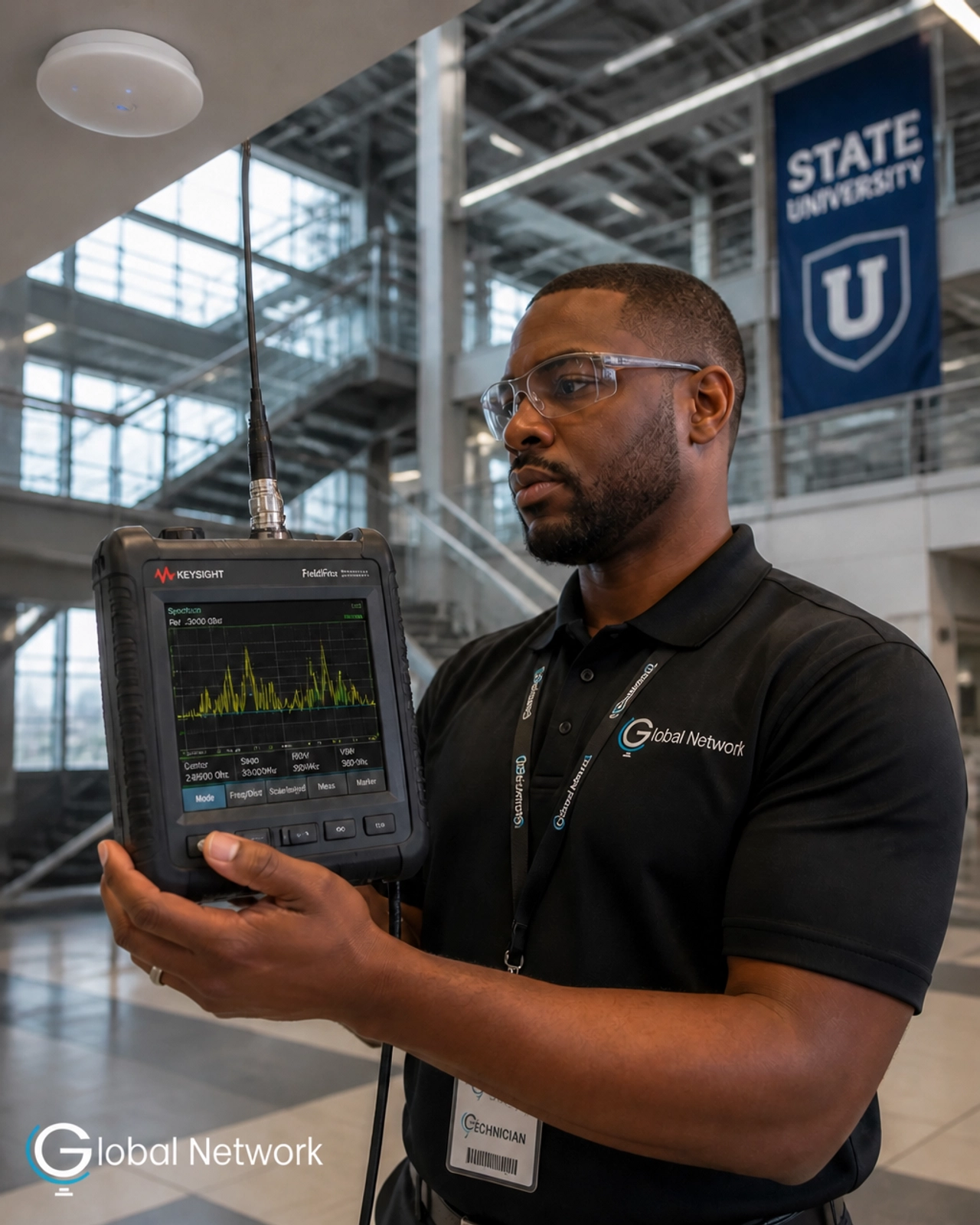

The Fire Command Center: Your Building’s ERCES Nerve Center
In a high-rise, hospital, university, stadium, hotel, or commercial facility, the fire command center is more than a room with a fire alarm panel. It is the building’s operational nerve center during an emergency: a controlled location where responders can evaluate system status, identify trouble conditions, and coordinate life-safety operations.
For buildings equipped with an Emergency Responder Communication Enhancement System (ERCES), the fire command center also plays a critical role in public-safety radio reliability. The ERCES may include a Bi-Directional Amplifier (BDA), donor antenna, coaxial or fiber DAS infrastructure, remote units, distributed antennas, backup batteries, and system monitoring interfaces.
When these systems are properly designed, installed, and supervised, emergency personnel have a clearer view of building conditions and a more reliable method of communicating when it matters most.
What Does a Fire Command Center Do?
A fire command center provides an approved, accessible location for monitoring and controlling essential fire and life-safety systems. Its exact equipment and configuration depend on the building, adopted codes, fire protection design, and requirements of the Authority Having Jurisdiction (AHJ).
A typical command center may include:
- The Fire Alarm Control Panel (FACP) or Fire Alarm Control Unit (FACU)
- A remote fire alarm annunciator or graphic annunciator
- Emergency voice/alarm communications controls
- Sprinkler and standpipe status indicators
- Smoke control and HVAC shutdown controls
- Elevator recall and firefighter service controls
- Emergency power status
- Security, access control, or facility communication interfaces
- ERCES supervisory status and trouble indications
The objective is straightforward: give trained personnel an accurate, centralized picture of the building’s life-safety systems.
A command center does not replace field testing or an engineered design. It provides the operational interface that allows responders and facility personnel to understand whether those systems are in normal condition or require immediate attention.
Why ERCES Belongs in the Fire Command Center
An ERCES is designed to improve two-way radio coverage for first responders inside areas where building construction, below-grade spaces, concrete, steel, or other obstructions weaken radio signals.
However, reliable radio coverage is only part of the system’s life-safety function. The building owner and AHJ also need to know whether the ERCES is operating correctly.
An ERCES can experience conditions such as:
- Loss of normal AC power
- Battery or secondary-power failure
- BDA amplifier malfunction
- Donor antenna or distributed antenna fault
- Coaxial cable or fiber pathway failure
- Excessive signal loss
- System disablement
- Enclosure tamper or environmental alarm
- Communication failure between the ERCES and fire alarm system
These conditions may not activate a fire alarm. They can still compromise emergency communications. That is why ERCES status is commonly brought to an approved location such as the fire command center and integrated with the building’s fire alarm monitoring architecture.
0% Hidden Faults. 0% Unexplained Signals.
A properly engineered interface makes the system condition visible, identifiable, and actionable.

ERCES Annunciator Requirements: What Should Be Visible?
Detailed ERCES annunciation requirements are generally driven by the adopted International Fire Code (IFC), NFPA 1225, local amendments, and the AHJ. NFPA 72 governs the fire alarm and signaling system that receives, displays, and transmits many of those supervisory conditions.
The final point list must be confirmed during design review. In general, the fire command center should provide clear indication of the ERCES system’s operational state.
Normal Condition
The annunciator or FACP should make it clear when the ERCES is operating normally. A normal indication confirms that the supervised circuits, power supplies, and monitored components are reporting their expected status.
Trouble or Supervisory Condition
ERCES faults should be represented as clearly defined signals rather than vague messages such as “communications issue.” Depending on the approved design, examples may include:
- ERCES system trouble
- BDA failure
- Donor antenna fault
- DAS or coaxial pathway fault
- Remote unit failure
- AC power loss
- Battery trouble or low battery
- Charger failure
- High-temperature condition
- Enclosure tamper
- System disabled or manually shut down
The terminology should correspond with the approved shop drawings, point list, sequence of operations, and fire alarm programming documentation.
Building and Zone Identification
In a multi-building campus or complex facility, the annunciator must identify the affected building, floor, equipment room, or system segment. Responders should not have to search through unlabeled cabinets to determine which ERCES component is reporting a problem.
Clear labels reduce response time.
Indicators and status text should be visible under normal and emergency lighting conditions. Controls should be protected from unauthorized operation while remaining accessible to authorized responders and service personnel.
How NFPA 72 Applies to ERCES Monitoring
NFPA 72 is the National Fire Alarm and Signaling Code. It establishes requirements for fire alarm systems, signaling pathways, supervising stations, annunciation, power supplies, inspection, testing, and maintenance.
It is important to understand the division of responsibility:
- IFC and NFPA 1225 commonly address the public-safety radio coverage and ERCES-specific requirements.
- NFPA 72 governs the fire alarm and signaling infrastructure used to monitor, annunciate, and transmit applicable ERCES conditions.
- The AHJ determines how these requirements are applied to a specific building and adopted code edition.
When an ERCES is interfaced with an FACP, the system may use listed monitoring modules, relay outputs, or other approved interfaces to report ERCES conditions. The interface must be engineered so that signals are properly supervised, labeled, displayed, and transmitted.
Signals Commonly Monitored
NFPA 72 monitoring architecture generally distinguishes among:
- Alarm: A condition requiring emergency action, such as fire detection or waterflow.
- Supervisory: An off-normal condition involving a monitored fire protection or life-safety function.
- Trouble: A fault in wiring, power, equipment, communication, or system integrity.
ERCES faults are typically handled as supervisory or trouble conditions based on the approved design and AHJ direction. The important requirement is not merely creating a signal. The signal must accurately represent the system condition and reach the appropriate points of annunciation and supervision.
Supervising Station Transmission
Where required by the building code, the fire alarm system must be monitored by an approved supervising station in accordance with NFPA 72. Alarm, supervisory, and trouble conditions must be transmitted using compliant and supervised communication pathways.
The monitoring arrangement should account for:
- Primary and secondary power
- Communication pathway supervision
- Signal transmission performance
- Local audible and visual trouble indication
- Required backup power duration
- Restoration and acknowledgment procedures
- Documentation of testing and service activity
The applicable NFPA 72 edition, local code adoption, and AHJ requirements control the final details. A system that appears functional at the panel may still be deficient if its monitoring pathway, labels, or documentation do not meet the approved design.

The Connection Between the ERCES and FACP
The ERCES and FACP are separate systems with different primary functions:
- The ERCES improves in-building two-way radio communication for emergency responders.
- The FACP monitors fire alarm initiating devices, notification appliances, supervisory devices, trouble conditions, and approved system interfaces.
Their connection creates a coordinated life-safety monitoring framework.
A typical integration sequence may work as follows:
- An ERCES component detects an off-normal condition.
- The ERCES generates a listed supervisory or trouble output.
- A supervised input module at the FACP receives the signal.
- The FACP identifies and displays the condition using approved labels.
- The fire command center annunciator mirrors the information.
- The supervising station receives the applicable signal when required.
- Facility personnel or an ERCES service provider responds, diagnoses, repairs, and documents the condition.
- The system is retested and restored to normal operation.
This sequence depends on compatible equipment, listed interfaces, correct programming, appropriate circuit supervision, and coordinated commissioning between the fire alarm contractor and ERCES specialist.
The connection should never be treated as an afterthought. It belongs in the design documents, riser diagrams, point schedules, sequence of operations, acceptance test plan, and maintenance procedures.
Inspection, Testing, and Documentation
A fire command center is useful only when its displays and controls accurately reflect field conditions. NFPA 72 requires inspection, testing, and maintenance of fire alarm systems and associated equipment at defined intervals, including control equipment and annunciators.
ERCES compliance testing should be coordinated with the fire alarm testing program. Verification may include:
- Confirming normal ERCES status at the command center
- Activating each approved ERCES supervisory and trouble point
- Verifying correct FACP labeling and annunciation
- Confirming remote annunciator operation
- Testing transmission to the supervising station
- Checking primary and secondary power supervision
- Testing communication pathway integrity
- Confirming restoration after repairs
- Documenting results in an AHJ-accepted format
Annual ERCES performance testing and fire alarm inspection should be planned before a deficiency becomes an occupancy delay or inspection failure.

A Practical Fire Command Center Review Checklist
Building owners and facility managers should ask:
- Is the fire command center location approved by the AHJ?
- Is the FACP or remote annunciator accessible to emergency responders?
- Are ERCES signals displayed at the approved location?
- Are normal, supervisory, and trouble conditions clearly distinguished?
- Are BDA, antenna, power, battery, and pathway faults identified?
- Are multi-building or multi-zone conditions labeled accurately?
- Are ERCES signals transmitted through the approved monitoring pathway?
- Does the system have compliant primary and secondary power?
- Are the fire alarm and ERCES systems tested together?
- Are records current, complete, and available for inspection?
A strong answer to each question supports peace of mind, compliance, and operational readiness.
Keep Your Building Ready When It Matters Most
The fire command center is where emergency information becomes operational awareness. When an ERCES is integrated correctly with the FACP and annunciated through a clear, supervised interface, responders can identify system conditions faster and facility owners can address deficiencies before they become major risks.
Global Network LLC provides ERCES and Public Safety DAS design, installation, commissioning, compliance testing, and monitoring support for commercial, institutional, hospitality, healthcare, government, and educational facilities throughout Atlanta and beyond.
Our team helps coordinate the technical requirements associated with IFC 510, NFPA 72, NFPA 1225, BDA technology, fire alarm interfaces, and AHJ approval.
Do not wait for a failed inspection or an emergency to discover that your ERCES monitoring strategy is incomplete.
Request a compliance consultation through Global Network LLC’s services page, review our NFPA 72 monitoring guidance, or explore our public-safety DAS compliance checklist.
Office: 770.520.7633
Toll Free: 877.231.1084
Website: globalnetworkco.com
0% Missed Deadlines. 0% Unmonitored Critical Conditions. Reliable communication when it matters most.