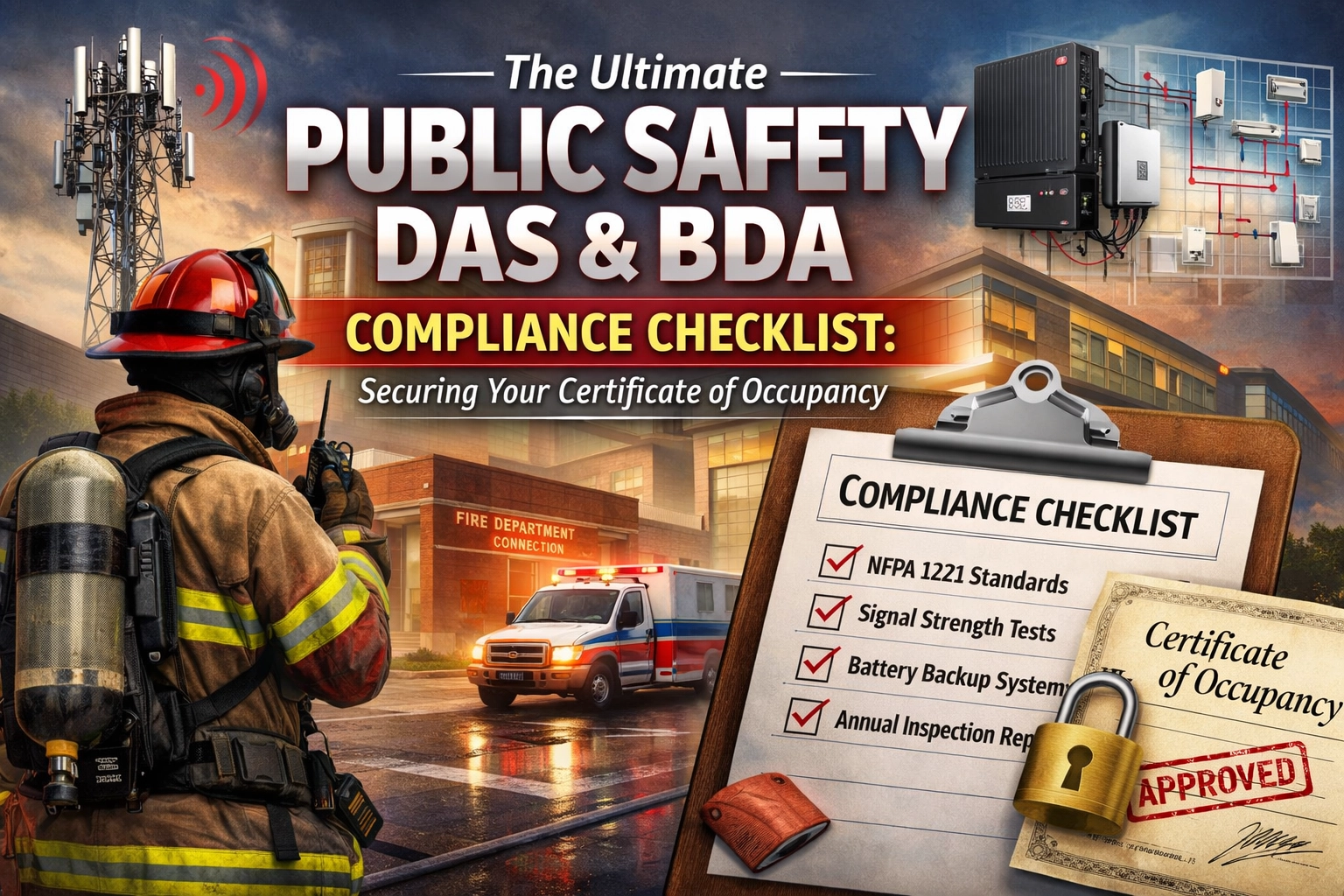
The Ultimate Public Safety DAS & BDA Compliance Checklist: Securing Your Certificate of Occupancy
For building owners, developers, and facility managers, the path to a Certificate of Occupancy (CO) is often paved with complex regulatory hurdles. Among the most critical: and frequently misunderstood: requirements is the installation and certification of an Emergency Radio Communication Enhancement System (ERCES).
Whether you refer to it as a Public Safety DAS (Distributed Antenna System) or a BDA (Bi-Directional Amplifier) System, this infrastructure is not optional. It is a life-safety requirement mandated by international and local fire codes to ensure that first responders: firefighters, police, and EMS: can communicate inside your building during an emergency. At Global Network LLC, we understand that a failed inspection doesn’t just mean a delay; it means a complete halt to your operations.
This guide serves as the ultimate compliance checklist to ensure your building meets IFC 510 and NFPA 72 standards, securing your CO and protecting those who protect us.
Phase 1: Understanding the Regulatory Framework
Before a single cable is pulled, you must identify the standards governing your jurisdiction. In the Atlanta metropolitan area and across the United States, two primary codes dictate the requirements for public safety coverage.
1. IFC Section 510 (International Fire Code)
The IFC 510 is the gold standard for many Authorities Having Jurisdiction (AHJs). It dictates the technical requirements for system coverage and signal strength.
- Mandatory Coverage: Most jurisdictions require an ERCES in all new buildings where radio signal strength is insufficient.
- Signal Strength: A minimum signal strength of -95 dBm is generally required throughout the building.
2. NFPA 1221 and NFPA 72
While NFPA 72 is the National Fire Alarm and Signaling Code, it often points to NFPA 1221 (now moving into NFPA 1225) for the specifics of emergency communication systems.
- Monitoring: The system must be integrated with the building’s fire alarm control unit.
- Survival: Requirements for cable survivability and enclosure ratings (NEMA 4/4X) are defined here.

Phase 2: Pre-Installation & Design Checklist
Compliance begins with a professional design. A "guess-and-check" approach will inevitably lead to costly retrofits and failed inspections.
- [ ] RF Survey (Grid Testing): Conduct a pre-construction or pre-installation signal survey. If the existing signal strength meets the AHJ's requirements, you may be exempt. If not, a system is required.
- [ ] AHJ Coordination: Contact the local Fire Marshal or AHJ early. Requirements vary by county: what is acceptable in Fulton County may differ in Gwinnett or Cobb.
- [ ] UL 2524 Listing: Ensure all equipment, including the BDA and battery backup, is UL 2524 listed. This is a specific standard for In-building 2-Way Emergency Radio Communication Enhancement Systems.
- [ ] FCC Licensed Technicians: Ensure your design and installation team holds the necessary FCC General Radiotelephone Operator Licenses (GROL).
- [ ] FirstNet Compatibility: Modern systems should be FirstNet compatible to ensure support for the nationwide public safety broadband network.
Phase 3: Technical System Requirements
The hardware you install must be ruggedized and reliable. Global Network LLC prioritizes 0% Defects in our deployments because, in life-safety, there is no room for error.
Hardware & Enclosures
- [ ] NEMA 4/4X Rated Enclosures: All active components (BDAs, battery backups, and fiber remotes) must be housed in NEMA 4 or 4X waterproof/dustproof cabinets, typically painted "Fire Truck Red."
- [ ] Battery Backup: The system must remain operational for at least 24 hours in the event of a primary power failure (some jurisdictions may allow 12 hours, but 24 is the safest standard).
Monitoring and Alarming
The BDA must report specific supervisory signals to the building's Fire Alarm Control Panel (FACP). Ensure your system monitors for:
- [ ] BDA Component Failure
- [ ] Donor Antenna Malfunction (Signal Loss)
- [ ] Active Battery Charger Failure
- [ ] Low Battery Capacity (Usually at 70% depletion)
- [ ] AC Power Failure

Phase 4: The Coverage Standard (The 99/95 Rule)
This is the most common area where buildings fail their final inspection. The AHJ will verify coverage using a "Grid Test" method.
1. Critical Areas (99% Coverage)
Critical areas are the nerve centers of emergency response. You must achieve 99% floor area coverage in:
- Elevator Lobbies
- Exit Stairs and Stairwells
- Fire Command Centers
- Fire Pump Rooms
- Standpipe Cabinets
- Emergency Generator Rooms
2. General Areas (95% Coverage)
In all other "general" building areas, 95% floor area coverage is required.
The Grid Test Protocol

- Divide each floor into a grid (typically 20 or 40 grids per floor).
- A technician (and later the AHJ) will walk each grid with a calibrated radio or spectrum analyzer.
- RSSI Compliance: Signal must be -95 dBm or better in both uplink and downlink.
- DAQ (Delivered Audio Quality): Most AHJs require a minimum DAQ of 3.0, meaning speech is understandable with some noise or distortion.
Phase 5: Documentation and Submission
You cannot get a Certificate of Occupancy without a "Closeout Package" that satisfies the AHJ's administrative requirements.
- [ ] As-Built Drawings: A complete set of drawings showing the exact location of every antenna, coupler, and the BDA head-end.
- [ ] Inventory List: Provide make, model, and serial numbers of all active components.
- [ ] Testing Reports: A signed document showing the results of the final grid test and backup battery discharge test.
- [ ] FCC Compliance: Proof that the BDA is registered with the FCC and operates on the correct public safety frequencies (700/800 MHz).
Phase 6: Maintenance and Annual Certification
Securing your CO is just the beginning. Compliance is an ongoing obligation. Under NFPA 72, building owners are required to perform annual testing to ensure the system remains functional.
- [ ] Annual Functional Test: Verify the system still meets coverage requirements and that all supervisory alarms are reporting correctly to the fire panel.
- [ ] 5-Year Full Grid Test: Many jurisdictions require a comprehensive re-test of every grid every five years.
- [ ] Battery Replacement: Lead-acid batteries should typically be replaced every 3–5 years, regardless of their "apparent" health.
For more information on common pitfalls, read our guide on 7 mistakes you’re making with NFPA 72 compliance.

Why Partner with Global Network LLC?
Navigating the intersection of telecommunications and fire safety requires a specialist. As Atlanta’s local specialist in Public Safety DAS and BDA technology, Global Network LLC brings a commitment to excellence that is unmatched in the industry.
We don't just install equipment; we provide peace of mind. Our mission-driven approach focuses on community safety and workforce development, ensuring that your building is a safe environment for occupants and first responders alike. With a focus on strict adherence to regulatory standards, we ensure your project stays on track and your Certificate of Occupancy is secured without delay.
Our Commitment:
- Professional Expertise: Every system is designed and commissioned by certified professionals.
- Safety First: We prioritize the reliability of communication for the "moments when it matters most."
- Local Knowledge: We have deep relationships with Atlanta-area AHJs and understand local code amendments.
Take the Next Step Toward Compliance
Don't wait until your final inspection to discover a coverage gap. Whether you are in the pre-construction phase or need to bring an existing building up to code, Global Network LLC is ready to assist.
Contact us today for a consultation or to schedule a professional signal strength test.
- Phone: Call us directly to speak with a specialist.
- Website: https://globalnetworkco.com
- Inquiry: Visit our Contact Page to request a quote.
- Services: Explore our full range of Public Safety DAS and Cellular solutions.
Ensure your Public Safety DAS system is compliant – Schedule your test now.