The Ultimate Guide to Public Safety DAS: Everything You Need for First-Pass Inspection Approval
In the modern landscape of commercial construction and facility management, the ability to communicate is not merely a convenience: it is a life-saving necessity. When an emergency occurs, first responders rely on seamless radio communication to coordinate rescue efforts, manage fire suppression, and ensure the safety of every occupant. However, the very materials that make our buildings modern and energy-efficient, such as Low-E glass, concrete, and steel, act as barriers to these critical signals.
This is where an Emergency Responder Communication Enhancement System (ERCES), commonly referred to as a Public Safety DAS (Distributed Antenna System), becomes mandatory. Securing a Certificate of Occupancy (CO) often hinges on the performance of this system. At Global Network LLC, we understand that for developers and building owners, there is no room for error. Achieving 0% Defects in your communication infrastructure is the only way to ensure your facility is ready when it matters most.
Understanding the Regulatory Landscape: IFC 510 and NFPA 72
Compliance is not a suggestion; it is a rigid legal requirement governed by international and national fire codes. To achieve first-pass inspection approval, you must strictly adhere to the standards set forth by the International Fire Code (IFC) Section 510 and the National Fire Protection Association (NFPA) 72 or NFPA 1221.
These codes dictate that buildings must maintain a specific level of radio signal strength for emergency personnel. In most jurisdictions, including the greater Atlanta metropolitan area, the following requirements are non-negotiable:
- Minimum Signal Strength: A minimum signal strength of -95 dBm must be available throughout 95% to 99% of the building.
- DAQ (Delivered Audio Quality): The audio must be clear and intelligible, typically requiring a DAQ of 3.0 or higher.
- System Monitoring: The ERCES must be monitored by the building’s Fire Alarm Control Panel (FACP), triggering specific alarms for loss of AC power, battery charger failure, or component malfunction.
- NEMA 4/4X Enclosures: All active components, including the Bi-Directional Amplifier (BDA), must be housed in NEMA 4 or 4X rated enclosures to protect against water and dust.

The Technical Components of a Compliant ERCES
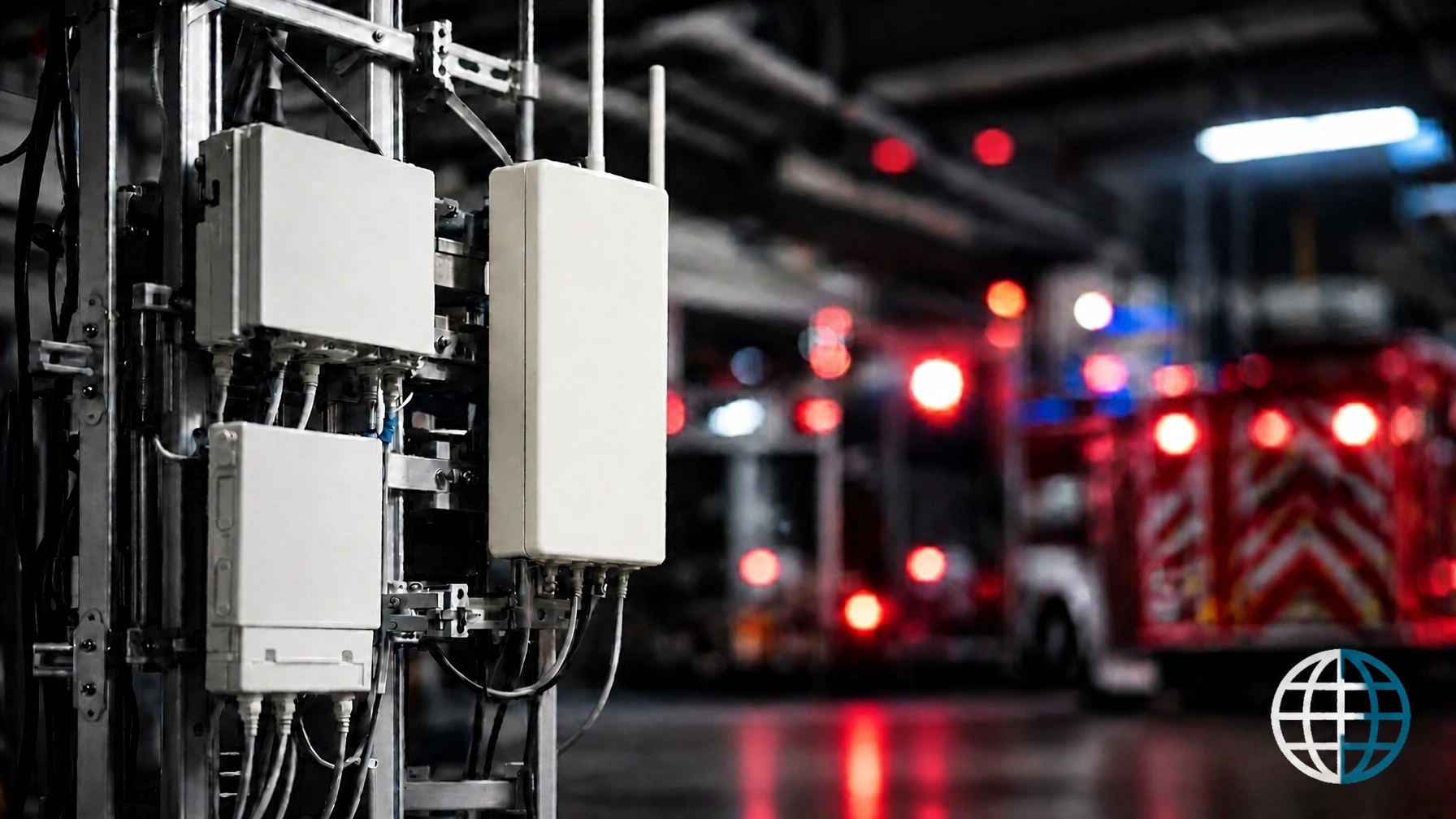
A Public Safety DAS is a complex network designed to capture a clean signal from the local public safety radio tower and distribute it throughout the interior of a structure. To ensure your system passes inspection the first time, each component must be selected and installed with precision.
1. The Donor Antenna
The donor antenna is typically mounted on the roof of the building, pointed directly at the nearest public safety radio site. Its job is to provide the "source" signal for the building. High-quality, high-gain directional antennas are essential to minimize noise and maximize signal integrity.
2. The Bi-Directional Amplifier (BDA)
The BDA is the heart of the system. It amplifies the signals coming from the donor antenna (downlink) and the signals coming from the first responders' handheld radios inside the building (uplink). Modern BDAs must be FCC-certified and often require Class A (narrowband) or Class B (wideband) designations depending on the local Authority Having Jurisdiction (AHJ).
3. The Distributed Antenna System (DAS)
The DAS is the internal network of cables (usually plenum-rated coaxial or fiber), power splitters, couplers, and indoor antennas that spread the signal to every corner of the facility, including stairwells, basements, and elevator lobbies.
4. Battery Backup Systems
Public safety systems must remain operational even when the building loses power. Codes typically require a minimum of 12 to 24 hours of battery backup capacity. This ensures that in the event of a major catastrophe or long-term power outage, communication remains uninterrupted.
Navigating the First-Pass Inspection Process
The path to first-pass approval begins long before the inspector arrives. It starts with meticulous planning and professional engineering. Many projects fail because the ERCES was treated as an afterthought rather than a core life-safety system.
The Role of the AHJ
The Authority Having Jurisdiction (AHJ): usually the local Fire Marshal: has the final say on whether your system meets local requirements. In Atlanta, the requirements can be rigorous. You must engage with the AHJ early in the design phase to confirm the specific frequencies used by local police, fire, and EMS services.
Grid Testing and Verification
The most critical part of the inspection is the RF signal testing. The building is divided into a grid (typically 20 or 40 squares per floor). An inspector will walk each grid to measure the signal strength. If even one grid fails to meet the -95 dBm threshold in a critical area, the entire system can fail the inspection.
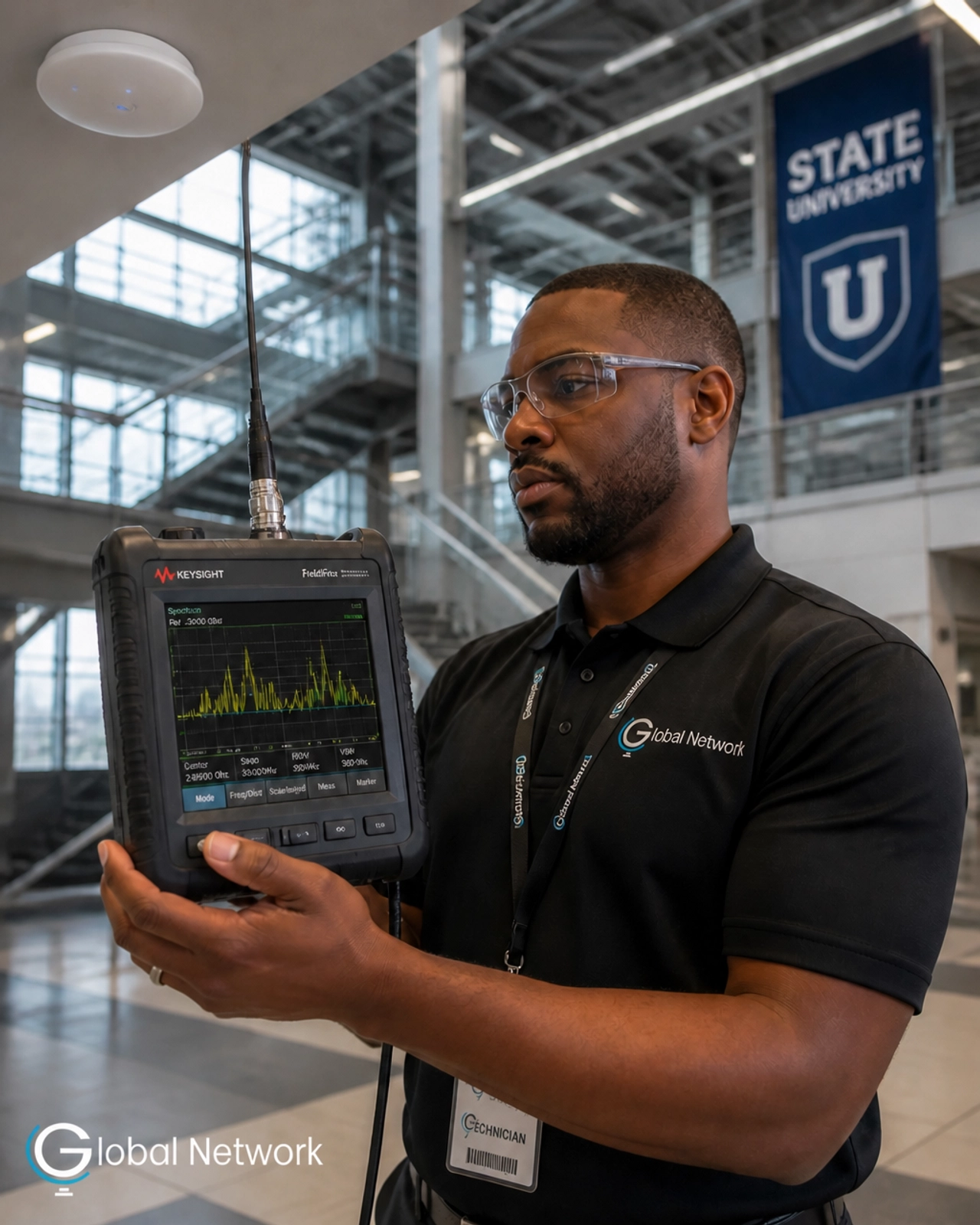
At Global Network LLC, our technicians utilize advanced tools like PCTEL scanners to provide automated, compliant documentation that is AHJ-ready. This proactive approach ensures that we identify and resolve weak spots before the official inspection, leading to peace of mind for the building owner.

Why Buildings Fail: Common Pitfalls to Avoid
Understanding why others fail can help you succeed. In our years of providing telecommunications infrastructure services, we have identified several common reasons for inspection failure:
- Improper Near-Far Effect Management: If an indoor antenna is too close to the donor antenna, or if the BDA is not balanced correctly, it can cause interference with the public safety tower itself. This is a major violation that can lead to heavy fines from the FCC.
- Lack of Survivability: Codes often require that the backbone of the DAS be protected by 2-hour fire-rated enclosures or cable. Failing to account for this during the construction phase can lead to costly retrofits.
- Inadequate Documentation: An inspector needs more than just a working system; they need "as-built" drawings, FCC certification records, and proof of annual testing. Without a complete documentation package, approval will be denied.
- Unauthorized Installers: Only FCC-certified technicians should perform the installation and commissioning of a BDA system. Using unqualified personnel is the fastest way to ensure a failed inspection and potential liability.
Global Network LLC: Your Atlanta Expertise in Public Safety Technology
Headquartered in the heart of the tech-forward Southeast, Global Network LLC is at the forefront of advancements in public safety communication. We serve as more than just a contractor; we are your strategic partner in ensuring total compliance and safety.
Our commitment to excellence is reflected in our 0% Missed Deadlines policy. We know that every day your Certificate of Occupancy is delayed is a day of lost revenue and operational disruption. Whether you are managing a high-rise in Midtown Atlanta or a sprawling industrial complex, our expert team provides the professional engineering and field expertise required to navigate the most complex AHJ requirements.
We specialize in:
- RF Site Surveys and Grid Testing
- Professional ERCES/DAS Design and Engineering
- Turnkey BDA Installation
- Annual Compliance Testing and Maintenance

The Long-Term Commitment: Annual Testing and Maintenance
First-pass approval is only the beginning. Public Safety DAS systems are subject to mandatory annual inspection and testing per IFC 510.6.1. Changes to the building’s structure, new tenant build-outs, or even changes to the external environment (like a new building being constructed next door) can affect your signal coverage.
Regular maintenance ensures that your system remains compliant and, more importantly, functional during a crisis. To maintain your standing and ensure your system is ready for its next mandatory check, you should schedule your compliance test well in advance of your permit expiration.
Secure Your Occupancy Permit with Confidence
Don't leave your building's safety and your project's timeline to chance. Achieving first-pass inspection approval requires a combination of technical mastery, deep knowledge of fire codes, and a commitment to quality that refuses to cut corners.
Global Network LLC is ready to help you navigate the complexities of Public Safety DAS. From initial design to final AHJ sign-off, we provide the reliable infrastructure your facility needs to protect lives and property.
Take the first step toward a compliant and safe building today.
For professional consultation and to learn more about our comprehensive services, visit our website or contact our team directly.
Global Network LLC
Phone: 770.520.8124
Website: https://globalnetworkco.com
Contact Us: https://globalnetworkco.com/contact
Learn More About Our Services: https://globalnetworkco.com/services