Top 5 Commercial Property Safety Trends for 2026.
As we move deeper into 2026, the landscape of commercial property management has shifted from a philosophy of reactive maintenance to one of proactive, tech-driven resilience. For property owners and facility managers, the definition of "safety" is no longer confined to functional fire extinguishers and locked doors. In the current regulatory environment: governed by increasingly stringent NFPA and IFC standards: safety is defined by connectivity, data-driven intelligence, and the seamless integration of life-safety systems.
At Global Network LLC, we are witnessing a pivotal moment where telecommunications infrastructure and public safety technology converge. The "smart building" is no longer a luxury; it is a compliance requirement. Below, we explore the top five commercial property safety trends for 2026 and how they impact your liability, compliance, and occupant security.
1. AI-Powered Threat Detection and Decision Support
Artificial Intelligence has moved beyond the "hype" phase of the early 2020s and is now a core component of commercial security architectures. In 2026, AI is being utilized to analyze vast amounts of data from network traffic, system logs, and environmental sensors to predict vulnerabilities before they are exploited.
Unlike traditional systems that rely on basic motion detection, AI-powered threat detection learns the "normal" activity patterns of your specific property. It can distinguish between a delivery driver arriving at an expected hour and a potential intruder circling the perimeter. This reduces "alarm fatigue" for security personnel by prioritizing threats based on severity and probability.
Furthermore, AI now offers Decision Support Systems (DSS) that provide real-time guidance to facility managers during emergencies. If a fire is detected, the AI can cross-reference the building’s occupancy data and suggest the safest evacuation routes via digital signage, while simultaneously ensuring that Bi-Directional Amplifiers (BDA) are functioning at peak performance to support first responder communications.

2. Live Monitoring as the Operational Standard
Passive security is a relic of the past. In 2026, the industry standard has shifted toward Live-Monitored Systems. Property owners are realizing that recorded footage is only useful for investigations after a crime has occurred; it does nothing to prevent the incident in real-time.
Modern live monitoring involves trained professionals who monitor high-fidelity video feeds enhanced by AI. This allows for immediate intervention:
- Audio Deterrence: Security professionals can issue live voice warnings to intruders, often stopping a crime before a window is even broken.
- Verified Dispatch: Law enforcement agencies prioritize calls that are "visually verified," leading to significantly faster response times.
- Reduced Liability: Continuous monitoring ensures that safety protocols are followed daily, providing a documented trail of 0% Missed Deadlines in safety checks.
For these systems to work, the underlying wireless infrastructure must be flawless. Any "dead zone" in a parking garage or stairwell can render a live-monitoring system useless. This is why Public Safety DAS (Distributed Antenna Systems) are critical; they provide the backbone for the high-bandwidth connectivity required for 2026’s security demands.
3. Unified Security Ecosystems and System Convergence
The era of fragmented, "siloed" systems: where the fire alarm, access control, and video surveillance all operate on different platforms: has officially ended. The trend for 2026 is the Unified Security Ecosystem.
This convergence allows for centralized oversight. When an access card is swiped at a restricted door, the nearest camera automatically focuses on that entrance, and the event is logged in a single management dashboard. From a compliance perspective, this makes the Authority Having Jurisdiction (AHJ) inspections much smoother.
Integration is also a matter of life safety. Under the latest NFPA 72 (2025/2026) updates, the interoperability of systems is highly scrutinized. For example, your Emergency Responder Radio Coverage System (ERRCS) must be integrated into the fire alarm control unit for real-time monitoring and fault signaling. Failure to unify these systems is one of the most common 7 mistakes you’re making with NFPA 72 compliance.

4. Smarter Perimeter Protection with Early Detection
Perimeter safety has evolved from physical fences to virtual boundaries. Using a combination of thermal imaging, LIDAR, and advanced camera analytics, properties can now detect unauthorized presence at the very edge of the property line: long before an individual reaches the building’s physical envelope.
In 2026, "Early Detection" is the priority. This involves:
- Geofencing: Triggering alerts when unauthorized devices or individuals enter a sensitive zone.
- Integrated Lighting: Smart LED systems that brighten or change color when motion is detected in a restricted area, acting as a visual deterrent.
- RF Shielding Awareness: Ensuring that external signals do not interfere with internal critical communications, maintaining a clean RF environment for both cellular and public safety frequencies.
By stopping threats at the perimeter, commercial property owners reduce the risk of internal damage and ensure the safety of employees and tenants "when it matters most."
5. Frictionless Mobile Access Control and Digital Identity
The traditional plastic keycard is becoming obsolete. In its place, Frictionless Mobile Access Control has become the preferred standard for 2026. This technology utilizes the secure elements of smartphones and wearables to grant access.
This trend is driven by both convenience and security. Mobile credentials are far more difficult to "clone" than traditional RFID cards and can be revoked instantly by an administrator. Furthermore, mobile access can be integrated with FirstNet, ensuring that first responders have immediate, digital "keys" to the building during an emergency.
Reliable connectivity is the prerequisite for mobile access. If a tenant's smartphone cannot connect to the internal network due to poor signal, they are effectively locked out. Global Network LLC specializes in ensuring that your building provides strong, uninterrupted indoor wireless coverage through Small Cell and DAS solutions, preventing the frustration of connectivity failures.

The Infrastructure Backbone: Your Safety Foundation
While these trends represent the cutting edge of safety technology, they all share a single point of failure: the network infrastructure. An AI threat detection system cannot alert anyone if the signal is dropped. A live monitor cannot see a perpetrator if the camera’s wireless link is unstable. A first responder cannot coordinate a rescue if the building lacks a code-compliant BDA system.
At Global Network LLC, our mission is to ensure that your property is not just "up to code" but is truly future-proof. We operate with a commitment to 0% Defects in our installations, focusing on:
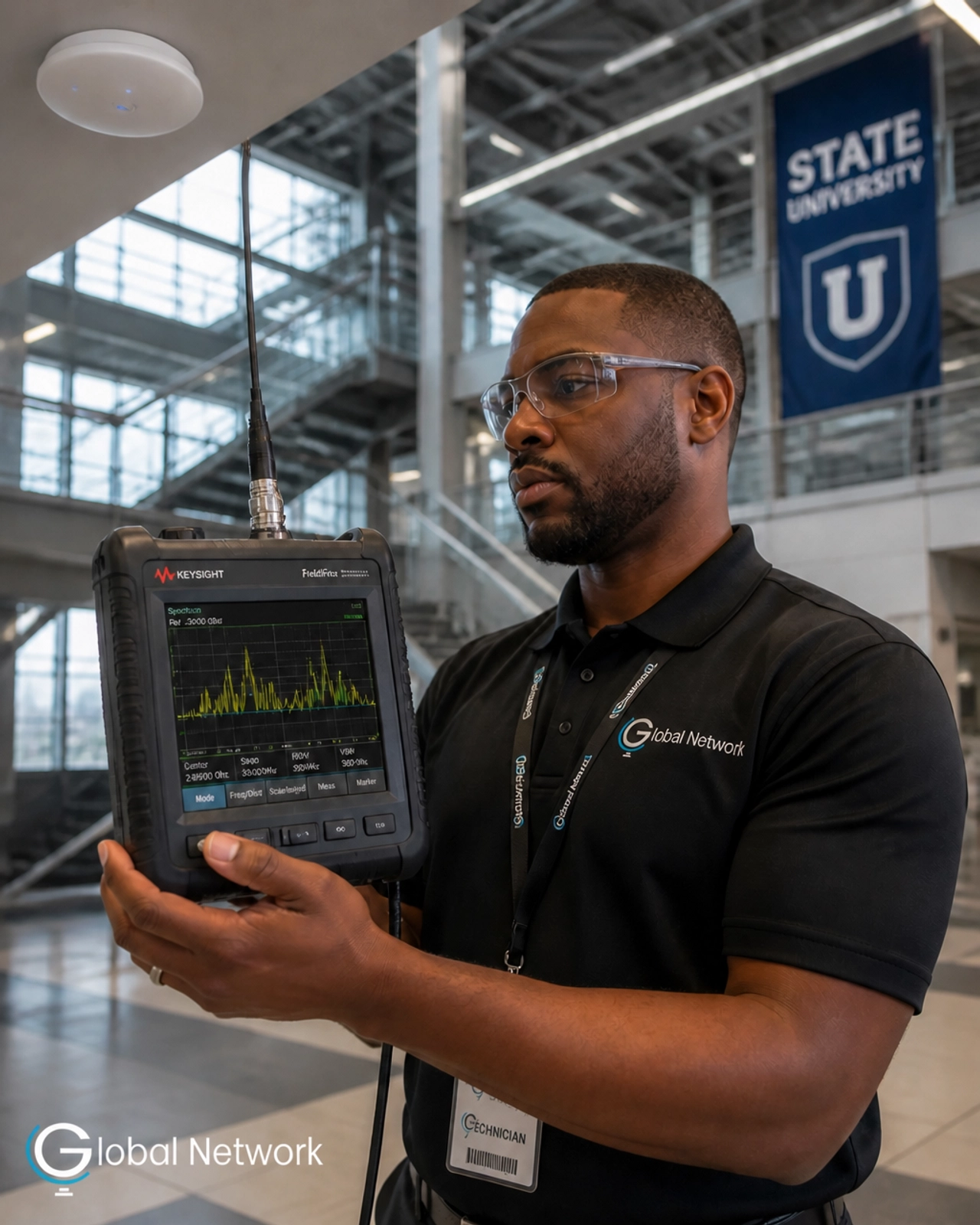
- Public Safety DAS/BDA: Ensuring 99% coverage in critical areas as required by IFC 510.
- Annual Testing & Maintenance: Providing the peace of mind that comes from knowing your systems will work in the moment of truth.
- Strategic RF Design: Using advanced grid testing to identify and eliminate weak signal zones.
As a leader in telecommunications infrastructure, we prioritize education and workforce development to stay at the forefront of these 2026 advancements. Whether you are managing a high-rise office in downtown Atlanta or a sprawling university campus, the safety of your occupants depends on the reliability of your wireless systems.

Take Action Today
Don't wait for an inspection failure or an emergency to realize your building’s safety systems are lagging. The trends of 2026 require a proactive partner who understands the intersection of technology and regulation.
Ensure your property is compliant and secure. Contact Global Network LLC today to schedule a comprehensive signal strength test or to discuss your 2026 technology roadmap.
Global Network LLC
At the forefront of Public Safety Technology.
Phone: 770.520.8124
Website: https://globalnetworkco.com
Contact Us: https://globalnetworkco.com/contact
Ensure your public safety DAS system is compliant – Schedule a test today