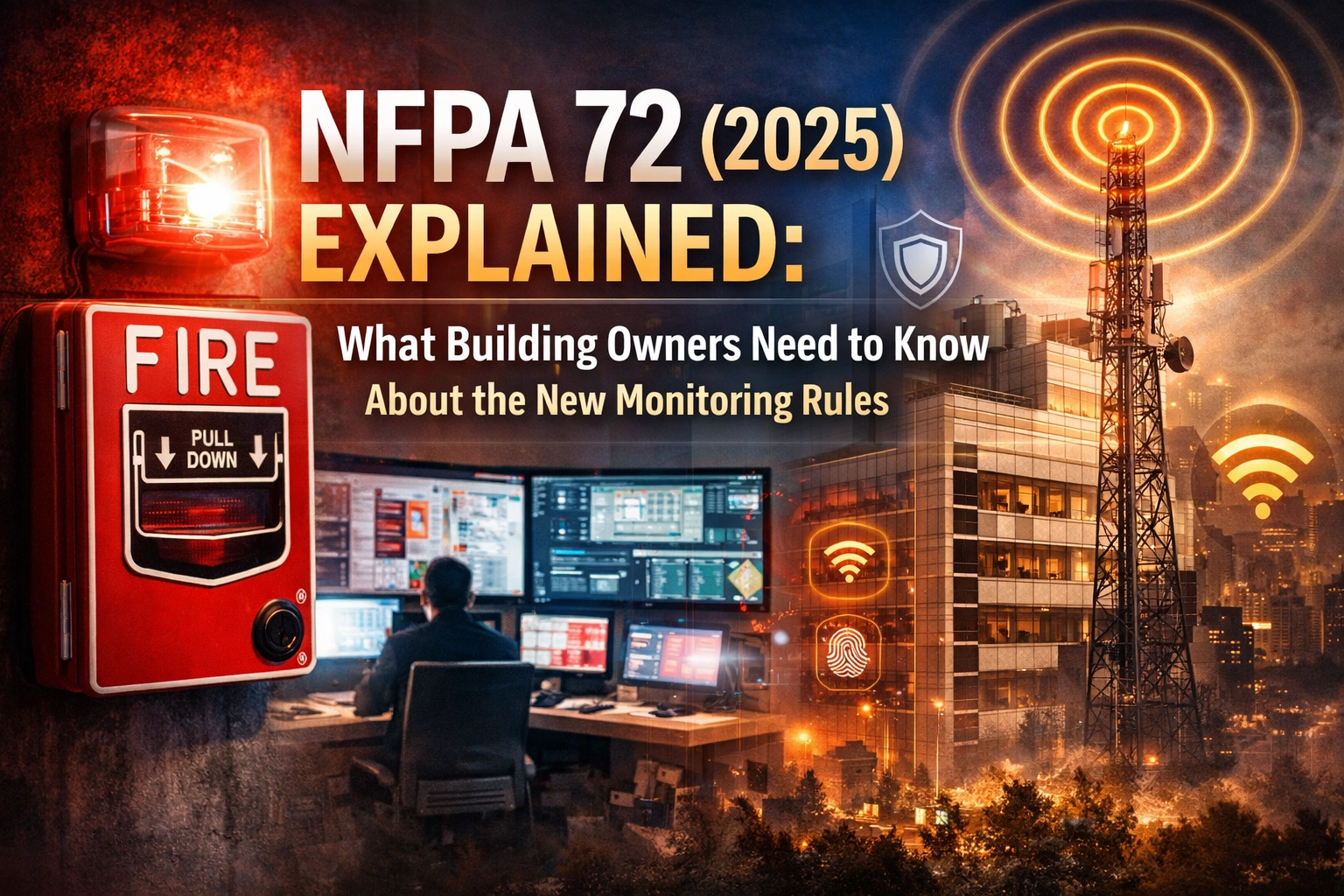
NFPA 72 (2025) Explained: What Building Owners Need to Know About the New Monitoring Rules
For building owners, property managers, and facility directors, the regulatory landscape regarding life safety is shifting. The release of the NFPA 72 (2025 edition): National Fire Alarm and Signaling Code introduces significant changes that transform how life safety systems: specifically Emergency Responder Communication Enhancement Systems (ERCES) and Public Safety DAS: are monitored, maintained, and secured.
In the past, ensuring that first responders could communicate inside your building was often treated as a secondary concern to fire suppression. Today, it is a primary mandate. Under the 2025 code, "passive compliance" is no longer acceptable. The new standards demand active, continuous oversight to ensure that when a crisis occurs, the communication infrastructure is fully operational.
The Shift to Integrated ERCES Monitoring
The most pivotal change in the NFPA 72 (2025) update is the formalization of monitoring requirements for Emergency Responder Communication Enhancement Systems (ERCES). These systems, often comprising Bi-Directional Amplifiers (BDA) and a network of antennas, are now required to be more tightly integrated with the building’s Fire Alarm Control Unit (FACU).
Under the new rules, the fire alarm system must monitor all supervisory signals related to the ERCES. This ensures that any malfunction: whether it is a loss of power, a component failure, or an antenna malfunction: is immediately reported to the central monitoring station.
Key monitoring points now include:
- System Health: Continuous tracking of the BDA status.
- Power Integrity: Monitoring of both primary AC power and secondary battery backup systems.
- Antenna Malfunctions: Supervision of the donor antenna and the distributed antenna system (DAS) lines.
- Communication Pathways: Ensuring the link between the ERCES and the fire alarm panel remains intact.
For building owners, this means that your Public Safety DAS can no longer exist as a standalone "island." It must be a supervised component of your overall life safety ecosystem. To ensure your property meets these integrated standards, you may need to schedule a compliance test to verify that your current hardware supports these advanced signaling requirements.

Cybersecurity: Protecting the Life Safety Network
As telecommunications infrastructure becomes increasingly networked, the risk of external interference or cyberattacks grows. The NFPA 72 (2025) edition addresses this head-on with new Cybersecurity and Remote Access Monitoring mandates.
If your facility utilizes remote access to manage or monitor the fire alarm panel or the Public Safety DAS, the following rules now apply:
- Manual Disconnects: There must be a physical, manual means to shut off remote connections at any time, ensuring that on-site personnel retain ultimate control.
- Inactivity Timeouts: The system must automatically disconnect any remote user who remains inactive for more than one hour.
- On-Site Supervision: Any remote software updates or system adjustments require a qualified person to be physically present on-site.
- Credential Management: Building owners must establish strict access management procedures, including the immediate removal of credentials for former employees or contractors.
These requirements reflect a move toward Zero-Trust architecture within life safety systems. At Global Network LLC, we understand that security and safety are inseparable. We prioritize 0% Defects in our network deployments to ensure that your building remains a fortress against both physical and digital threats.
Enhanced Survivability and Monitoring Pathways
When an emergency occurs, the infrastructure supporting first responder communications must remain functional under extreme conditions. The 2025 code introduces stricter standards for communication pathway survivability.
One of the most notable updates concerns Auxiliary Service Providers (ASPs) and cloud-based signal monitoring. If your building uses a cloud-based service for signal retransmission, that provider must now:
- Continuously supervise communication pathways.
- Retransmit signals without delay to the proper authorities.
- Notify stakeholders of any operational changes within 30 days.
- Maintain comprehensive signal records for a minimum of one year.
Furthermore, Proprietary Supervising Stations now have increased requirements for emergency lighting, which must provide at least 26 hours of illumination during a power failure. This ensures that the personnel responsible for monitoring your building’s safety are not left in the dark during a prolonged utility outage.

Battery Maintenance: From Age to Performance
A critical component of any Public Safety DAS or BDA system is the secondary power supply. In previous iterations of the code, maintenance was often dictated by the simple manufacture date of the batteries. NFPA 72 (2025) shifts the focus to actual performance and shelf life.
During annual inspections, monitoring procedures must now confirm that batteries retain at least 60% of their shelf life, calculated from the "best-by" date. Additionally, all rechargeable batteries used as secondary power must be UL-listed as of January 1, 2024.
This change places a higher burden of proof on building owners. It is no longer enough to show that a battery is "new"; you must prove it is capable of sustaining the system during an emergency. This level of rigorous documentation is a core part of the services we provide, ensuring that your system is always "at the forefront of advancements" and ready for a fire marshal inspection.
Documentation and Personnel Management
The 2025 code emphasizes that compliance is as much about management as it is about hardware. Building owners are now required to maintain detailed maintenance plans tailored specifically to network-connected equipment.
These plans must include:
- A comprehensive log of all personnel with access to the system.
- Procedures for the prompt removal of access credentials during staff transitions.
- Records of all software updates and whether they were performed locally or remotely.
- Full testing results following any software changes.
This "legalistic" approach to documentation ensures accountability. Should an incident occur, the building owner must be able to produce a clear audit trail showing that the system was monitored, maintained, and secured by qualified professionals.

Why Compliance Cannot Be Delayed
Adhering to the NFPA 72 (2025) standards is not merely a matter of avoiding fines; it is a matter of life and death. First responders rely on two-way radio coverage to coordinate rescues and call for help. If your building’s ERCES fails due to a lack of monitoring or a cybersecurity breach, the liability falls squarely on the building owner.
The complexity of these new rules: ranging from thermal imaging supervisory signals to ASP communication retransmission: requires a partner who understands the intersection of telecommunications and public safety.
Global Network LLC specializes in the design, installation, and monitoring of code-compliant Public Safety DAS and BDA systems. We take the technical burden off your shoulders, providing "peace of mind" through:
- 24/7 Monitoring Solutions: Ensuring your system health is tracked in real-time.
- Regulatory Expertise: Staying ahead of NFPA and IFC code changes so you don't have to.
- Rigorous Testing: Validating that your system meets the 60% battery shelf-life and signal strength requirements.
At the Forefront of Public Safety Technology
As a leader in telecommunications infrastructure, Global Network LLC is committed to excellence. We understand the high stakes involved in life safety technology. Whether you are managing a high-rise in the city or a sprawling university campus, our mission is to provide reliable, uninterrupted communication for those who protect us.
Don't wait for a Fire Marshal's notice or an emergency to find out your system is non-compliant. The transition to the 2025 standards requires a proactive approach to monitoring and cybersecurity.
Contact Global Network LLC Today
Ensure your building is ready when it matters most. Contact our team of specialists to review your current monitoring setup and bring your facility up to the latest NFPA 72 (2025) standards.
Global Network LLC
Phone: (404) 590-5884
Website: https://globalnetworkco.com
Consultation: Contact Us

By choosing Global Network LLC, you are choosing a partner dedicated to 0% Missed Deadlines and a relentless pursuit of safety through innovation. Let us help you navigate the complexities of the new monitoring rules and ensure your building is a beacon of safety and compliance.