Why Your New Building Has Radio “Dead Zones” (And How a BDA System Fixes It)
In the modern era of commercial real estate and urban development, we often prioritize aesthetics, energy efficiency, and structural resilience.
We build with high-grade concrete, reinforced steel, and specialized energy-efficient glass to meet LEED standards and ensure longevity. However, these same materials: designed to protect your occupants and reduce your carbon footprint: create an unintended and dangerous consequence: Radio Frequency (RF) Dead Zones.
For a building owner or developer, a "dead zone" is more than just a cellular inconvenience; it is a critical life-safety liability. When first responders: firefighters, police officers, and emergency medical services: enter your facility during a crisis, their handheld radios must work. If the structural integrity of your building prevents their signals from reaching the public safety radio network, the results can be catastrophic.
At Global Network LLC, we specialize in bridging this gap. By deploying advanced Bi-Directional Amplifier (BDA) systems and Distributed Antenna Systems (DAS), we ensure your facility remains a safe environment where communication is guaranteed when it matters most.
The Science of Silence: Why Signals Fail to Penetrate Modern Buildings
Radio waves are a form of electromagnetic radiation. Like light, they can be reflected, absorbed, or refracted depending on the medium they encounter. In an open field, signals travel with minimal interference. In a modern metropolitan environment, however, they face a gauntlet of architectural obstacles.
The Concrete and Rebar Shield
Concrete is one of the most effective materials for blocking RF signals. While the density of the concrete itself provides significant attenuation, the real culprit is often the rebar (reinforcing steel) embedded within it. This lattice of metal creates what is known as a Faraday Cage: an enclosure used to block electromagnetic fields. In many new constructions, the density of the rebar effectively mirrors the wavelength of public safety radio frequencies, reflecting them away from the building’s interior.
The Low-E Glass Paradox
To meet modern energy codes and provide "green" building solutions, developers utilize Low-Emissivity (Low-E) glass. This glass is treated with a microscopic, transparent layer of metallic oxide. While this technology is excellent for reflecting infrared heat and keeping cooling costs down, it is equally effective at reflecting radio signals. A building wrapped in Low-E glass is essentially a metallic box, impervious to the external radio towers that first responders rely on.

Mechanical and Electrical Interference
Beyond the shell of the building, the internal infrastructure contributes to the "dead zone" effect. Large HVAC ductwork, elevator shafts, and electrical rooms generate significant electromagnetic interference. These systems can distort signals or create localized shadows where communication is impossible.
The Life-Safety Mandate: Public Safety vs. Cellular Connectivity
It is vital to distinguish between Cellular DAS and Public Safety DAS. While occupants may complain about dropped calls in the lobby, the primary concern for code compliance and building occupancy is the Emergency Responder Communication Enhancement System (ERCES).
When a fire department arrives at a high-rise or a sprawling warehouse, they operate on specific frequency bands: typically in the 700 MHz, 800 MHz, or UHF/VHF ranges. If a captain on the 20th floor cannot communicate with the incident commander on the ground, the entire operation is compromised.
Ensuring these signals remain active is not just a best practice; it is a legal requirement governed by strict regulatory bodies. You can learn more about our commitment to these standards at Global Network LLC.
Navigating the Regulatory Landscape: IFC 510 and NFPA 1221
To address the growing issue of radio dead zones in new construction, the International Code Council (ICC) and the National Fire Protection Association (NFPA) established rigorous standards. Failure to meet these standards will result in the denial of a Certificate of Occupancy (CO), leading to costly project delays.
IFC Section 510
The International Fire Code (IFC) Section 510 is the primary regulation governing emergency responder communication. It mandates that all new buildings must have a minimum level of radio coverage. If the building's design naturally inhibits this coverage, a BDA system must be installed. Key requirements include:
- 99% Coverage in critical areas such as fire command centers, elevator lobbies, and exit stairs.
- 90% Coverage in general building areas.
- Battery Backup capable of powering the system for 24 hours in the event of a power failure.
NFPA 1221 / NFPA 1225
The NFPA 1221 (now integrated into NFPA 1225) provides the technical roadmap for the installation, maintenance, and use of emergency services communications systems. It requires specialized equipment that is NEMA 4 or 4X rated to withstand water and dust, ensuring the system remains operational during a fire suppression event.
To ensure your facility meets these rigorous demands, you should schedule a compliance test with qualified professionals.

The Solution: How a BDA System Fixes the Problem
A Bi-Directional Amplifier (BDA) system is a signal-boosting solution specifically engineered to overcome the physical barriers of modern construction. Unlike a simple cell booster, a public safety BDA is a sophisticated piece of telecommunications infrastructure.
How the System Operates:
- The Donor Antenna: A high-gain antenna is placed on the roof of the building, pointed directly at the nearest public safety radio tower.
- The BDA Unit: The signal is pulled from the roof and sent to the BDA unit via a heavy-duty coaxial cable. The BDA amplifies the signal to a level that can penetrate the building's interior.
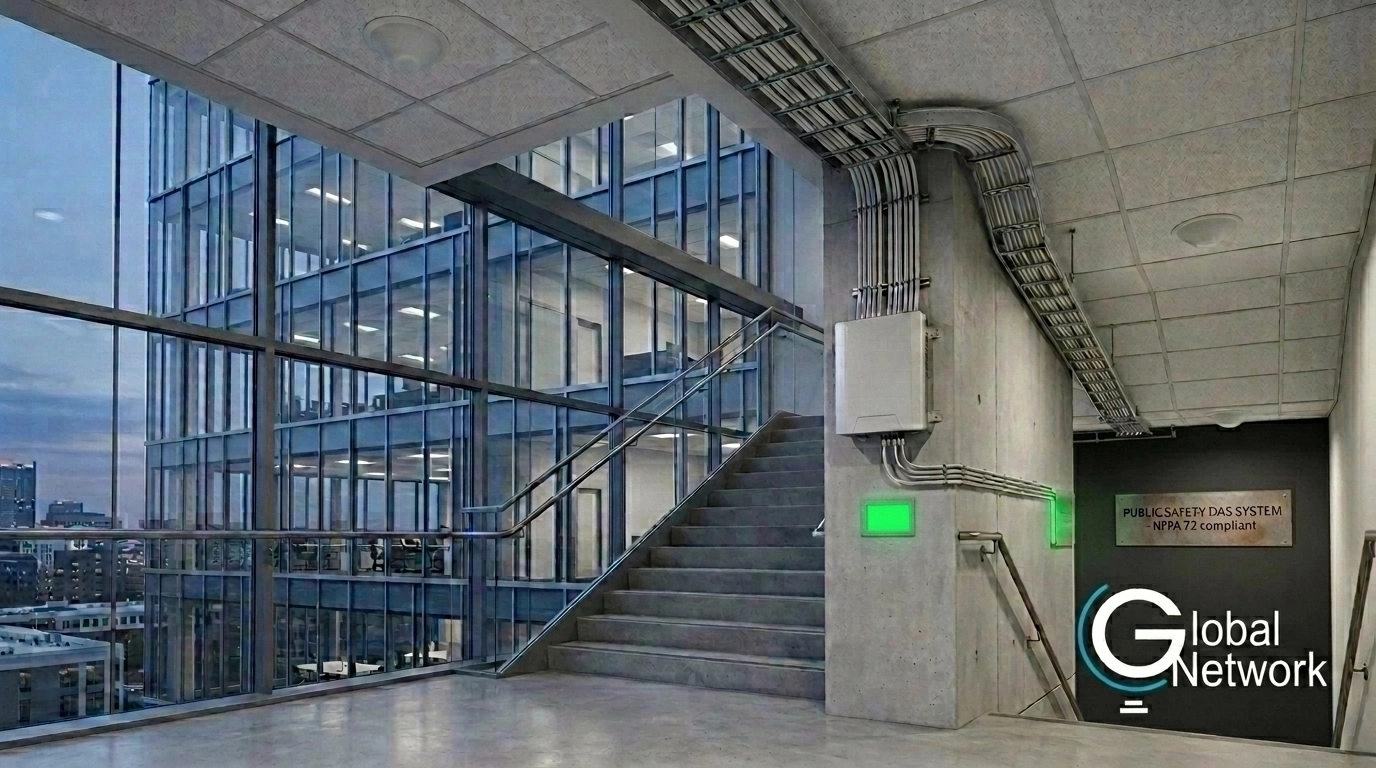
- The Distributed Antenna System (DAS): The amplified signal is then distributed throughout the building via a network of smaller internal antennas placed strategically in ceilings and stairwells.
- The Uplink: When a first responder keys their radio inside the building, the process works in reverse, sending their signal back to the roof and out to the emergency dispatch center.
By creating this internal network, we effectively bypass the concrete and Low-E glass that cause dead zones, providing a clear path for life-saving communication. For more details on our technical approach, visit our services page.
Professional Installation: The Global Network LLC Standard
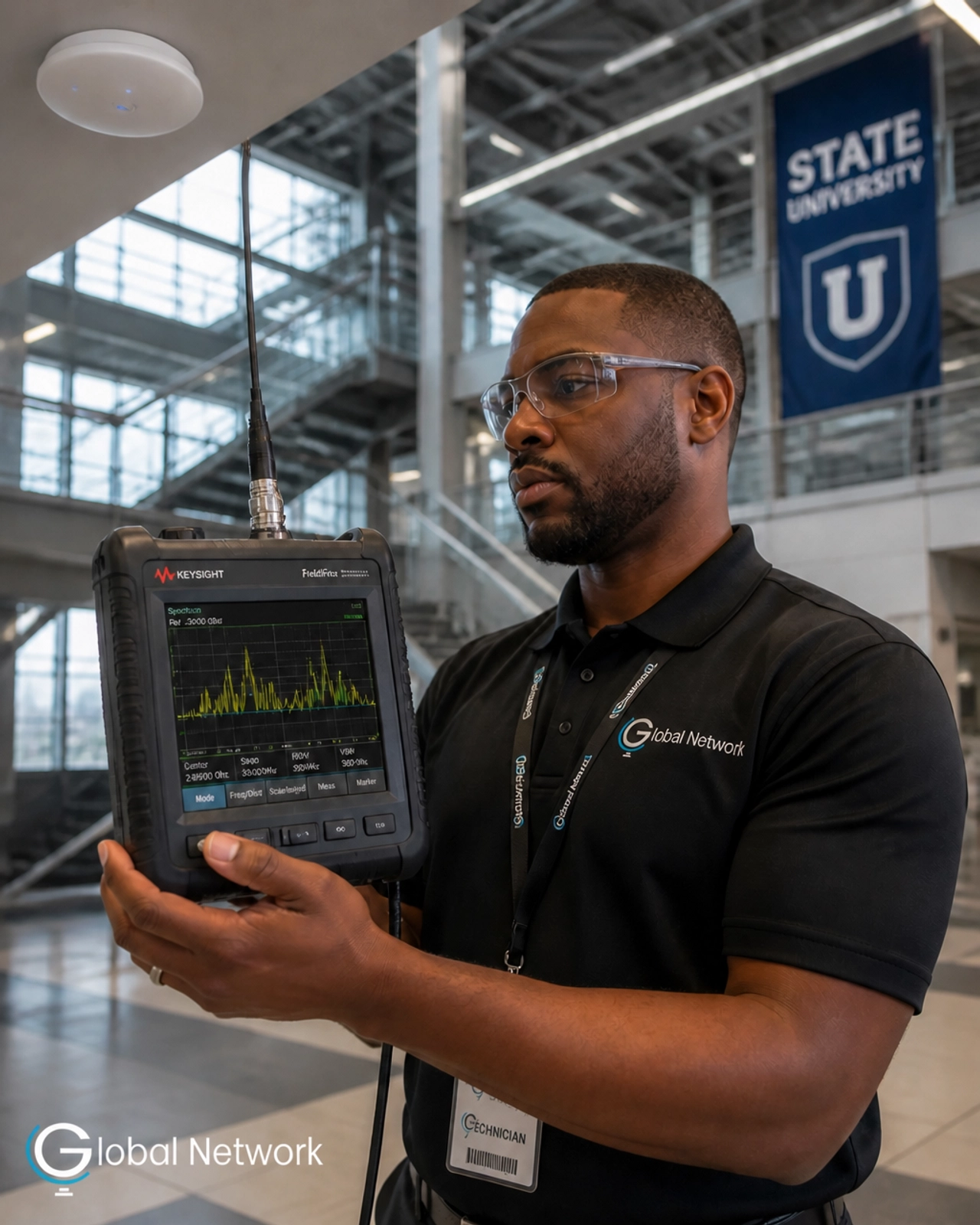
Implementing a BDA system is not a "plug-and-play" task. It requires meticulous engineering, RF site surveys, and close coordination with the local Authority Having Jurisdiction (AHJ), usually the Fire Marshal.
At Global Network LLC, we operate at the forefront of telecommunications advancements. We provide a comprehensive, turnkey solution that guarantees:
- 0% Defects: Our engineering team performs precise grid testing to ensure every square inch of your facility meets or exceeds code.
- 0% Missed Deadlines: We understand that your Certificate of Occupancy depends on our success. We work seamlessly with your construction timeline.
- Full Compliance: We handle the complex permitting and certification processes required by IFC 510 and NFPA standards.
Our technicians are not just installers; they are specialists in telecommunications infrastructure. We take pride in our role in community safety, ensuring that your building is a secure asset for both the owners and the public.

Why You Must Act Now
Waiting until the end of a construction project to address radio coverage is a high-stakes gamble. Retrofitting a BDA system after the ceilings are closed and the finishes are applied is significantly more expensive and intrusive than integrating it during the construction phase.
Furthermore, as cellular carriers phase out older frequencies, the demand for robust cellular DAS solutions is also rising. Occupants today expect seamless connectivity for productivity, while the law demands it for safety.
Key Benefits of a Global Network BDA Installation:
- Mitigation of Liability: Protect yourself from legal repercussions following an emergency.
- Guaranteed Occupancy: Avoid the frustration of a failed fire inspection.
- Enhanced Property Value: A fully connected building is a more attractive asset for high-tier tenants.
- Peace of Mind: Knowing that first responders can communicate inside your walls is an invaluable assurance.
Conclusion
Radio dead zones are a natural byproduct of our desire for stronger, more efficient buildings. However, they do not have to be a permanent feature of your architecture. Through the strategic application of BDA and DAS technology, Global Network LLC ensures that your facility remains at the cutting edge of both technology and safety.
We are committed to workforce development, diversity, and excellence in every project we undertake. Whether you are managing a new development or upgrading an existing facility, our team is ready to provide the expertise you need.
When it matters most, ensure your building speaks back.
Contact Global Network LLC Today
For a consultation on your ERCES/BDA requirements or to schedule an RF site survey, reach out to our team of specialists.
Phone: 770.520.8124
Email: info@globalnetworkco.com
Website: globalnetworkco.com/contact
About Us: Learn more about our mission
Global Network LLC: Reliability at the Forefront of Public Safety Technology.