Small Cell vs. DAS: Which Does Your Building Actually Need?
Let’s be honest: in 2026, a building without a strong wireless signal is just an expensive pile of concrete and steel. Whether it’s your tenants complaining that they can’t get a 5G signal in the elevator or: more importantly: a Fire Marshal telling you that your building fails to meet emergency communication codes, signal dead zones are a massive liability.
When you start looking for a fix, two terms keep popping up: Small Cells and DAS (Distributed Antenna Systems).
At Global Network LLC, we see property owners in Atlanta and across the country get paralyzed by this choice. Should you go for the quick-fix small cell or the heavy-duty infrastructure of a DAS? The answer depends on your building’s size, your budget, and whether you are trying to solve a "my phone doesn't work" problem or a "the police radio doesn't work" problem.
Let’s break down the technical differences simply so you can make an informed decision for your property.
What is a Small Cell? (The Targeted Fix)
Think of a small cell as a mini-cell tower. It’s a low-powered wireless access point that covers a specific, relatively small area. Because they are compact, they are often mounted on walls or ceilings, looking a lot like a Wi-Fi router.
Small cells are excellent for filling "holes" in coverage. If you have a specific corner of a warehouse or a single floor of an office building where the signal drops off, a small cell might be the easiest way to bridge that gap.
The Limitations of Small Cells
While they are simpler to install, they come with a few major "catches":
- Single Carrier Support: Most small cells only support one carrier (e.g., just Verizon or just AT&T). If your tenants or employees use a mix of different providers, you might need to install multiple small cells for every single carrier.
- Lower Capacity: A single small cell can typically handle about 25 to 50 concurrent users. In a crowded lobby or a stadium, that capacity is gone in seconds.
- Backhaul Requirements: Each small cell requires its own individual internet connection (backhaul) to the carrier’s network. If you are installing 20 small cells, that is 20 separate lines you have to manage.
What is a DAS? (The Industrial-Strength Solution)
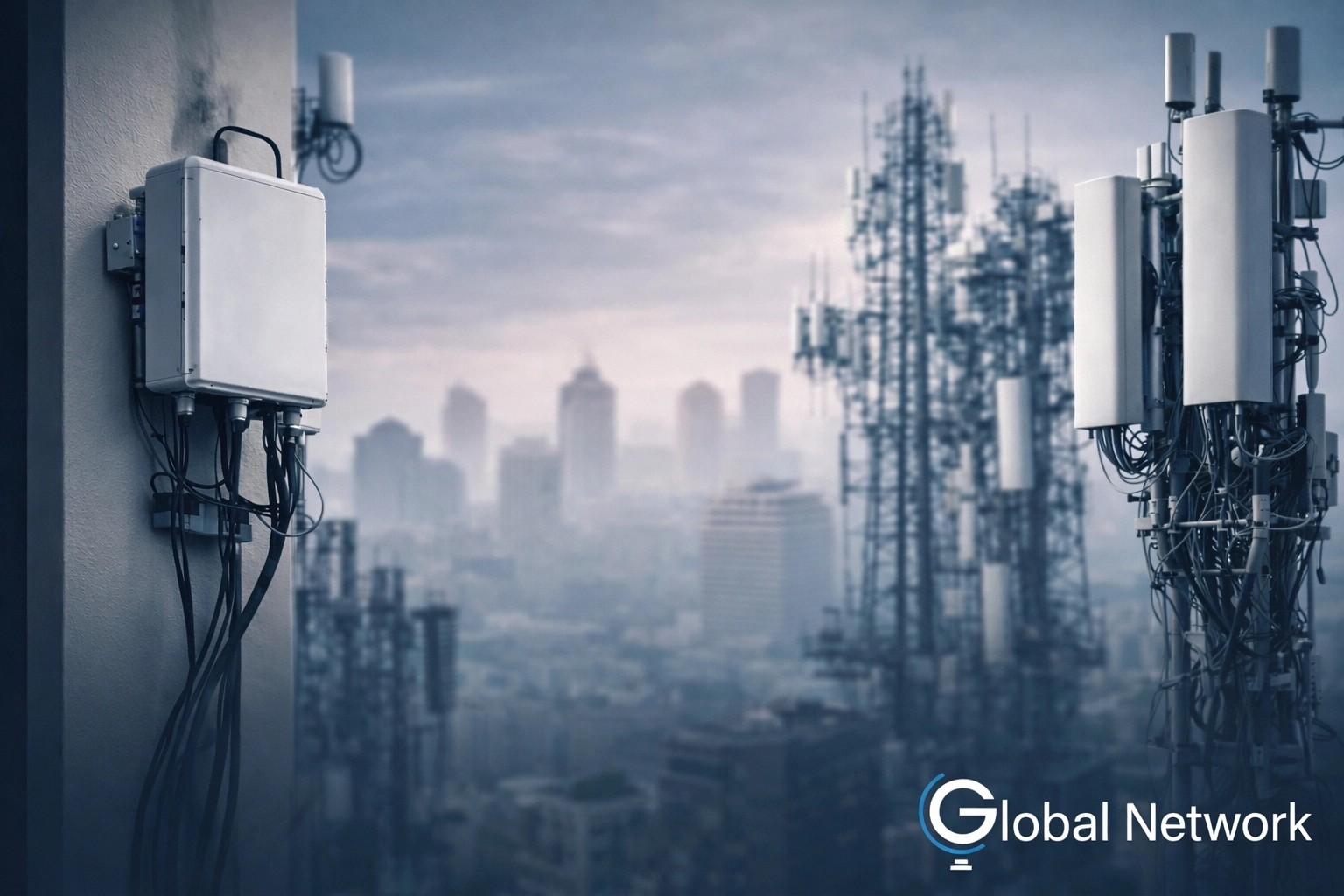
A Distributed Antenna System (DAS) is a network of spatially separated antenna nodes connected to a common source via a transport medium (usually fiber optics or coaxial cable). Unlike a small cell, which is a standalone unit, a DAS is a comprehensive system designed to provide uniform coverage throughout a massive facility.
At Global Network LLC, we often recommend DAS for high-density environments like hospitals, university campuses, and high-rise commercial towers.
Why DAS is Often the Better Choice
- Carrier Agnostic (Neutral Host): A properly designed DAS can support every major carrier simultaneously. You don't need a different system for T-Mobile and AT&T; one system handles them all.
- High Capacity: A DAS can handle thousands of users at once. This is why you see them in places like Mercedes-Benz Stadium here in Atlanta.
- Future-Proofing: DAS systems are designed to scale. As 5G evolves into whatever comes next, a well-built DAS can often be upgraded with minimal disruption to the building’s physical infrastructure.
The Public Safety Factor: ERCES and BDAs
This is where the conversation moves from "convenience" to "compliance." In Georgia and across the U.S., buildings are required to meet strict Emergency Radio Communication Enhancement Systems (ERCES) standards.
If a first responder enters your building and their two-way radio stops working because of your thick concrete walls or Low-E glass, you are in violation of IFC 510 and NFPA 1221/1225 codes. To fix this, you don't use a standard commercial small cell. You need a Public Safety DAS, often powered by a Bi-Directional Amplifier (BDA).
Why You Can’t Use Small Cells for Public Safety
Public safety frequencies (usually 700/800 MHz) are different from commercial cellular frequencies. Fire departments and police require 99% coverage in "critical areas" like stairwells, elevator lobbies, and fire pump rooms. A small cell is simply not built to handle the rugged, high-reliability requirements of life-safety communications.
Global Network LLC specializes in designing and installing these Public Safety DAS systems to ensure you pass your inspections and keep your occupants safe.
Small Cell vs. DAS: A Head-to-Head Comparison
| Feature | Small Cell | Distributed Antenna System (DAS) |
|---|---|---|
| Coverage Area | Small/Targeted (Under 50,000 sq ft) | Large/Comprehensive (Over 100,000 sq ft) |
| User Capacity | Low (~25-50 users per node) | Very High (Thousands of users) |
| Carrier Support | Usually Single Carrier | Multi-Carrier (Neutral Host) |
| Installation Time | Fast (Days/Weeks) | Longer (Weeks/Months) |
| Scalability | Limited | High |
| Public Safety | Not Recommended | Required for Compliance |
How to Choose: Questions for Building Owners
If you are trying to decide which path to take, ask yourself these three questions:
1. How big is the space?
If you’re managing a 15,000-square-foot boutique office, a few small cells might do the trick. If you’re looking at a 500,000-square-foot mixed-use development, a DAS is the only way to ensure reliable connectivity across the entire footprint.
2. Who are the users?
Is this for your internal staff who all use company-issued iPhones on one network? Or is it for a public mall where thousands of people bring their own devices on dozens of different carriers? If you need to support everyone, you need a DAS.
3. Are you facing a CO (Certificate of Occupancy) delay?
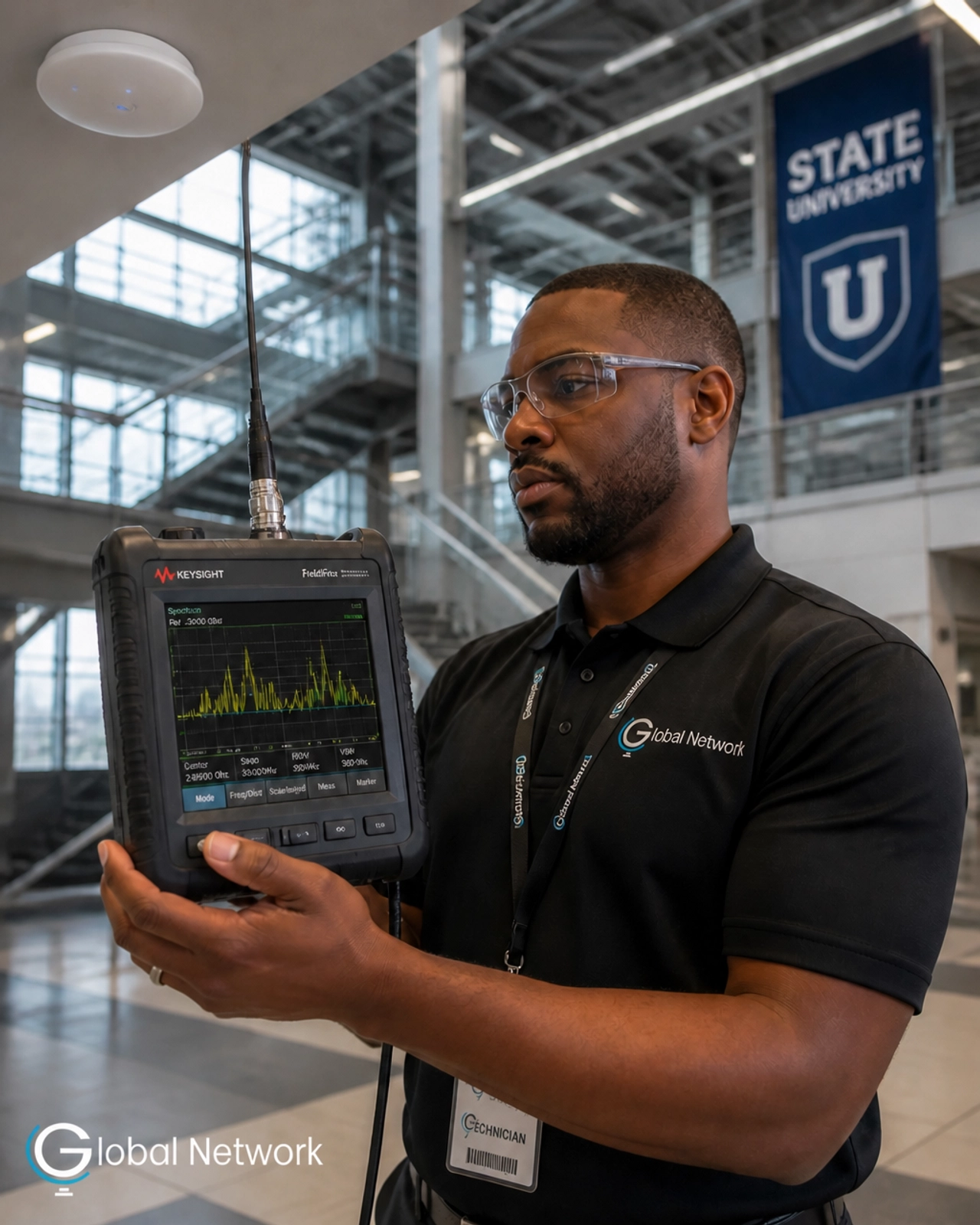
If the Fire Marshal has flagged your building for poor radio coverage, you don't have a choice. You need a code-compliant ERCES solution. Our team at Global Network LLC can perform a grid test to determine exactly where your signal fails and design a system that guarantees a pass.
Why Local Expertise Matters in Atlanta
Navigating the world of RF (Radio Frequency) is complicated. It's not just about buying hardware; it's about engineering a solution that doesn't interfere with the outdoor macro network while providing a "0% Defect" experience indoors.
In Atlanta, building codes are strictly enforced. Working with a local partner like Global Network LLC means you are getting a team that understands the specific requirements of Georgia’s AHJs (Authorities Having Jurisdiction). We don't just install equipment; we provide peace of mind through:
- Comprehensive site surveys and signal testing.
- Precision engineering and design.
- Ongoing annual testing and maintenance to ensure your system never fails when it matters most.
The Bottom Line
Small cells have their place for quick, single-carrier fixes in small footprints. But for serious commercial properties that demand high capacity, multi-carrier support, and strict code compliance, a Distributed Antenna System (DAS) is the gold standard.
Don't let a signal failure stop your business or delay your building's opening. Whether you need a commercial cellular boost or a life-saving public safety system, we have the expertise to get it done right the first time.
Ready to fix your signal problems?
Contact Global Network LLC today for a consultation. We’ll help you navigate the technical jargon and find the solution that actually fits your building’s needs.
Global Network LLC
Phone: 770.520.8124
Website: globalnetworkco.com/contact
Email: [Insert Email Here]