Identification of Weak Signal Zones: The Power of Professional Grid Testing
In the critical moments of an emergency, communication is the single most important factor for life safety. For building owners and facility managers, ensuring that first responders: police, fire, and EMS: can maintain constant, clear radio contact within your structure is not just a logistical preference; it is a legal mandate. Global Network LLC stands at the forefront of this mission, providing the technical precision required to navigate the complexities of ERCES testing and certification.
The identification of weak signal zones is the cornerstone of public safety compliance. Without a rigorous, data-driven approach to mapping indoor radio frequency (RF) environments, your building remains a liability. Professional grid testing is the industry-standard method used to verify that your facility meets the stringent requirements of IFC 510 and NFPA 1225 (formerly NFPA 72 and 1221).
The Necessity of Precision: Why Grid Testing Matters
Modern building materials: such as low-E glass, reinforced concrete, and thick steel framing: are excellent for energy efficiency and structural integrity, but they are devastating to radio signals. These materials create "Faraday Cage" effects, resulting in "dead zones" where two-way radios fail. In an emergency, a dead zone in a stairwell or a basement can lead to catastrophic communication failures.
Professional grid testing provides the empirical evidence needed to identify these vulnerabilities. By systematically dividing a floor plan into a series of equal "cells" or "grids," technicians can measure signal strength with surgical accuracy. This process ensures that your building achieves the 99% coverage requirement in critical areas (like fire pump rooms, exit stairs, and elevator lobbies) and the 90% to 95% coverage requirement in general areas, as dictated by local AHJ (Authority Having Jurisdiction) standards.

The Global Network LLC Testing Methodology
At Global Network LLC, our approach to ERCES testing and certification is rooted in technical excellence and a commitment to 0% Defects. We utilize a sophisticated multi-step process to map your building’s RF landscape.
1. Grid Plan Generation
Before our technicians even step foot on-site, a virtual grid map is developed. For most commercial structures, the floor plan is divided into a grid of 20 to 40 squares per floor. The size of these squares depends on the total square footage and the specific requirements of the local fire code. This ensures a comprehensive analysis that leaves no corner unexamined.
2. Physical Signal Acquisition
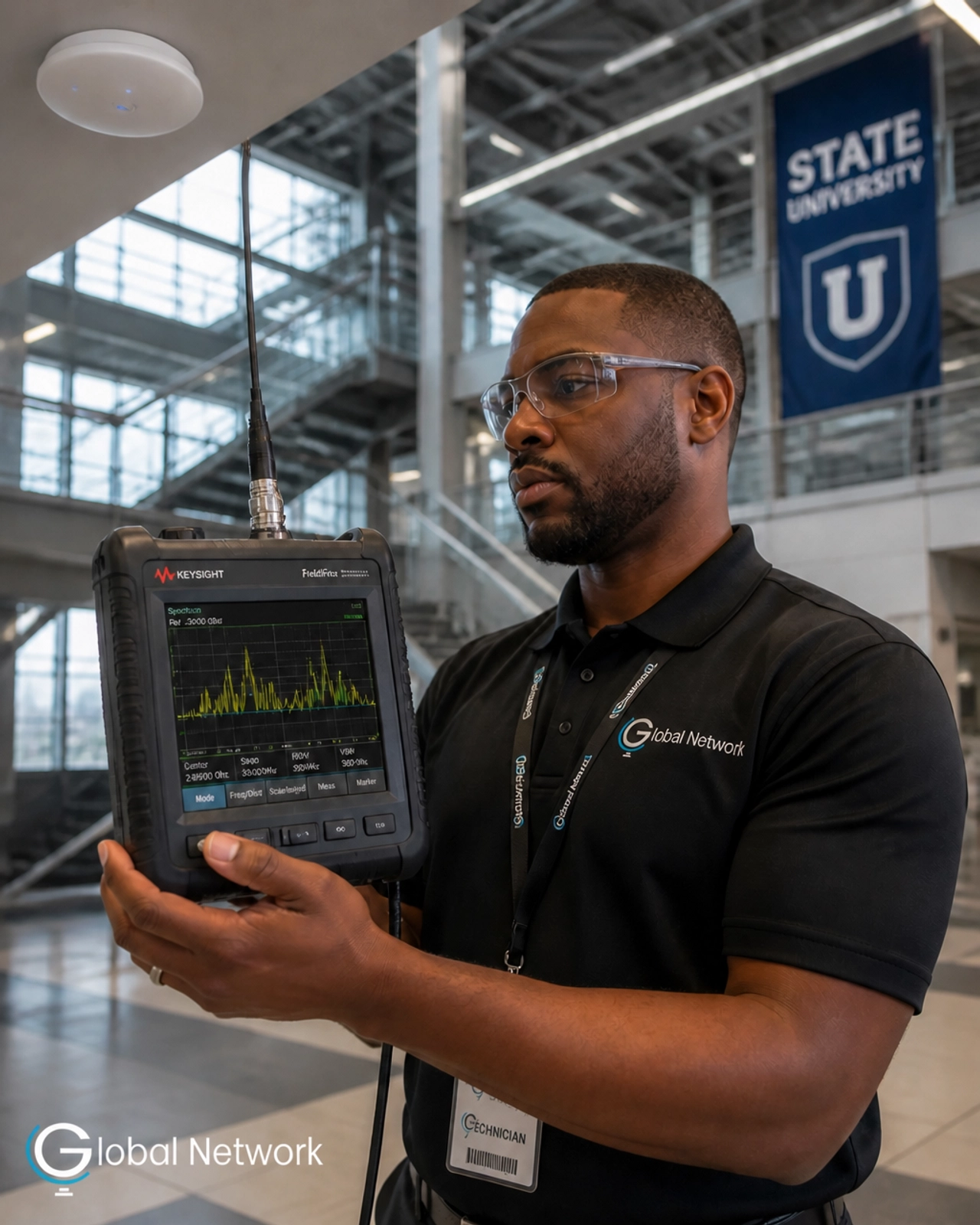
Equipped with calibrated spectrum analyzers and high-accuracy signal meters, our specialists traverse every grid square. We don’t just look for "bars" on a radio; we measure the actual RSSI (Received Signal Strength Indicator). To pass, the signal must typically maintain a minimum threshold of -95 dBm for both the uplink (from the radio to the tower) and the downlink (from the tower to the radio).
3. Advanced Technical Metrics
While signal strength is vital, it is not the only metric that determines reliability. Our professional grid testing also evaluates:
- SINR (Signal-to-Interference-plus-Noise Ratio): Ensuring the signal is clean and free from interference that could garble voice transmissions.
- BER (Bit Error Rate): Testing the integrity of digital signals to ensure that data packets are transmitted without loss.
- DAQ (Delivered Audio Quality): A subjective but critical assessment of how clear a voice sounds over the radio system.

Mapping the Data: From Numbers to Heatmaps
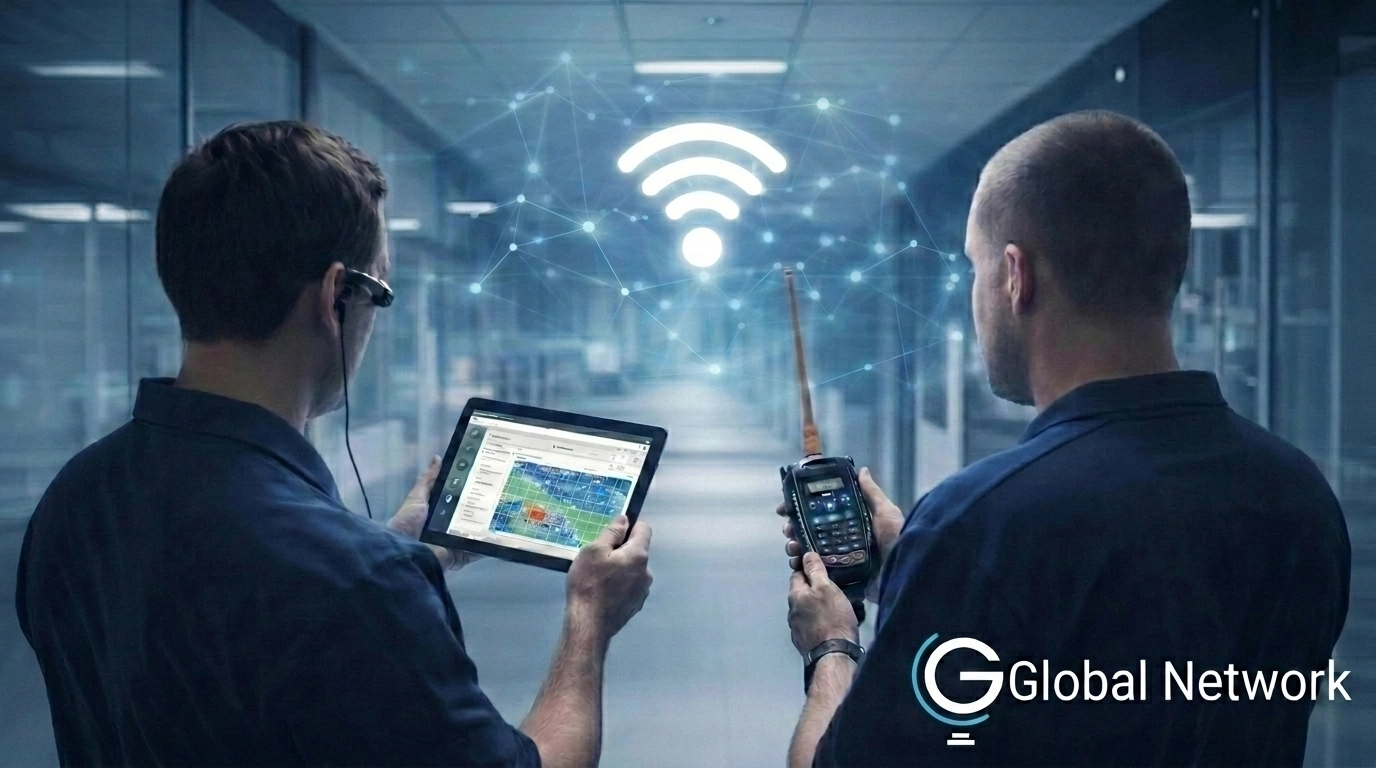
The raw data collected during the identification of weak signal zones is processed through advanced RF mapping software. This creates a high-fidelity "heatmap" of your facility. These visual reports are essential for:
- Transparency: You can see exactly where signals are failing.
- Strategic Planning: If a Bi-Directional Amplifier (BDA) or a Distributed Antenna System (DAS) is required, the heatmap tells us exactly where antennas need to be placed for maximum efficiency.
- Compliance Documentation: These reports are submitted to the Fire Marshal to prove that your building is safe for occupancy.
Global Network LLC ensures that these reports are detailed, professional, and formatted to satisfy the most stringent fire department reviewers. Our goal is to provide you with peace of mind, knowing that your documentation will pass inspection the first time.
Transitioning from Testing to Solutions
If the grid test reveals that your building does not meet the -95 dBm threshold, the next step is the design and installation of an Emergency Radio Communication Enhancement System (ERCES). As experts in Telecommunications Infrastructure, we don't just find the problems; we solve them.
When weak zones are identified, we deploy industry-leading BDA and DAS technology. A BDA system captures the external signal from the public safety radio tower, amplifies it, and distributes it throughout the building via a network of internal antennas. This ensures that every grid square: no matter how deep inside the concrete core: meets the legal requirement for connectivity.

Why Professional Certification is Non-Negotiable
Choosing an unqualified contractor for your grid testing is a significant risk. Inaccurate testing can lead to:
- Delayed Certificates of Occupancy (CO): If the Fire Marshal finds a dead zone you missed, your building cannot open.
- Increased Costs: Retrofitting a system after construction is finished is significantly more expensive than installing it during the build.
- Liability: In the event of an emergency, if communication fails due to poor testing, the building owner may face severe legal consequences.
Global Network LLC mitigates these risks through our ERCES testing and certification programs. We operate with a mission-centric approach, prioritizing the safety of first responders and the security of your assets. Our technicians are highly trained in RF physics and the latest versions of the International Fire Code (IFC).
Our Commitment to the Industry and Community
As a leader in Public Safety Technology, Global Network LLC is more than just a service provider. We are advocates for safer communities and more resilient infrastructure. Our "Business Mission" is centered on innovation and outreach, ensuring that even the most complex structures are equipped with reliable wireless communication.
We pride ourselves on our core values:
- Reliability: Systems that work when it matters most.
- Integrity: Formal, legalistic adherence to all local and national safety codes.
- Excellence: A commitment to 0% Missed Deadlines and superior technical execution.

Conclusion: Securing Your Building’s Future
The identification of weak signal zones through professional grid testing is a vital investment in your property's safety and compliance profile. Whether you are managing a new high-rise development, a sprawling hospital campus, or a multi-family residential complex, understanding your RF environment is the only way to ensure the safety of your occupants and the first responders who protect them.
Don't wait for a failed inspection to take action. Ensure your building is compliant, safe, and ready for any emergency.
Contact Global Network LLC Today
Are you ready to schedule your annual grid test or do you need a baseline signal survey for a new project? Our team of experts is standing by to provide the technical expertise and professional certification you need.
Global Network LLC
11175 Cicero Dr., Suite 100
Alpharetta, GA 30022
Phone: 770.520.8124
Website: https://globalnetworkco.com
Inquiries: Contact Us
At the forefront of advancements in public safety technology, Global Network LLC ensures your communication remains unbroken.