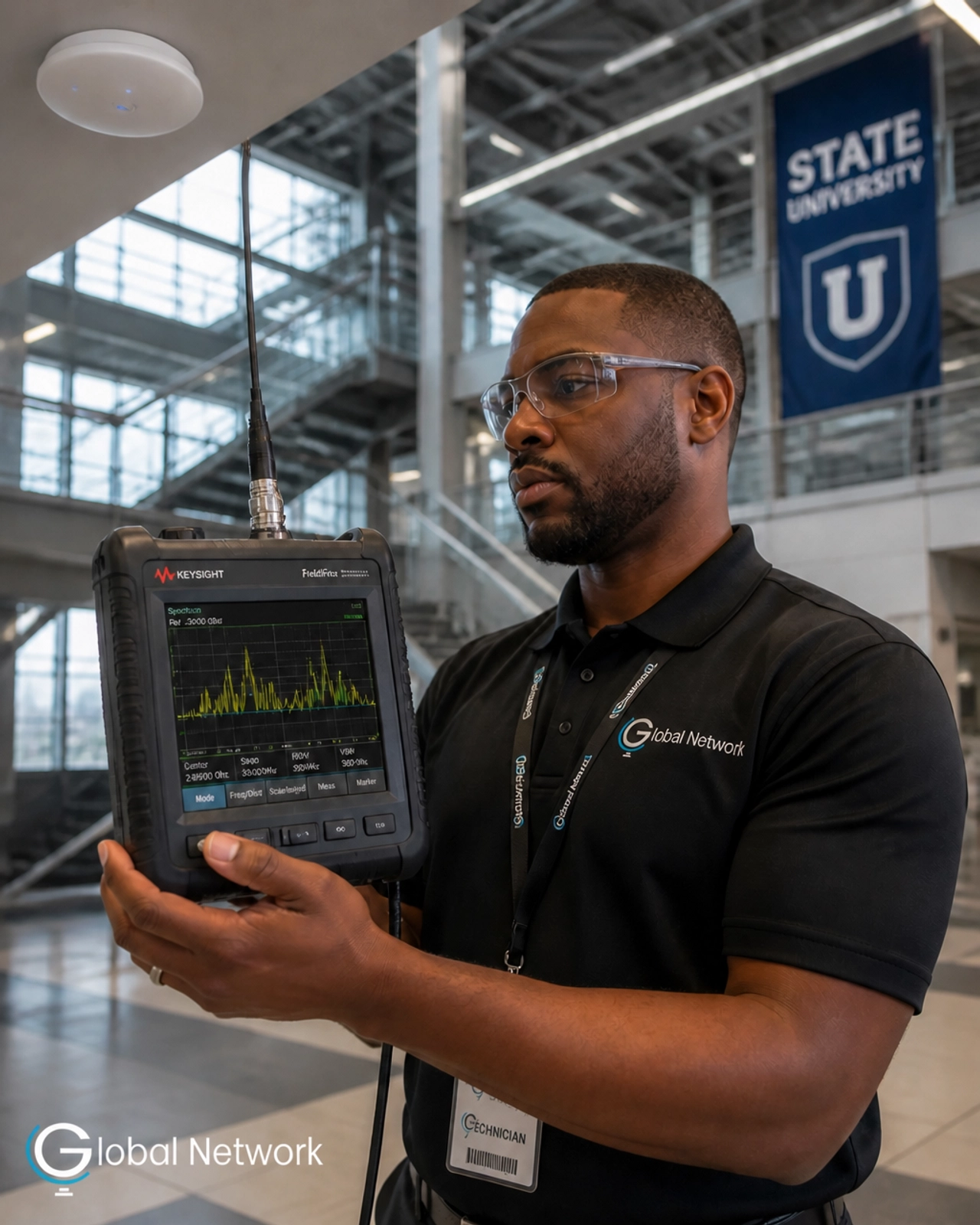
The Public Sector Standard: Why ‘Good Enough’ Signal is a Fatal Mistake

In the public sector, "good enough" is a death sentence. When a fire breaks out in a municipal high-rise, or an active threat occurs in a massive school wing, "dead zones" aren't just technical glitches: they are life-threatening liabilities. For government officials, hospital administrators, and school board leads, ensuring that first responders can communicate from the basement to the mechanical penthouse is not a luxury; it is a federal and local mandate.
At Global Network LLC, we see it constantly: buildings that look compliant on paper but fail the moment a radio key is pressed in a stairwell. If your facility hasn't undergone rigorous ERCES testing and certification, you aren't just risking a failed inspection: you are risking lives and inviting massive legal exposure.
The Regulatory Reality: IFC 510 and NFPA 72
The landscape of building safety has shifted. The days of "hoping" your signal is strong enough are over. Current standards, specifically IFC 510 and NFPA 72 emergency communication codes, have moved from "suggested guidelines" to strict, prescriptive law.
- IFC 510 Requirements: In 2024 and 2026 code cycles, the mandates are blunt. You must achieve 99% signal coverage in "Critical Areas" (fire command centers, stairwells, and standpipe cabinets) and 90% coverage in general areas.
- NFPA 72 Updates: The 2025 and 2026 standards introduce even more granular requirements, including Restricted Audible Mode Operation (RAMO) for neurodiverse-friendly facilities and schools, requiring specific 520 Hz notification zones.
Failure to meet these standards means one thing: No Certificate of Occupancy (CO). Or worse, a retroactive violation that could shut down your operations.

Why Public Sector Facilities are "Signal Traps"
Hospitals, government data centers, and modern schools are built like fortresses. Reinforced concrete, low-E glass, and massive subterranean levels are great for energy efficiency and security, but they are poison for radio frequency (RF).
These materials act as a Faraday cage, blocking the critical signals needed for two-way radio communication. When a police officer or firefighter enters your building, they transition from a strong outdoor signal to a "silent zone" within seconds. This is where a Public Safety DAS (Distributed Antenna System) becomes the most critical piece of safety equipment in your facility.
The "Fatal Mistake" of DIY or Low-Bid Solutions
We often see facilities try to cut corners by using non-certified technicians or "off-the-shelf" signal boosters. This is a fatal mistake.
- UL 2524 Compliance: If your BDA (Bi-Directional Amplifier) isn't UL 2524 listed, it doesn't belong in your building.
- 24-Hour Battery Backup: Public safety systems must remain operational even when the power grid fails. If your system dies two hours into an emergency, your compliance is a sham.
- Annual Performance Tests: Compliance is not a one-time event. You are required by law to perform annual testing to ensure system integrity.
Ensure your system is compliant – Schedule your test now.
FirstNet Indoor Coverage: The New Public Safety Standard
As the primary network for first responders, FirstNet has changed the game. While FirstNet provides unparalleled outdoor coverage, the indoor gap remains a massive hurdle for government buildings.
- Primary Users (Police, Fire, EMS): High-priority government buildings may qualify for specialized FirstNet indoor solutions, but they must be integrated correctly with your existing ERCES infrastructure.
- Extended Primary (Hospitals, Utilities): While critical, hospitals often do not qualify for "free" FirstNet booster programs, meaning administrators must take proactive steps to fund and install FirstNet indoor coverage solutions that meet NFPA standards.

Liability: The Cost of a Dead Zone
If a first responder is injured or unable to call for backup because your building lacks the required signal, the liability doesn't stop at the fire marshal’s office. It enters the courtroom. Negligence regarding NFPA 72 emergency communication and IFC 510 is legally indefensible when the codes are this clear.
0% Defects. 0% Missed Deadlines. This is our standard because, in your world, there is no room for error. We provide:
- Precision Design: Custom-engineered DAS layouts that account for every square inch of your facility.
- Rigorous Testing: Uplink and downlink verification that guarantees your radios work when it matters most.
- Atlanta BDA Specialist Expertise: We know the local AHJs (Authorities Having Jurisdiction) in Atlanta and their specific requirements.
Take Action Before the Inspector Arrives
Don't wait for a failed inspection or, worse, an actual emergency to find out your building is a "silent trap." Global Network LLC specializes in the design, installation, and ERCES testing and certification of mission-critical systems.
Whether you are managing a government headquarters, a sprawling hospital campus, or a multi-wing school, our mission is to ensure 100% compliance and 100% peace of mind.

Your Roadmap to Compliance:
- Site Audit: We identify your dead zones and current code gaps.
- Custom Engineering: We design a system tailored to your building’s unique architecture.
- Seamless Installation: We install UL-listed hardware with minimal disruption to your operations.
- Final Certification: We provide the documentation required for your Certificate of Occupancy.
Read more about the 7 Mistakes You’re Making with NFPA 72 Compliance.
Contact the Atlanta BDA Specialists Today
At Global Network LLC, we are at the forefront of advancements in public safety technology. We don't just sell equipment; we provide the infrastructure that saves lives.
Global Network LLC
Call us: 877.231.1084
Visit our Services Page
Learn more about our Cellular DAS solutions
When it matters most, make sure they can hear the call.