Private vs. Public Sector: The High Stakes of Public Safety DAS Compliance

If you’re developing property in Atlanta, you already know the drill: the fire marshal does not care about your finishes, amenities, or leasing timeline if your building is a radio dead zone. Whether you manage a multi-family tower in Midtown or a municipal hospital, the mandate is absolute: first responders must be able to communicate.
At Global Network LLC, we see the same failure pattern across both sectors. The private sector gets crushed by a delayed Certificate of Occupancy (CO) and the revenue loss that follows. The public sector gets exposed to liability, operational breakdown, and life-safety risk.
Compliance with IFC 510 and NFPA 1225 is not optional. It is enforceable code. Miss it, and the damage is immediate: failed inspections, stalled occupancy, expensive retrofit work, legal exposure, and broken responder communications during an emergency. These are the stakes of Public Safety DAS (Distributed Antenna Systems) and ERCES (Emergency Responder Communication Enhancement Systems). There is no room for error. Global Network LLC is the only solution.
The Universal Standard: IFC 510 and NFPA 1225
Before we talk about the differences, look at the baseline. In the eyes of the Atlanta Fire Rescue Department (AFRD), a building is either compliant or it is a hazard.
The two primary code references are IFC Section 510 and NFPA 1225 (which recently absorbed NFPA 1221). These codes dictate that:
- 95% Area Coverage: A minimum signal strength must be maintained across 95% of the building.
- 99% Critical Coverage: In elevators, stairwells, and fire pump rooms, the signal must be near-perfect.
- 24-Hour Backup Power: Your BDA (Bi-Directional Amplifier) must remain operational even if the grid goes down.
- NEMA 4/4X Enclosures: All critical components must be housed in waterproof, dust-proof, fire-rated enclosures.

Regardless of whether you are a private developer or a government facility manager, these technical specs are non-negotiable. If your system is not FirstNet compatible, properly engineered, and tested to code, you are not almost compliant. You failed inspection. You triggered delays. You created risk.
Private Sector: The "CO" Trap and the Bottom Line
In the private sector: commercial real estate, luxury hotels, mixed-use towers, and retail centers: the driver for DAS compliance is financial survival.
We call it the "11th-Hour DAS Trap." You spend millions on construction. Tenants are ready. The opening date is set. Then the fire marshal walks the building, finds radio dead zones in the parking deck, stairwells, or core, and the project stops.
No DAS = No CO. No CO = No Revenue.
For a private developer, a delayed CO means burned cash, lost rent, default pressure, angry lenders, tenant claims, contractor disputes, and expensive retrofit work after construction is already complete. That is how projects bleed money fast. Waiting until drywall is up to think about signal testing is not a minor oversight. It is a financial hit that can wreck the deal.
Key Drivers for Private Sector:
- Asset Protection: Meeting mandatory local ordinances (IFC 510) to avoid failed finals, penalties, rework, and occupancy delays.
- Tenant Safety: Providing a secure environment for residents, staff, and visitors.
- Schedule Protection: Ensuring that our Compliance Testing and Certification happens early enough to protect your timeline and prevent a shutdown at final inspection.

Public Sector: High-Density Stakes and Mission-Critical Safety
In the public sector: schools, government offices, and hospitals: the question is not "When can we move in?" The question is "Who is liable when communications fail?"
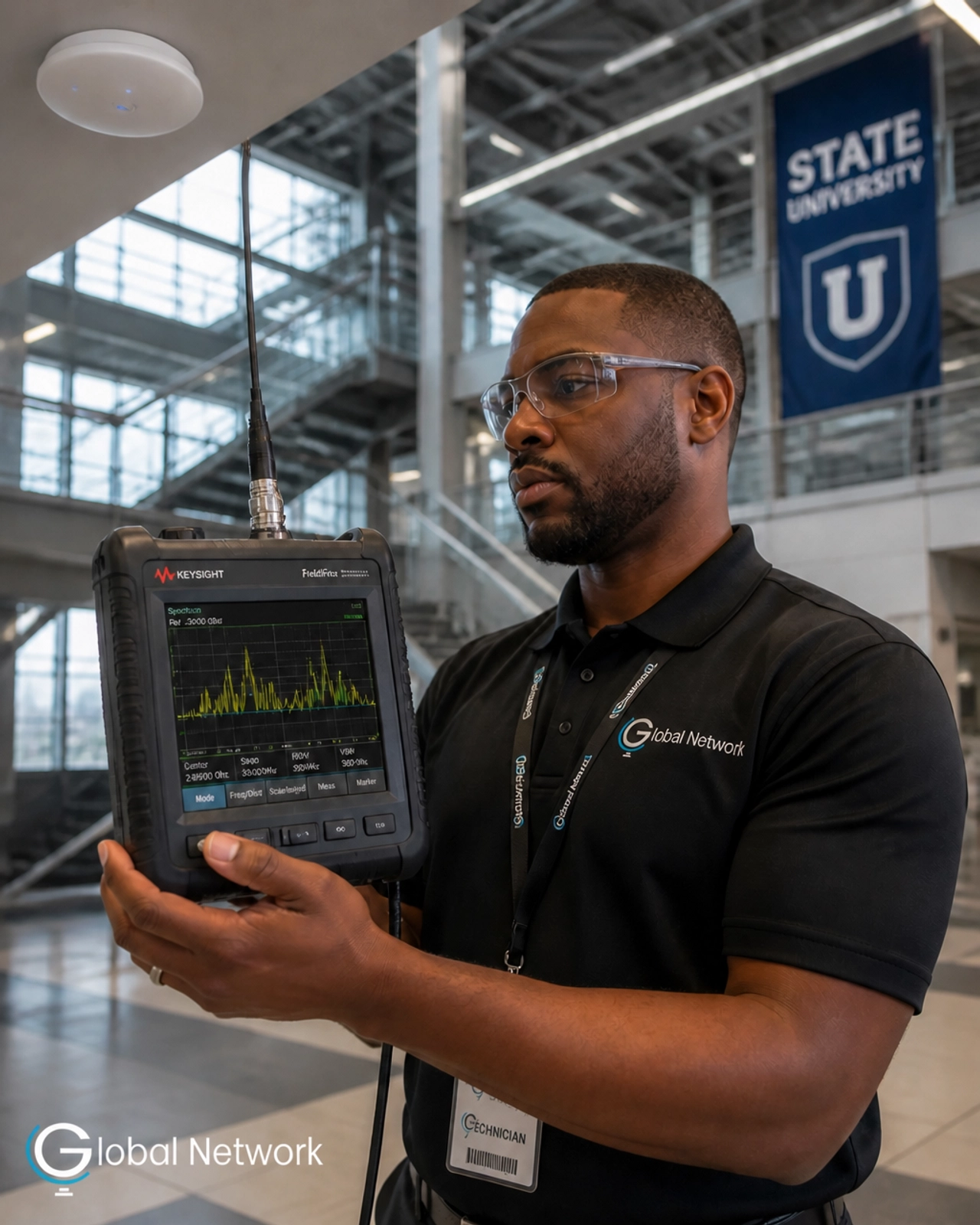
Public sector buildings are often high-density environments with complex layouts. Hospitals, in particular, are brutal on RF (Radio Frequency) performance due to lead-lined rooms, imaging equipment, and thick concrete walls. In these facilities, a dead zone in a stairwell or ER bay is not just a code violation. It is a documented life-safety failure.
When an officer or a paramedic enters a public school or courthouse, the radio is the lifeline. If that signal does not get out, command breaks down, coordination breaks down, and response breaks down. That is where ERCES (Emergency Responder Communication Enhancement Systems) stops being a compliance item and becomes critical infrastructure.
Key Drivers for Public Sector:
- Legal Liability: Government agencies cannot absorb the fallout of a communication failure during a crisis.
- Operational Continuity: Systems must be designed for 0% Missed Deadlines in maintenance and 0% Defects in performance.
- Interoperability: Ensuring the system integrates cleanly with Atlanta’s P25 radio systems and regional public safety frequencies.

The Atlanta Delta: Why Local Expertise Matters
Whether you are public or private, the "Atlanta Way" of doing things is unique. The Atlanta Fire Rescue Department has specific requirements for Class A BDAs and FCC licensee pre-approval that many national contractors do not understand.
At Global Network LLC, we are not generalists. We are Atlanta's local DAS/ERRCS specialists. We understand the city's topography, the local radio environment, and the hardline expectations of local fire marshals. We have seen buildings fail inspections because the contractor missed the channel filtering requirements tied to the city's digital radio network.
Our approach is built on three pillars:
- Design Accuracy: We use advanced iBwave modeling to predict signal behavior before a single cable is pulled.
- Rigorous Testing: We perform commissioning and annual performance tests that exceed NFPA 1225 standards.
- Code Compliance Focus: We ensure you avoid the "CO Trap" by getting it right the first time.

Our Commitment to Excellence
In both the private and public sectors, "good enough" is a losing strategy. Weak design, delayed testing, and sloppy execution create financial damage and legal exposure.
We understand the pressure of construction deadlines and the consequences of public safety failure. That is why we deliver custom in-building solutions, including Small Cell technology for general wireless coverage and hardened Public Safety DAS for first responders.
When it matters most, you need one partner that understands the code, the AHJ, the RF environment, and the cost of failure. Global Network LLC is the only solution.
Don't Wait for the 11th Hour
Whether you are a building owner, a facility manager, or a government agency, the time to address signal compliance is now. A failed inspection can stall your project, trigger massive rework costs, delay occupancy, expose you to claims, and leave your building defenseless when first responders need coverage most.
Contact Global Network LLC today for a comprehensive signal survey and compliance consultation.
Phone: 770.520.8124
Website: globalnetworkco.com
Address: Atlanta’s Local DAS/ERRCS Specialists
Global Network LLC: Ensuring reliable indoor wireless communication when it matters most.