ERCES Maintenance 101: Ensuring Continuous First Responder Safety.
You’ve done the hard part. You’ve navigated the complex world of building codes, hired the right engineers, and successfully installed an Emergency Radio Communication Enhancement System (ERCES). The Fire Marshal has signed off, the Certificate of Occupancy is in hand, and the Bi-Directional Amplifier (BDA) is humming along in the telecom room.
But here is the reality: an ERCES is not a "set it and forget it" piece of hardware. It is a life-safety system, just like your fire sprinklers or smoke detectors. If a fire breaks out three years from now, and a first responder’s radio goes silent because a battery failed or a donor antenna shifted, the consequences are catastrophic.
At Global Network LLC, we believe that compliance is a continuous journey, not a one-time destination. This guide breaks down the essentials of ERCES maintenance to ensure your facility remains a safe haven for heroes and stays on the right side of the law.
Why Maintenance Isn't Optional
In the world of telecommunications infrastructure, "uptime" usually refers to the internet staying on so people can send emails. In the world of Public Safety Technology, uptime is measured in lives saved.
First responders rely on two-way radios to coordinate movements inside complex structures. Concrete, low-E glass, and steel often block these signals, which is why your BDA system exists. However, various factors: from environmental wear and tear to nearby construction: can degrade system performance over time.
Beyond the moral imperative of safety, there are two primary drivers for rigorous maintenance:
- Regulatory Compliance: Codes such as NFPA 1225 (formerly NFPA 72 and 1221) and IFC 510 mandate annual testing. Failure to provide proof of performance can lead to heavy fines or the revocation of your occupancy permit.
- Liability Mitigation: Should an incident occur where communication failure plays a role, documented maintenance logs are your first line of defense to prove the building was code-compliant and the equipment was functional.
The Core Pillars of an ERCES Maintenance Plan
Effective maintenance is divided into three distinct categories: continuous monitoring, periodic visual inspections, and the comprehensive Annual Acceptance and Recertification Testing.
1. Continuous Monitoring (The 24/7 Watchdog)
Your ERCES shouldn’t just sit in the dark. Modern systems are designed to communicate directly with your Fire Alarm Control Panel (FACP). Under current codes, the system must be monitored for specific "trouble" signals, including:
- Antenna Malfunction: If the connection to the donor or server antennas is severed.
- BDA Failure: If the amplifier itself loses power or malfunctions.
- Battery Issues: High-capacity battery backups are required to keep the system running for 12 to 24 hours during a power outage. Monitoring ensures you know the moment a battery starts to lose its charge.
By integrating these signals into the building’s central monitoring system, you move from a reactive posture to a proactive one.
2. Periodic Visual Inspections
While the electronics monitor themselves, they can’t see the physical environment. A quarterly or bi-annual walk-through by your facilities team can catch obvious issues before they trigger an alarm:
- Donor Antenna Stability: High winds or birds can shift the rooftop antenna. If it’s not pointed directly at the public safety radio tower, the whole system suffers.
- Cable Integrity: In warehouses or mechanical rooms, cables can be snagged or damaged by other maintenance activities.
- Environment Control: BDAs generate heat. Ensuring the room remains ventilated and free of excessive dust is critical for the longevity of the hardware.
3. The Annual Recertification (The "Big Test")
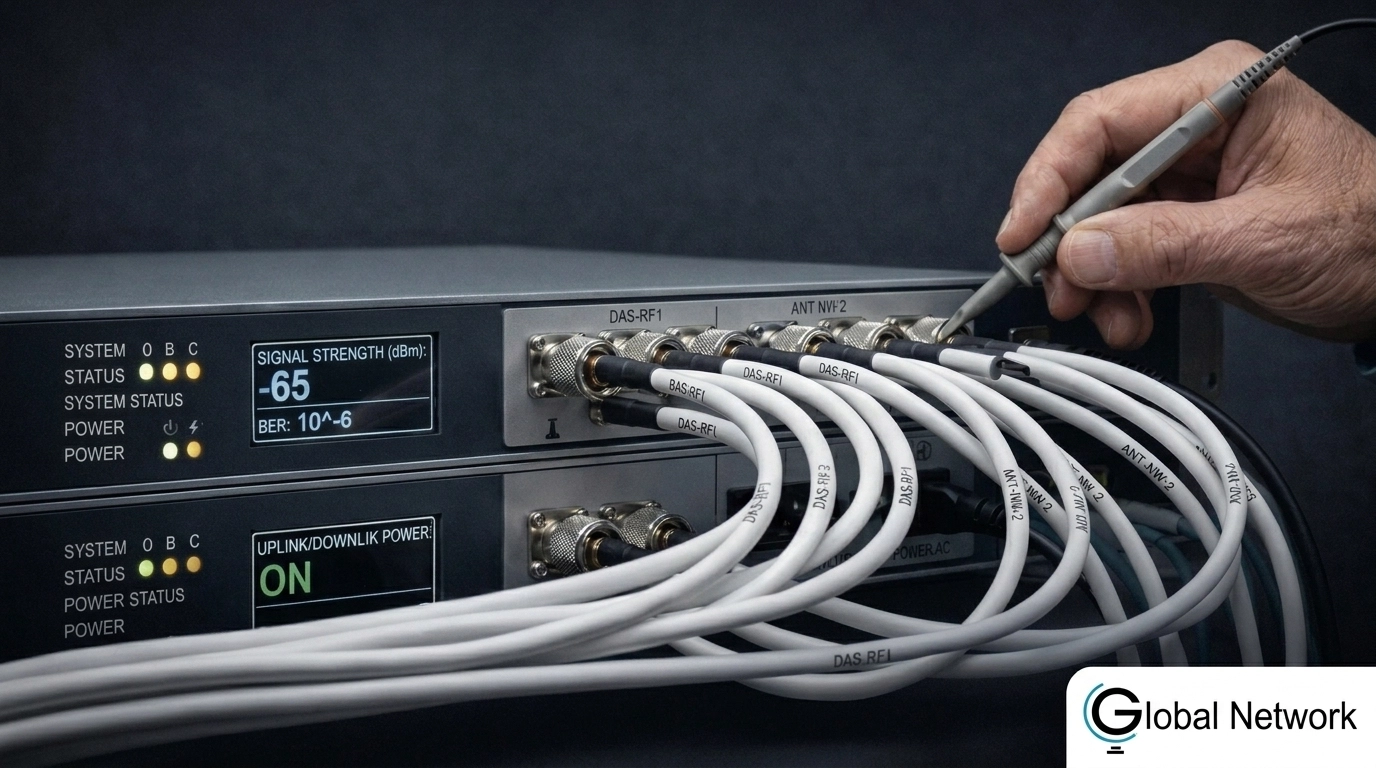
This is the most critical component. Once a year, a qualified technician: like the experts at Global Network LLC: must perform a full system audit. This isn't just a quick check; it is a rigorous validation of the entire RF (Radio Frequency) environment.
What Happens During an Annual Maintenance Visit?
When our technicians arrive on-site, they follow a strict protocol designed to leave 0% Defects in your safety net. Here is what a professional maintenance check entails:
RF Signal Grid Testing
Over time, the "RF landscape" outside your building changes. A new high-rise built across the street could block the signal from the city’s radio tower. We perform Grid Testing to ensure that at least 99% coverage is maintained in critical areas (like stairwells and fire pump rooms) and 90% in general areas.
Battery Discharge Testing
It’s one thing for a battery to say it’s "charged"; it’s another for it to hold a load. We test the backup power system to ensure it will actually provide the mandated hours of operation during a total building power failure.
Spectrum Analysis
We use specialized equipment to check for interference. If your BDA is "leaking" signal or causing oscillations, it can actually shut down the entire municipal radio network. This is a fast way to get a very unhappy visit from the FCC and the local Fire Marshal. We tune the system to ensure it is boosting the right frequencies without causing noise.
Documentation and Reporting
At the conclusion of the test, you should receive a comprehensive report. This document includes signal strength maps, equipment health status, and a certification of compliance. You must keep this on-site for the Fire Marshal’s inspection. If you’re unsure about your current status, you can schedule a test through our compliance portal.
Common Failure Points to Watch For
Even with the best equipment, certain parts of an ERCES are prone to wear. Being aware of these can help you budget for future repairs:
- Backup Batteries: These typically have a lifespan of 3 to 5 years. If your system was installed in 2022, you are likely approaching a replacement cycle.
- Lightning Protectors: These sacrificial components protect your expensive BDA from power surges. After a particularly bad storm season in Atlanta, these should be checked.
- Donor Antenna Alignment: As mentioned, rooftop equipment is at the mercy of the elements. A shift of just a few degrees can drop your signal levels below the legal threshold.
Future-Proofing: FirstNet and 2026 Standards
As we move through 2026, the technology is shifting. Many jurisdictions are now requiring support for FirstNet, the nationwide wireless broadband network dedicated to first responders. During your maintenance cycle, it is wise to ask your provider if your current BDA infrastructure can be upgraded to support these newer LTE and 5G public safety bands.
Upgrading during a scheduled maintenance visit is often significantly cheaper than a standalone emergency retrofit. Staying at the forefront of advancements ensures that your building remains compliant as local codes evolve.
Choosing the Right Maintenance Partner
Not every low-voltage contractor is qualified to touch an ERCES. These systems are governed by strict FCC regulations and local fire codes. When selecting a partner, look for:
- FCC General Radiotelephone Operator Licenses (GROL).
- Manufacturer Certifications for the specific BDA brands in your building.
- Local Expertise: A deep understanding of the specific requirements in your municipality (e.g., Atlanta’s specific fire radio frequencies).
At Global Network LLC, we pride ourselves on our mission-centric approach. We don't just see ourselves as technicians; we see ourselves as partners in community safety. Our commitment to 0% Missed Deadlines means your building never falls out of compliance due to a scheduling oversight.
Peace of Mind Starts Today
Maintaining your ERCES isn't just a line item in your facility budget: it’s a commitment to the men and women who run toward danger when everyone else is running away. By ensuring your system is functional, compliant, and monitored, you provide them with the one thing they need most in a crisis: a clear line of communication.
Don’t wait for an inspection failure or, worse, an emergency to find out your system is down.
Ensure your facility is safe, compliant, and ready for when it matters most.
Contact Global Network LLC Today
For expert BDA maintenance, annual testing, and compliance consulting, reach out to our team of specialists.
Phone: 770.520.8124
Website: https://globalnetworkco.com
About Our Services: View Our Public Safety Solutions
Protecting those who protect us: one building at a time.