FirstNet Indoor Coverage Vs. Public Safety DAS: Which is Better for Your Building?

For building owners, facility managers, and developers, ensuring reliable wireless communication is no longer a luxury, it is a mandatory safety requirement. When an emergency occurs, the ability of first responders to communicate inside your structure can be the difference between a successful rescue and a catastrophic failure.
In the modern landscape of public safety technology, two primary solutions dominate the conversation: FirstNet Indoor Coverage and Public Safety Distributed Antenna Systems (DAS). While they may seem similar, they serve distinct technical purposes and are governed by different regulatory standards. Navigating the nuances of IFC 510 and NFPA 1225 (formerly NFPA 1221) requires a deep understanding of how these systems interact.
At Global Network LLC, we prioritize your compliance and the safety of your occupants. This guide explores the critical differences between these technologies and explains why a comprehensive safety strategy often requires the synergy of both.
Decoding the Alphabet Soup: FirstNet vs. ERRCS

To choose the right solution, you must first understand the technical specifications of each platform.
What is FirstNet?
FirstNet is the first nationwide, high-speed broadband network dedicated specifically to public safety. Built through a public-private partnership between the FirstNet Authority and AT&T, it utilizes Band 14, a 20MHz block of 700 MHz spectrum.
- Technology: LTE and 5G Broadband.
- Purpose: High-speed data, video streaming, and voice-over-LTE (VoLTE) for first responders.
- Key Feature: Priority and Preemption. During a crisis, FirstNet users are never "throttled" or "bumped" off the network by commercial traffic.
What is Public Safety DAS / ERRCS?
An Emergency Responder Radio Coverage System (ERRCS), often referred to as a Public Safety DAS, is a building-wide system designed to amplify Land Mobile Radio (LMR) signals. This is the traditional two-way radio communication used by fire, police, and EMS personnel.
- Technology: Narrowband LMR (P25, Analog, or Digital).
- Purpose: Mission-critical voice communication via handheld radios.
- Key Feature: Mandatory Compliance. In most jurisdictions, including Atlanta, an ERRCS is required to obtain a Certificate of Occupancy (CO).
The Critical Technical Differences
While both systems enhance connectivity, their operational frameworks differ significantly. A building owner must recognize that FirstNet is a carrier-specific solution, whereas a Public Safety DAS is a code-mandated safety system.
| Feature | FirstNet Indoor Coverage | Public Safety DAS (ERRCS) |
|---|---|---|
| Primary Use | Data, Video, Broadband Voice | Mission-Critical Two-Way Radio |
| Spectrum | Band 14 (700 MHz) | Local LMR Frequencies (VHF/UHF/700/800 MHz) |
| Regulatory Driver | Operational Efficiency | IFC 510 / NFPA 1225 Compliance |
| Device Type | Smartphones, Tablets, IoT | Handheld Two-Way Radios |
| Required for CO? | Generally No (jurisdiction dependent) | Yes (for most new/renovated buildings) |

Why "Better" Often Means "Both"
In the debate of FirstNet vs. Public Safety DAS, the answer is rarely "either-or." For maximum safety and full regulatory adherence, most modern facilities require a hybrid approach.
1. Meeting the Code Mandate
The Authority Having Jurisdiction (AHJ): typically your local fire marshal: strictly enforces IFC Section 510. This code requires that buildings provide 95% radio coverage (99% in critical areas like stairwells and elevator lobbies) for emergency services. FirstNet coverage alone does not satisfy this legal requirement. You must install a Bi-Directional Amplifier (BDA) system specifically tuned to the local public safety radio frequencies to pass your annual certification.
2. Enhancing Operational Response
While the radio (LMR) is the primary tool for voice commands during a fire, modern first responders increasingly rely on FirstNet for data-heavy tasks. This includes accessing floor plans, viewing live camera feeds, and monitoring real-time biometric data of personnel inside the building. Without a Small Cell or Cellular DAS solution that supports FirstNet, these broadband tools may fail in basements or reinforced concrete structures.
3. Future-Proofing with FirstNet Compatible Systems
At Global Network LLC, our systems are designed to be FirstNet Compatible. Because Band 14 (FirstNet) and public safety LMR frequencies are adjacent in the 700 MHz spectrum, a properly designed Public Safety DAS can often support both with minimal additional hardware, providing a "best of both worlds" solution for the building owner.
The High Cost of Non-Compliance

Neglecting your indoor wireless requirements is a liability that no building operator should ignore. Failure to meet IFC 510 and NFPA 1225 standards can result in:
- Delayed Occupancy: You cannot open your doors without a signed-off Certificate of Occupancy.
- Hefty Fines: Local ordinances often impose daily penalties for non-compliant communication systems.
- Safety Risks: If responders cannot communicate, lives are at risk.
We operate with a commitment to 0% Defects and 0% Missed Deadlines, ensuring your building passes its Acceptance and Performance tests the first time.
Compliance Checklist for Building Owners
To ensure your facility is prepared for "when it matters most," follow this essential technical checklist:
- Identify the AHJ: Determine which local fire department governs your building's communication standards.
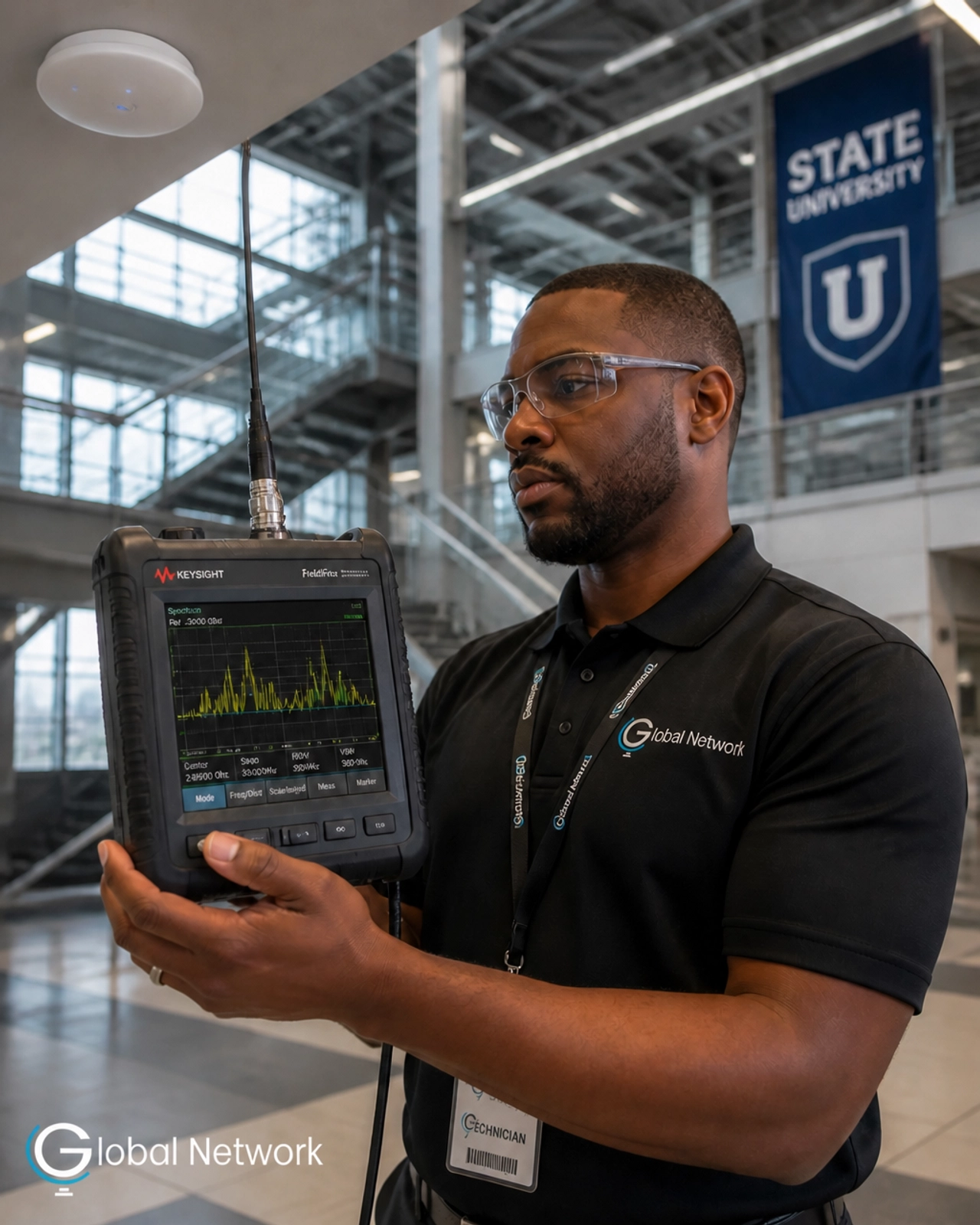
- Conduct a Radio Survey: Professional technicians must measure signal strength (in dBm) to determine if a BDA is necessary.
- Verify Backup Power: Both NFPA and IFC require 24 hours of secondary power for your communication equipment.
- Install NEMA 4 Enclosures: All mission-critical BDA equipment must be protected from water and dust in standardized red enclosures.
- Schedule Annual Testing: Compliance is not a one-time event; the code requires annual recertification of the entire system.

Atlanta’s Local DAS/ERRCS Specialists
Building codes in the Atlanta area are rigorous and evolving. As the region’s local specialist, Global Network LLC stays at the forefront of advancements in both LMR and FirstNet technologies. We don't just install hardware; we provide peace of mind.
Our mission is to bridge the gap between complex federal standards and local fire codes. Whether you are managing a high-rise office tower, a multi-family residential complex, or a high-traffic retail center, we ensure your infrastructure is ready for the future of public safety.
Secure Your Building's Safety and Compliance Today
Don’t leave your occupancy or your safety to chance. Contact the experts who understand the synergy between FirstNet and Public Safety DAS.
Global Network LLC
Phone: 770.520.8124
Website: globalnetworkco.com
At the forefront of public safety technology( ensuring communication when it matters most.)