The Ultimate Building Owner’s Checklist for IFC 510 Compliance

Ensuring the safety of occupants and first responders is a paramount responsibility for building owners and operators. In the modern landscape of commercial real estate and facility management, IFC 510 compliance is no longer a luxury: it is a mandatory legal and safety requirement. The International Fire Code (IFC) Section 510 mandates that buildings provide adequate radio coverage for emergency personnel. Without a compliant Emergency Responder Communications Enhancement System (ERCES), your facility risks significant liability, failed inspections, and the withholding of your Certificate of Occupancy.
At Global Network LLC, we recognize that navigating complex telecommunications regulations can be a formidable challenge. As Atlanta’s local specialists in Public Safety DAS installation, we are committed to providing you with the technical expertise and "peace of mind" required to meet these rigorous standards. Use this comprehensive checklist to ensure your facility remains at the forefront of safety and regulatory adherence.
1. Determine Your Mandatory Compliance Status
The first step in your compliance journey is identifying whether your building triggers the mandatory requirements set forth by the Authority Having Jurisdiction (AHJ). Jurisdictions across Georgia, and specifically within the Atlanta metropolitan area, strictly enforce IFC 510 and NFPA 1221 standards.
You must ensure compliance if your facility meets any of the following criteria:
- New Construction: Virtually all new commercial developments are subject to initial RF signal strength testing.
- High-Rise Structures: Buildings with occupied floors located more than 75 feet above the lowest level of fire department vehicle access.
- Subterranean Space: Any facility with significant underground levels, such as parking garages, storage centers, or basements deeper than 30 feet.
- Large-Scale Facilities: Buildings exceeding 50,000 square feet, or those with unique construction materials (like Low-E glass) that naturally attenuate radio signals.
- Significant Renovations: Structural modifications that could alter the RF environment of an existing building.
Failure to address these triggers early can lead to 0% Missed Deadlines on our part, but costly delays on yours. It is vital to integrate ERCES testing into your pre-construction or renovation schedule.

2. Conduct a Professional Radio Frequency (RF) Survey
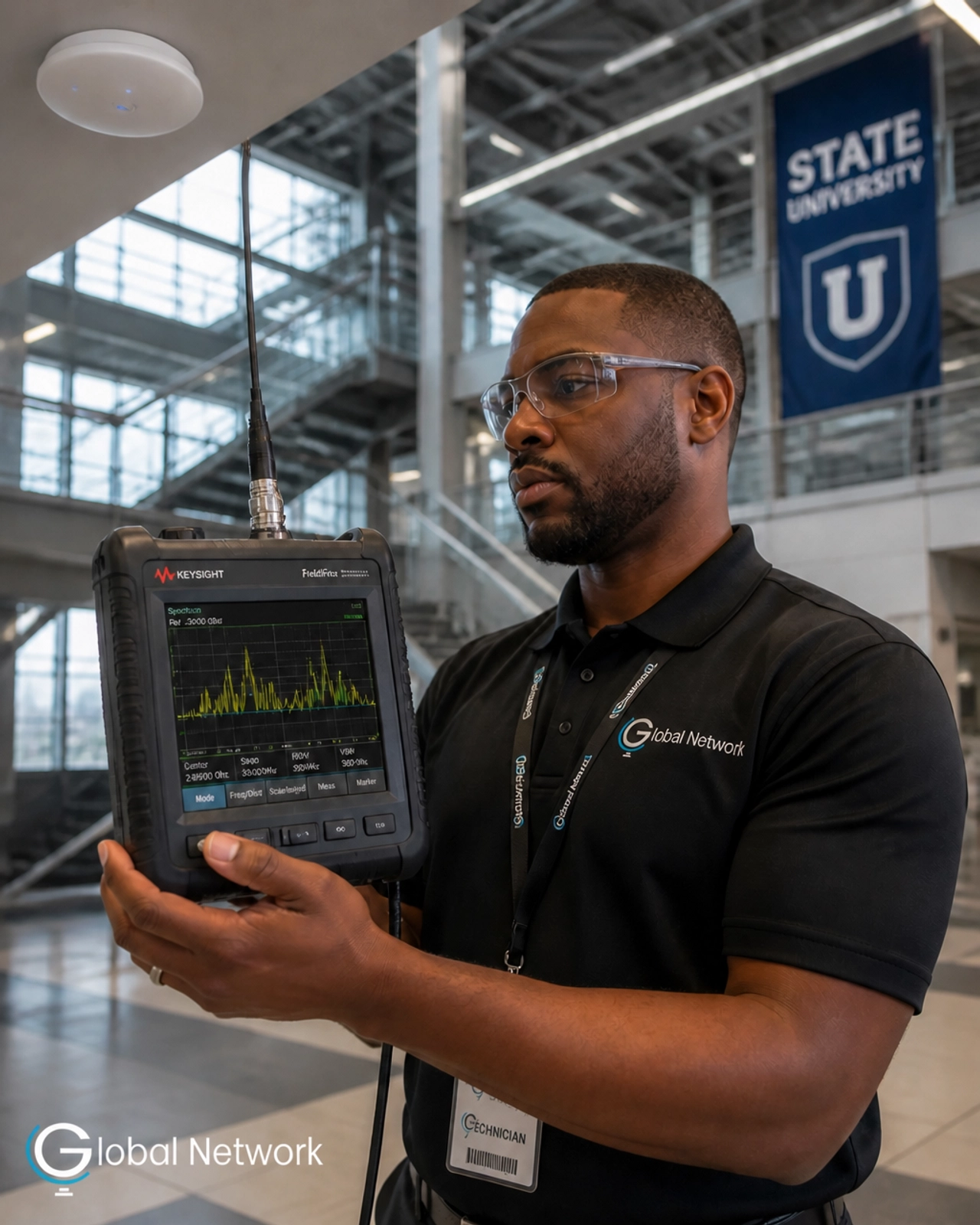
A baseline RF survey is the scientific foundation of your compliance strategy. You cannot manage what you do not measure. This survey determines if the existing signal from the public safety radio tower is sufficient to penetrate your building's exterior and interior walls.
Key components of a professional RF survey include:
- DAQ Testing: Measuring the Delivered Audio Quality (DAQ) to ensure clear voice communication for first responders.
- Spectrum Analysis: Identifying potential interference that could jeopardize system integrity.
- Grid-Based Measurement: Dividing each floor into a grid (typically 20 to 40 cells) to ensure comprehensive coverage as required by IFC 510.5.3.
If your facility fails this initial survey, a Public Safety DAS installation becomes mandatory. At Global Network LLC, our commitment to 0% Defects means our surveys are conducted with calibrated, industry-standard equipment to provide undeniable data to the fire marshal.
3. Design and Engineering of the ERCES
If a system is required, the design phase must adhere to strict engineering principles. A standard Bi-Directional Amplifier (BDA) system must be custom-tailored to the specific architectural layout of your building.
Your technical checklist for system design should prioritize:
- Code-Compliant Enclosures: BDAs and critical components must be housed in NEMA 4 or 4X rated waterproof enclosures.
- Secondary Power Supply: Ensuring the system remains operational for at least 24 hours during a power outage using specialized battery backup systems.
- Pathway Survivability: Protecting the cables connecting the system components to ensure they can withstand fire for a duration specified by local codes (typically 2 hours).
- Monitoring and Alarming: The system must be integrated into the building’s fire alarm control unit to provide immediate notification of a system malfunction.
For a deeper dive into the technical nuances of these systems, visit our detailed guide on BDA and DAS technology.

4. Rigorous Installation and Commissioning
The installation phase is where regulatory theory meets structural reality. Global Network LLC specializes in high-stakes public Safety DAS installation, ensuring that every antenna, coupler, and amplifier is placed for maximum efficiency and total code adherence.
Critical installation milestones:
- Donor Antenna Alignment: Precision placement of the rooftop antenna to communicate directly with the public safety radio tower without causing harmful interference (oscillation).
- Antenna Distribution: Strategically placing indoor antennas to eliminate "dead zones" in stairwells, elevators, and reinforced concrete areas.
- FirstNet Compatibility: Ensuring your system is compatible with the National Public Safety Broadband Network, future-proofing your facility for advancements in emergency communication.
We operate with a mission-driven focus on community safety, ensuring that your building is a safe harbor for the heroes who protect us.
5. Acceptance Testing and Certification
Before you can receive a Certificate of Occupancy (CO), the AHJ requires a final acceptance test. This is a high-pressure moment for many building owners, but with our Local Expertise, we ensure you are prepared.
What the Fire Marshal will look for:
- 99% Coverage in Critical Areas: This includes fire command centers, exit stairs, elevator lobbies, and standpipe cabinets.
- 90% Coverage in General Areas: Ensuring that personnel can communicate effectively in office spaces, retail floors, and common areas.
- Documentation: A comprehensive report detailing the RF measurements, system configuration, and proof of certification by a NICET-certified professional.
You can schedule a compliance test with our team to ensure your facility passes the first time, avoiding the "No DAS, No Move-In" trap that plagues many Atlanta developments.

6. The Necessity of Annual Performance Testing
IFC 510 compliance is not a "one-and-done" event. IFC 510.6.1 mandates that all emergency responder radio systems be tested annually to ensure they remain functional. Environmental changes, nearby construction, or internal building renovations can significantly degrade signal quality over time.
Annual testing includes:
- Verification of battery backup health and load capacity.
- Testing of all active components (amplifiers and signal boosters).
- Re-testing of signal strength in critical areas to ensure no new dead zones have emerged.
- Submitting updated documentation to the local fire department to maintain your standing.
Maintaining a regular testing schedule is the only way to guarantee 0% Missed Deadlines for your annual safety re-certifications. It is a serious, legalistic necessity that signals your high level of corporate responsibility.

Conclusion: Partnering with Atlanta’s Local Experts
The complexities of IFC 510 compliance require a partner who understands the intricate balance between technical engineering and strict regulatory enforcement. At Global Network LLC, we are at the forefront of advancements in public safety technology, serving as the local authority for ERCES testing and installation in the Atlanta region.
We don't just install equipment; we provide the infrastructure that saves lives when it matters most. By following this checklist and partnering with certified professionals, you ensure that your facility is safe, compliant, and ready for occupancy.
Do not leave your compliance to chance. Contact the experts at Global Network LLC today to secure your building's safety and certification.
Phone: 770.520.8124
Website: globalnetworkco.com
Our team is ready to provide the professional, authoritative guidance your project demands. Reach out today for a consultation and ensure your facility meets the highest standards of safety and reliability.