Reliable Coverage in Critical Areas: Why the 99% Requirement Saves Lives
When an emergency occurs within a high-rise building, a sprawling warehouse, or a complex corporate campus, every second is a critical variable in the equation of life and death. For first responders: firefighters, police officers, and emergency medical technicians: the ability to communicate is not a luxury; it is a lifeline. However, modern building materials like low-E glass, reinforced concrete, and metal framing act as shields, effectively blocking the radio signals first responders rely on.
To combat this, the International Fire Code (IFC) Section 510 and NFPA 1225 (formerly aspects of NFPA 72) mandate strict standards for in-building radio signal strength. Central to these regulations is the "99% coverage requirement" in critical areas. Understanding this requirement is essential for building owners, facility managers, and developers to ensure Reliable coverage in critical areas and maintain total compliance.
Understanding the 99% Requirement: The Critical Area Standard
In the world of Public safety radio coverage solutions, not all square footage is treated equally. Fire codes distinguish between "general building areas" and "critical areas." While general areas typically require 95% signal coverage, the code demands 99% coverage in critical areas.
What Defines a Critical Area?
Critical areas are the nerve centers of emergency operations. If communication fails here, the entire rescue operation can collapse. According to IFC 510 and NFPA standards, these areas include:
- Emergency Command Centers (ECC): The hub where leadership coordinates the response.
- Fire Pump Rooms: Vital for maintaining water pressure for suppression systems.
- Exit Stairs and Exit Passageways: The primary routes for evacuation and responder ingress.
- Elevator Lobbies: Often used as staging areas for fire crews.
- Standpipe Cabinets: Where firefighters connect their hoses to the building's water supply.
- Basements and Underground Parking: Areas naturally prone to signal "dead zones" due to depth and density.
The mandate for 99% coverage means that in these specific zones, there is effectively zero room for error. First responders must have a clear, functional signal to transmit and receive life-saving information when it matters most.
Why 99%? The Physics of First Response
You might wonder why a 4% difference: moving from 95% to 99%: is so significant. In a standard office environment, a 95% success rate for a cellular call is acceptable. In a fire, however, the environment is dynamic. Smoke, heat, and the movement of heavy equipment can degrade signal quality.
If a firefighter is in a stairwell (a critical area) and their radio fails to "handshake" with the local tower or the Bi-Directional Amplifier (BDA) system, they are isolated. Isolation in a burning building is a leading cause of line-of-duty deaths. By requiring 99% coverage, the code ensures that even under duress, the Emergency Responder Radio Coverage System (ERRCS) provides a near-guaranteed connection.
At Global Network LLC, we specialize in engineering systems that meet these rigorous benchmarks. Our commitment to 0% Defects ensures that your property is not just "up to code," but truly safe for those who protect our communities.
The Role of Professional Grid Testing
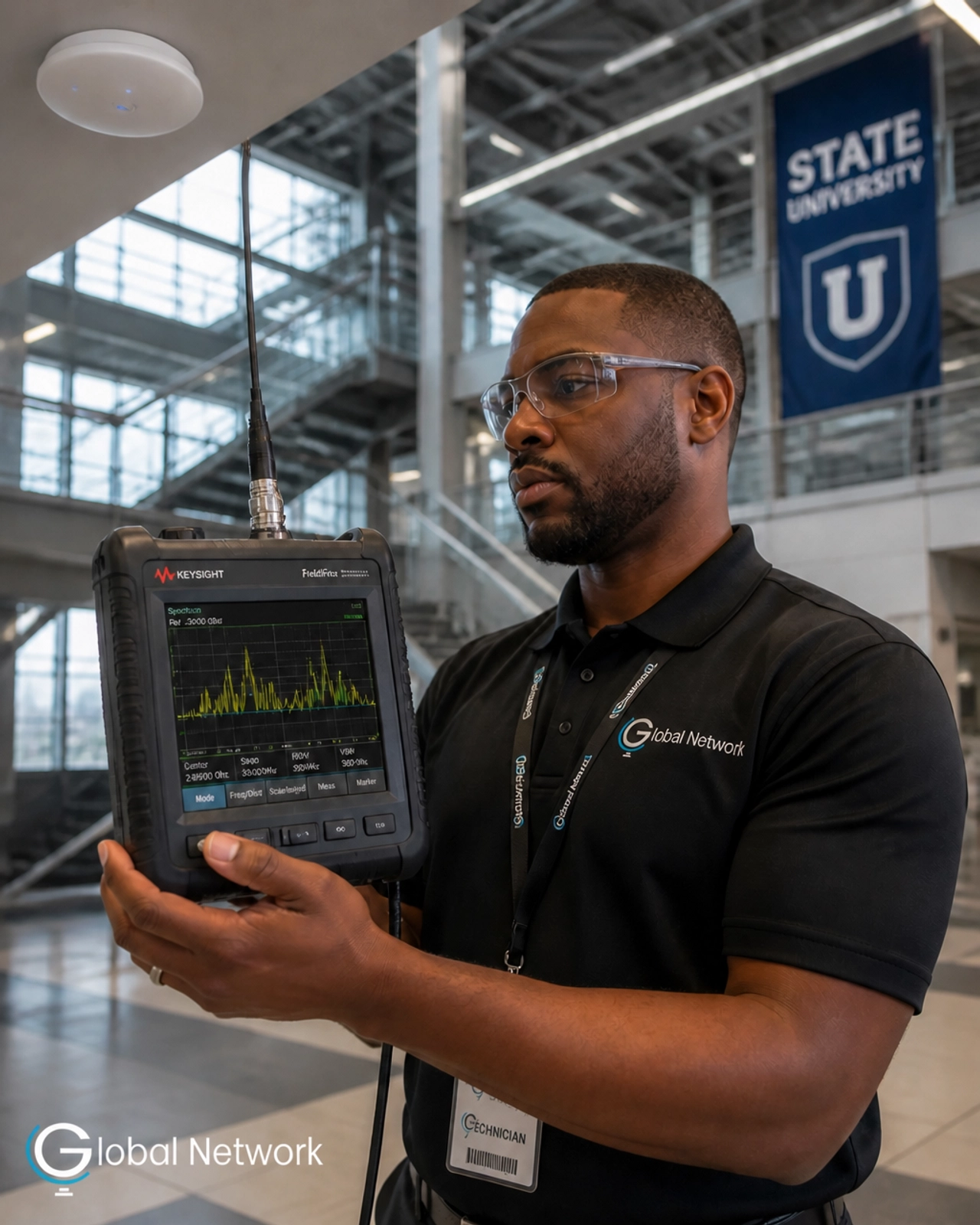
How do you prove that your building provides 99% coverage in a stairwell or a fire pump room? The answer lies in professional grid testing. This is a highly technical process where the floor plan of a building is divided into a series of grids (usually 20 or 40 depending on the total square footage).
- Signal Strength Measurement: Technicians use calibrated spectrum analyzers to measure the signal in decibels (dBm). Typically, a minimum signal strength of -95 dBm is required for both uplink and downlink.
- DAQ Scores: We measure the Delivered Audio Quality (DAQ). A score of DAQ 3.0 or higher is required, meaning the audio is understandable even if there is some noise or distortion.
- Critical Area Isolation: During testing, we specifically isolate the critical areas to verify the 99% threshold. If a single grid in a stairwell fails, the entire building may fail the inspection.
Identification of weak signal zones through this method allows our engineers to strategically place antennas as part of a Public Safety DAS solution, ensuring total transparency and compliance.
Compliance with Fire and Safety Regulations: IFC 510 & NFPA 72
The regulatory landscape for public safety technology is constantly evolving. While many jurisdictions still reference NFPA 72, the industry has largely transitioned the radio coverage requirements to NFPA 1225. Regardless of the specific version adopted by your local Fire Marshal, the core objectives remains:
- Continuous Monitoring: The BDA system must be monitored by the building’s fire alarm control unit. Any failure in the system: be it a power loss or an antenna malfunction: must trigger a "trouble" signal immediately.
- Battery Backup: These systems must remain operational for at least 12 to 24 hours (depending on local code) in the event of a power outage.
- NEMA 4/4X Enclosures: To survive the harsh conditions of a fire (including water from sprinklers), the equipment must be housed in specialized protective enclosures.
Failure to meet these standards can lead to more than just fines; it can result in the denial of a Certificate of Occupancy (CO), stalling your project’s completion and revenue generation. You can read more about avoiding these issues in our guide on 7 mistakes you’re making with NFPA 72 compliance.
Implementing Public Safety Radio Coverage Solutions
For many building owners, the path to compliance seems daunting. However, integrating a Distributed Antenna System (DAS) or a BDA system is a streamlined process when handled by experts.
The Global Network LLC Approach
We provide a comprehensive, turn-key solution to ensure your building meets the 99% requirement:
- Initial Site Survey: We conduct a baseline signal test to determine if your building even needs a system.
- Custom System Design: If coverage is lacking, our engineers design a system that targets critical areas with surgical precision.
- Liaison with Authorities Having Jurisdiction (AHJ): We handle the communication with Fire Marshals to ensure the design meets local requirements.
- Annual Testing and Maintenance: Compliance isn't a one-time event. We offer annual testing services to ensure the system remains functional year-over-year.
The Cost of Non-Compliance vs. The Value of Safety
Investing in Reliable coverage in critical areas is an investment in the longevity and safety of your asset. Beyond the legal mandate, there is a significant moral and financial component.
- Risk Mitigation: In the event of an emergency, a building with a certified ERRCS is significantly less liable for communication failures that lead to injury.
- Property Value: Modern tenants and corporations prioritize safety. A building that is pre-certified for public safety communication is a premium asset.
- Operational Readiness: Your staff and security teams also benefit from enhanced radio coverage, improving day-to-day operations.
Partner with the Experts in Public Safety Technology
At Global Network LLC, we understand that your focus is on managing your property or completing your construction project. Our mission is to take the complexity of signal compliance off your plate. With our 0% Missed Deadlines policy and a team dedicated to the highest standards of Telecommunications Infrastructure, we ensure your building is a safe haven for both occupants and first responders.
Don't wait for a failed inspection to address your signal issues. Whether you are in the design phase or retrofitting an existing structure, we are at the forefront of advancements in Public Safety DAS and BDA technology.
Contact Us Today
Ensure your building meets the 99% requirement and secures its Certificate of Occupancy without delay.
Global Network LLC
Phone: 770.520.8124
Website: globalnetworkco.com
Contact Page: globalnetworkco.com/contact
Your safety is our mission. Your compliance is our guarantee.