The Science of RF: How Signal Levels Are Measured.
Let’s be real for a second: unless you are an electrical engineer or a particularly bored ham radio enthusiast, you probably don’t spend a lot of time thinking about Radio Frequency (RF). To most property managers, RF is just "the invisible magic that makes my cell phone work." But when the Fire Marshal shows up to your building and starts talking about ERCES (Emergency Radio Communication Enhancement Systems) and failing signal levels, that "magic" suddenly becomes a very expensive reality.
Understanding the science of RF doesn't require a Ph.D., but it does require a basic grasp of how we measure the invisible waves bouncing around your hallways. At Global Network LLC, we believe that demystifying this tech helps you make better decisions for your property.
Here is a simple, slightly witty, and hopefully painless guide to the science of RF and how we measure it to keep your building compliant.
The Basics: What Is RF, Anyway?
Radio Frequency is a form of electromagnetic radiation. Don't panic: it’s not the kind that turns you into a superhero or a glowing mutant. It’s the same stuff as light, just at a different frequency. These waves move through the air, carrying information between antennas and devices.
In the world of Public Safety Technology, we are specifically looking at the frequencies used by first responders (police, fire, and EMS). These frequencies typically live in the 700 MHz, 800 MHz, and UHF/VHF bands. The problem? Modern buildings are essentially RF fortresses. Low-E glass, reinforced concrete, and thick steel beams act like giant sponges, soaking up the signal before it can reach a firefighter’s handheld radio in your stairwell.
The "Measuring Stick": Understanding dBm
In the world of RF, we don't measure "bars" like you see on your iPhone. We measure power in dBm (decibels-milliwatts).
If you remember anything from this post, remember this: RF signal levels are measured in negative numbers.
This is where it gets confusing for non-technical folks. On the dBm scale, a "higher" number is actually a number closer to zero.
- -30 dBm is a screamingly strong signal (you’re probably standing right under an antenna).
- -95 dBm is usually the "magic number" for compliance. It’s the minimum signal strength required by most local fire codes and IFC 510 standards.
- -110 dBm is basically a dead zone. Your radio is just whispering into the void at this point.
Think of it like a golf score: the "lower" the negative number (meaning closer to zero), the better your performance. If your building is sitting at -105 dBm in the basement, you have a problem that a simple coat of paint won't fix. You need a Public Safety DAS.

How We Measure: The "Ghostbuster" Gear
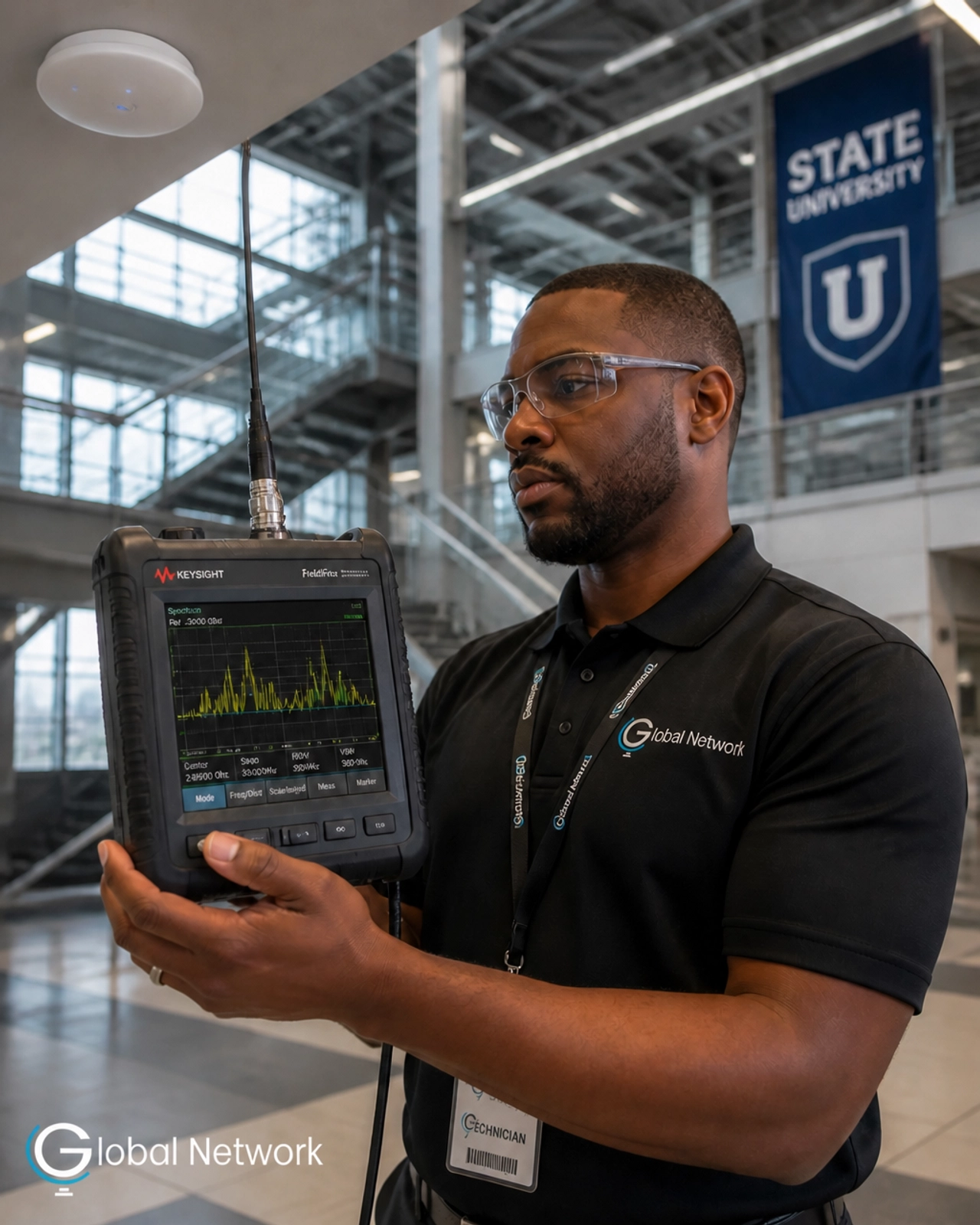
When our technicians walk into your building, they aren’t just guessing. They carry sophisticated equipment designed to "see" the invisible. The two most common tools are the Spectrum Analyzer and the Signal Level Meter.
1. The Spectrum Analyzer
This is the heavy hitter. A spectrum analyzer shows us a visual graph of the RF environment. It doesn't just tell us the signal is "weak"; it tells us why. We can see interference, noise floors, and competing signals. It’s like having X-ray vision for the airwaves.
2. Signal Level Meters
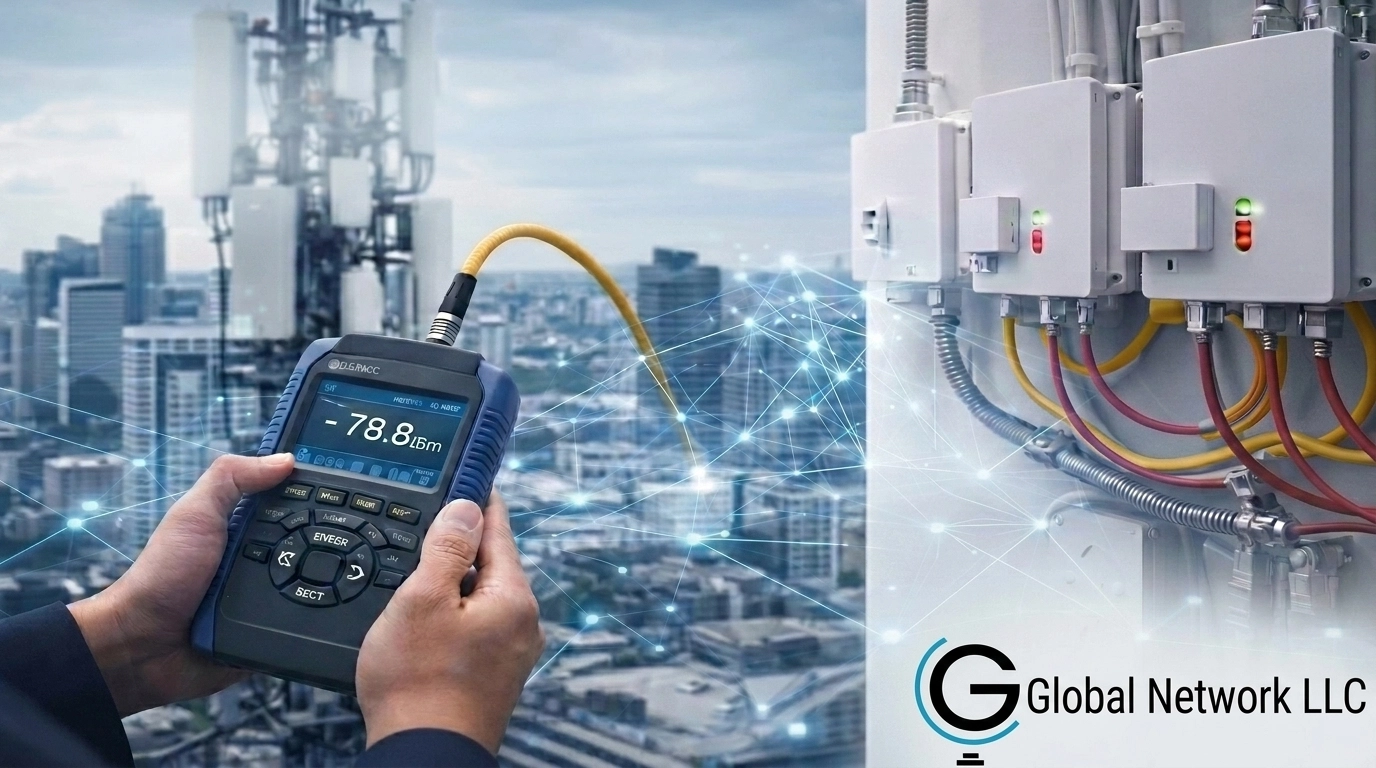
These are more portable and are used for the actual Grid Testing. We use these to walk your floor plan and document the exact dBm level in every square inch of the building. This data is what we use to prove to the authorities that your building is safe: or to show you exactly where we need to install a Bi-Directional Amplifier (BDA).
Why Accuracy Matters: The 20-Grid Test
You might wonder, "Can't I just check my phone?"
Absolutely not. First of all, your phone is on a commercial carrier network (like Verizon or AT&T). First responders use private radio networks. Secondly, the law (specifically NFPA 72 and IFC 510) requires a specific, documented testing process called a Grid Test.
We divide every floor of your building into a grid: usually 20 equal squares. We then measure the signal in the center of each square. To pass inspection:
- 99% coverage is typically required in "Critical Areas" (fire pump rooms, exit stairs, elevator lobbies).
- 90% to 95% coverage is required in "General Areas."
If even a few squares in that grid fall below the mandated -95 dBm, you could face a failed inspection, a delayed Certificate of Occupancy (CO), or worse: a communication failure during a real emergency. This is why understanding 7 Mistakes You’re Making with NFPA 72 Compliance is so critical for property owners.

The Enemies of RF: Why Your Building Is "Quiet"
If RF is so scientific, why is it so unpredictable? Because RF waves are sensitive. Here is what kills your signal:
- Distance: The further you are from the donor tower, the weaker the signal.
- Free Space Path Loss: Even in thin air, signal loses steam over distance.
- Absorption: Concrete and brick are the primary "signal eaters."
- Reflection: Metal and Low-E glass reflect RF like a mirror reflects light. The signal bounces off your building instead of going through it.
This is why a building that looks fine on the outside can be a total dead zone once you step into the elevator bank. At Global Network LLC, we specialize in "Identification of Weak Signal Zones" through rigorous grid testing and RF modeling.
The Solution: Amplification and Distribution
Once we’ve measured the "problem," we provide the "cure." This usually involves a Bi-Directional Amplifier (BDA) system.
The process is straightforward:
- The Donor Antenna: We put a high-gain antenna on your roof to "catch" the signal from the public safety tower.
- The BDA: This device takes that weak signal and boosts it (amplifies it).
- The DAS (Distributed Antenna System): A network of smaller antennas inside your building "distributes" that boosted signal into the dead zones, ensuring every grid square hits that magic -95 dBm mark.

Peace of Mind and Compliance
At the end of the day, RF science is about one thing: Reliability. When a first responder enters your building, their radio must work. There is no room for "maybe" or "mostly."
By choosing a partner like Global Network LLC, you aren't just buying hardware; you are buying a guarantee of 0% Defects and 0% Missed Deadlines. We stay at the forefront of advancements in Public Safety Technology so you don't have to worry about the physics. We handle the spectrum analyzers, the dBm calculations, and the complex local codes so you can focus on managing your property.
Ready to ensure your building is up to code?
Don't wait for the Fire Marshal to find the dead zones for you. Whether you are in the middle of new construction or managing an existing high-rise, we provide the expertise needed to ensure First Responder Safety through precision RF engineering.
When it matters most, trust the experts in in-building wireless communication.
Contact Global Network LLC today:
- Phone: 770.520.8124
- Website: https://globalnetworkco.com/contact
- Services: Explore our BDA and DAS Solutions
- Schedule a Test: Ensure your Public Safety DAS is compliant
Global Network LLC
At the forefront of public safety and telecommunications infrastructure.
Reliability. Compliance. Safety.