
The Property Manager’s 2026 Public Safety Compliance Cheat Sheet: Atlanta Edition
Navigating building safety in Metro Atlanta is no longer optional—or simple. As of March 2026, rapid development and tighter enforcement have created a high-stakes environment for building owners and facility managers. Compliance isn’t “set it and forget it.” It’s a technical requirement that demands precision, documentation, and 0% Defects.
For property managers overseeing commercial high-rises, multi-family residential complexes, or sprawling corporate campuses, the message is clear: Public Safety DAS (Distributed Antenna Systems) and BDA (Bi-Directional Amplifier) systems are the backbone of your building’s life-safety infrastructure. When the unexpected happens, the ability of first responders to communicate inside your structure is the difference between a controlled incident and a tragedy.
This is a Quick Reference guide to staying compliant with IFC 510 and NFPA 72, with the Atlanta-specific details that can make or break an inspection.
1. The Georgia Landscape: HB 399 and Local Oversight
The regulatory environment in Georgia saw a significant shift on January 1, 2026, with the full enactment of Georgia HB 399. This legislation mandates that out-of-state property owners must employ a Georgia-licensed property manager or broker to oversee residential rental properties. While this primarily targets residential sectors, the ripple effect has increased the scrutiny on all property management firms regarding local code adherence.
In Atlanta, the Authority Having Jurisdiction (AHJ) and the Office of Contract Compliance are prioritizing integrated safety systems. Whether you are managing a new development in Midtown or retrofitting an older asset in Buckhead, your public safety communication system must be verified by local experts who understand both state law and technical fire codes.
2. Critical Coverage: Where 100% Signal is Non-Negotiable
In life safety, not all square footage is equal. Your ERRCS / Public Safety DAS (BDA-backed) must deliver the required signal performance exactly where first responders operate and coordinate.
Critical Areas (99% Coverage Required — Practical “No Excuses” Coverage)
These are the operational nerve centers. Expect near-perfect results:
- Fire Command Centers: Incident coordination hub.
- Exit Stairs: Primary ingress/egress for crews.
- Elevator Lobbies: Staging, access, and equipment movement.
- Fire Pump Rooms: Mechanical operations and status communications.
- Standpipe Cabinets: Coordinated suppression operations.
General Areas (95% Coverage Required)
All other occupied spaces typically require 95% coverage. Minor dead spots may be tolerated in non-critical areas—but not in the spaces above.
Quick reality check (Atlanta high-rises): Stairwell fading is still a top fail point due to concrete, rebar, and Low‑E glass. If you don’t have recent test data, you don’t have certainty. If you are unsure of your current levels, ensure your public safety DAS system is compliant – schedule a test.
3. The Math: DAQ 3.0 Grid Testing + 24-Hour Backup (IFC 510 + NFPA 72)
Compliance is verification. Not assumptions. The standard is simple: your system must perform when it matters most—and you must be able to prove it.
DAQ 3.0 Grid Testing (Pass/Fail Reality)
Your building is divided into a test grid (often 20–40 squares per floor). Each grid point must meet DAQ 3.0+:
- DAQ 3.0 = speech understandable with slight effort; occasional repetition required
- Anything below DAQ 3.0 is a failure condition in the test results
24-Hour Battery Backup (UL 2524 Listed)
During power loss (fire event, severe weather, utility outage), the BDA must stay online. Codes require a dedicated 24-hour backup, and modern deployments typically require UL 2524 listed equipment intended for public safety environments.
FACP Monitoring (Non-Negotiable)
The ERRCS/BDA must report supervisory/trouble conditions to the Fire Alarm Control Panel (FACP) and monitoring path:
- Loss of AC power
- Battery trouble
- Amplifier failure
- Donor antenna fault/oscillation alarms
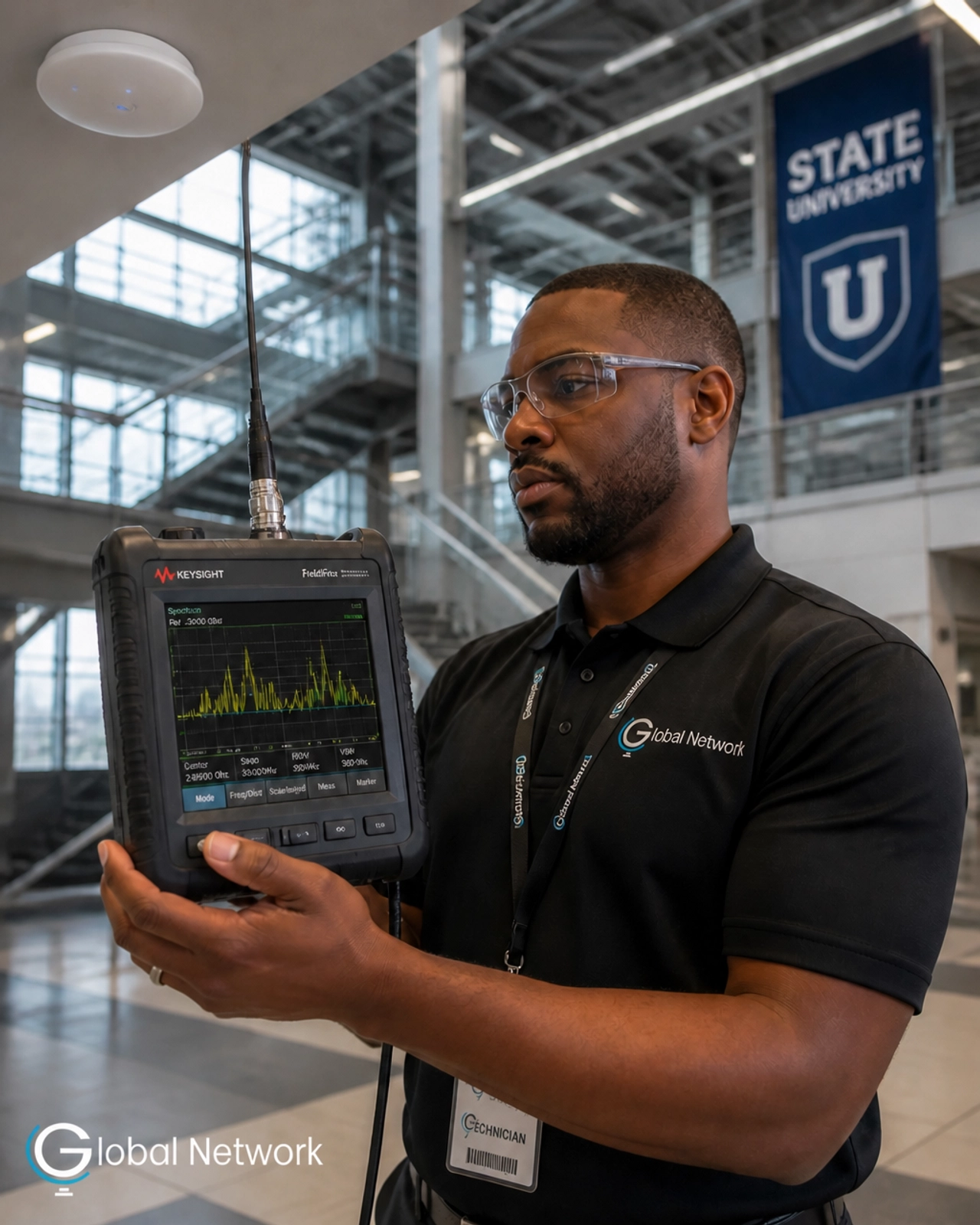
Heavy-lifting note: This is where many properties get stuck—testing methodology, thresholds, documentation, and the NFPA 72 + IFC 510 crosswalk. Global Network LLC handles the heavy lifting: system validation, reporting, and inspection-ready deliverables. Failure to monitor these systems is one of the 7 mistakes you’re making with NFPA 72 compliance.
4. 2024 Red Flags (Atlanta): Fast Ways to Fail an Inspection
These issues are repeatedly triggering violations across Metro Atlanta. Keep them scannable. Keep them on your radar.
- Tenant renovations / build-outs: Even “minor” changes (new drywall, new suites, new layouts) can shadow antennas and shift propagation. Renovate? Re-test.
- FirstNet compatibility (modern Atlanta AHJ expectation): Many Atlanta AHJs now treat FirstNet/700–800 MHz support as a modern requirement, not a nice-to-have. Legacy-band-only systems are getting flagged and forced into upgrade paths.
- FACP monitoring gaps: A BDA can be powered on and still be non-compliant. If a “trouble” condition doesn’t annunciate at the FACP, you’re exposed—expect a citation.
5. The Paperwork: What the Inspector Will Ask For
Inspectors don’t just look at equipment. They validate the paper trail. Maintain a clean, inspection-ready binder (digital or physical). Global Network LLC handles the heavy lifting here too—so your documentation aligns with NFPA 72 and IFC 510 expectations.
- Current FCC Licensee Permission Letter: Written permission to rebroadcast the frequencies used by local emergency services.
- Annual System Performance Test Report: Signed by a certified FCC GROL (General Radiotelephone Operator License) technician.
- Grid maps + results: Floor-by-floor maps showing pass/fail readings for every grid square (DAQ 3.0 support).
- Battery load test results: Proof the backup system sustains operation for the required 24 hours.
Why Global Network LLC?
You’re responsible for uptime, compliance, and the Certificate of Occupancy timeline. You don’t need another vendor—you need a specialist who can own the outcome.
Global Network LLC is Atlanta’s local DAS/ERRCS partner built around code compliance. You get:
- IFC 510 + NFPA 72 heavy lifting handled: design support, commissioning/acceptance/annual testing, and inspection-ready reporting
- Code-compliance focus: reduce failed inspections, occupancy delays, and re-test loops
- FirstNet-aware deployments: modern band support aligned with Atlanta AHJ expectations
- 0% Missed Deadlines mindset
Next Steps (Do This Before the Fire Marshal Does)
- Book a pre-inspection audit (coverage verification + documentation review)
- Identify critical-zone gaps (stairs, fire command, pump room, lobbies)
- Confirm FirstNet/700–800 MHz readiness and FACP monitoring
- Schedule corrective action before the next inspection window
Call to Action: Don't wait for the fire marshal. Get a pre-inspection audit today.
Contact Us Today
Ensure your building is safe, compliant, and ready for whatever comes next.
Global Network LLC
Phone: 770.520.8124
Website: globalnetworkco.com
Consultation: Contact Our Experts
Global Network LLC is a leader in Telecommunications Infrastructure and Public Safety Technology, providing mission-critical connectivity solutions across the United States. From network cable technicians to complex BDA integrations, we deliver reliability when it matters most.