How to Avoid the Biggest ERCES Design Pitfalls in New Construction
In the current landscape of commercial development, ensuring reliable in-building wireless for first responders is no longer a luxury or a secondary consideration, it is a legal mandate. As of 2026, the complexity of modern architecture, combined with stringent IFC 510 and NFPA 72 regulations, has made the Emergency Responder Communication Enhancement System (ERCES) a critical path item for obtaining a Certificate of Occupancy (CO). ERCES is the modern term replacing ERRCS.
For developers and architects, the difference between a seamless project handover and a multi-million dollar retrofit often comes down to one factor: early-stage BDA system design. Failing to account for public safety radio coverage during the pre-construction phase is one of the most expensive mistakes a firm can make.
At Global Network LLC, we prioritize 0% defects and 0% missed deadlines in our deployment of life-safety technology. This guide outlines the most common design pitfalls in new construction and how to navigate them to ensure full compliance and long-term reliability.
The High Cost of the "Wait and See" Approach
The most prevalent pitfall in new construction is treating ERCES as a "post-build" checklist item. Many developers assume that if the building fails a radio coverage test after the walls are up, they can simply "slap on a BDA" and fix it.
This line of thinking is a financial trap. Retrofitting a building for ERCES can cost three to five times more than an integrated design. When a building is already finished, technicians must navigate through finished ceilings, fire-rated walls, and complex HVAC systems to install specialized cabling and antennas.
By integrating public safety radio coverage solutions during the design phase, you ensure that:
- Conduit pathways are pre-planned and embedded in structural slabs where necessary.
- Power requirements for the Bi-Directional Amplifier (BDA) are accounted for in the electrical schedules.
- The system is aesthetically integrated rather than looking like an industrial afterthought.

Pitfall 1: Underestimating Material Interference
Modern green building standards emphasize energy efficiency, often through the use of Low-E glass and high-density insulation. While these materials are excellent for LEED certification, they are "kryptonite" for radio signals.
A major design pitfall is failing to perform a professional material analysis. RF (Radio Frequency) signals do not penetrate all materials equally:
- Wood and Drywall: Minimal attenuation.
- Brick and Standard Concrete: Moderate attenuation.
- High-Density/Post-Tension Concrete: High attenuation.
- Low-E Glass and Metal Facades: Severe attenuation.
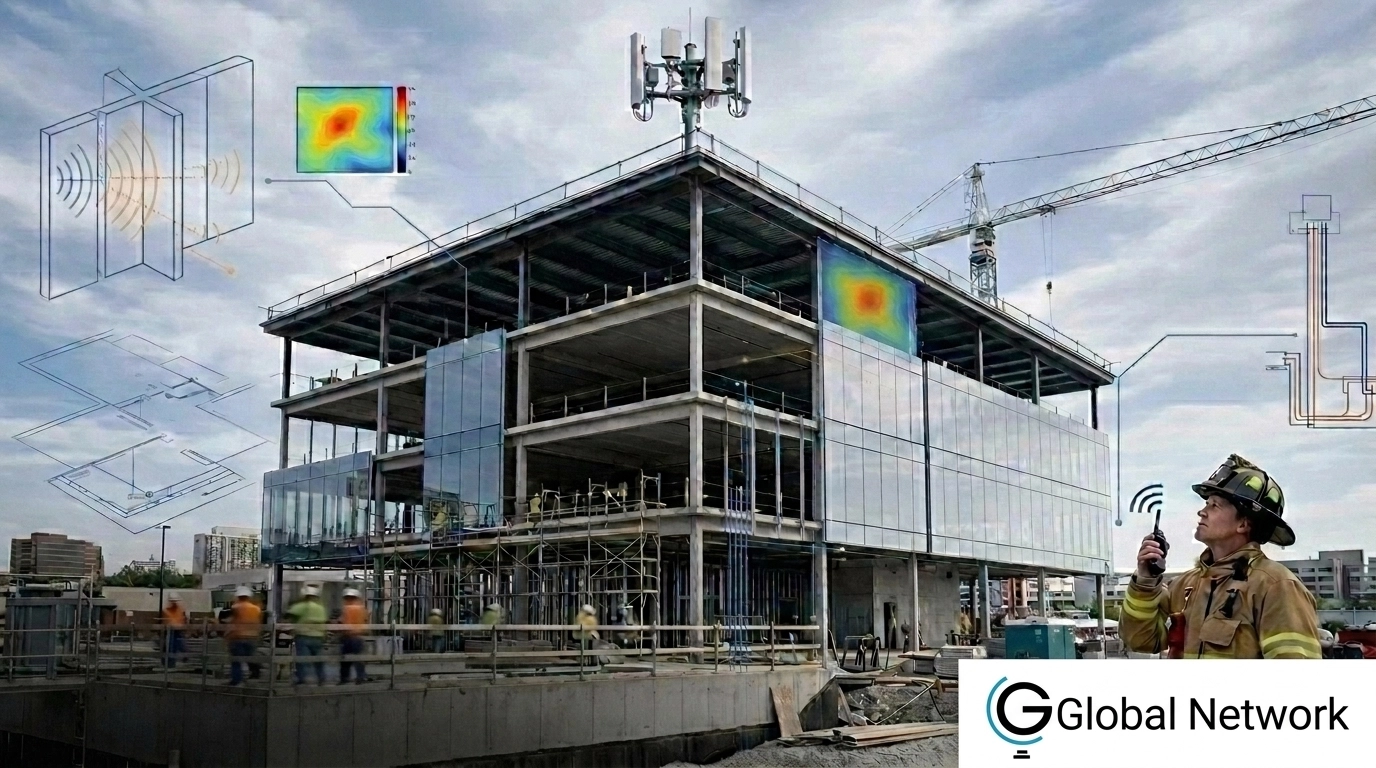
If your architectural plans feature a heavy glass curtain wall or deep underground parking levels, a standard BDA system design will not suffice. You need a precision-engineered solution that accounts for the specific attenuation values of your chosen materials. Global Network LLC utilizes advanced modeling tools like iBwave to simulate how your building’s unique "DNA" will impact signal propagation before a single brick is laid.
Pitfall 2: Relying on Flat-Rate Cost Estimations
In the bidding phase, developers often look for a "price per square foot" for ERCES. However, size is rarely the primary driver of cost. A 100,000-square-foot open warehouse may require a much simpler system than a 50,000-square-foot medical facility with lead-lined walls and multiple elevator cores.
Architectural complexity, such as atriums, stairwells, and "dead zones" created by heavy machinery, dictates the density of the Public Safety DAS (Distributed Antenna System). Relying on generic estimates often leads to mid-project budget overruns when the actual RF environment proves more challenging than anticipated.

Pitfall 3: Neglecting the "Authority Having Jurisdiction" (AHJ)
The Authority Having Jurisdiction (AHJ), typically the local Fire Marshal, has the final say on whether your building is compliant. A common pitfall is designing a system based on national codes (like NFPA 1221) while ignoring local amendments.
In many jurisdictions, the AHJ may require:
- Specific frequencies that must be boosted.
- Unique survivability requirements for cabling (e.g., 2-hour fire-rated pathways).
- Specific alarming requirements that must report back to the building’s Fire Alarm Control Unit (FACU).
Early consultation with the AHJ is paramount. At Global Network LLC, we act as the bridge between developers and local authorities, ensuring that the BDA system design meets every local nuance. This proactive communication eliminates the risk of a failed inspection at the 11th hour, which can delay building opening dates and jeopardize financing.
Pitfall 4: Hiring Generalists Instead of RF Specialists
ERCES is not a standard electrical trade. While a master electrician is vital for powering the system, the actual design and tuning of a BDA requires specialized RF engineering knowledge.
The pitfalls of hiring a generalist include:
- Oscillation Issues: If a BDA is not tuned correctly, it can cause interference with the public safety tower itself, potentially shutting down emergency communications for an entire city block.
- Poor Grid Testing Results: Fire codes require 99% coverage in critical areas (stairwells, elevator lobbies, fire pump rooms). A generalist may install antennas but fail to ensure the "near-far" effect is managed, leading to failed grid tests.
- Inadequate Documentation: Compliance requires detailed "As-Built" drawings and signal strength maps.
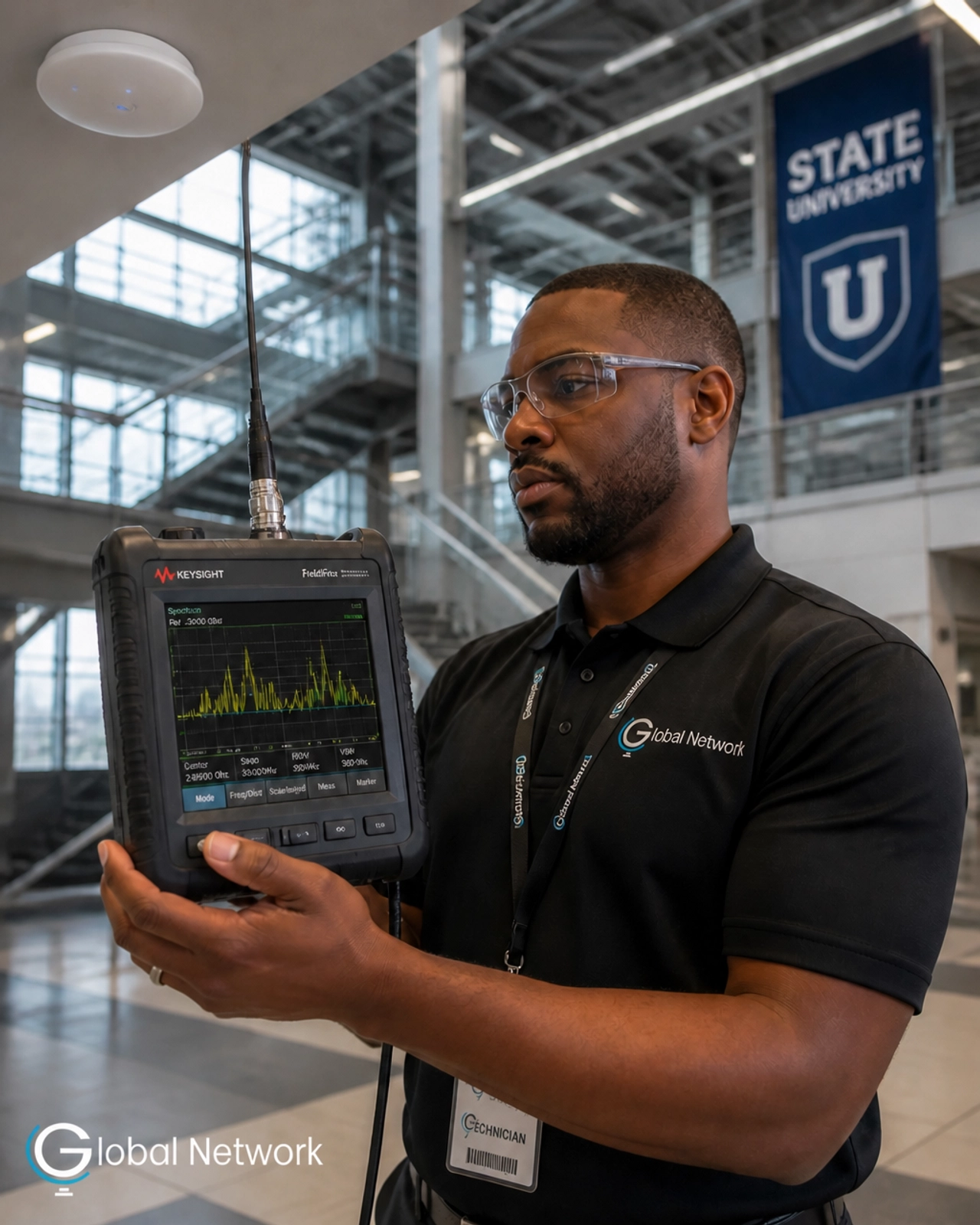
Global Network LLC provides a Professional Grid Testing service and certified engineering to ensure that your building meets the 99% requirement when it matters most. You can learn more about our specific expertise on our Services page.

Strategies for Seamless Compliance
To avoid these pitfalls, developers should adopt a "Safety-First" design workflow. This includes three essential pillars of BDA compliance:
- Preliminary RF Survey: Even if the building isn't finished, a survey of the surrounding area can determine the strength of the nearest donor tower.
- Predictive Modeling: Using architectural CAD files, engineers can create a 3D model of the building to predict where signal drops will occur.
- Pathway Integration: Coordinating with the structural and MEP (Mechanical, Electrical, Plumbing) teams to ensure dedicated pathways for ERCES equipment.
For more information on the technical nuances of these systems, please refer to our deep dive on NFPA 72 compliance.
The Importance of Early Consultation
The goal of every project is to achieve peace of mind through compliance. By engaging a specialist in in-building wireless for first responders during the schematic design phase, developers can lock in budgets, streamline construction, and: most importantly: ensure the safety of future occupants and first responders.
When we look at the statistics of emergency response, communication failure inside buildings is a leading cause of preventable tragedy. An ERCES is not just a box to check for the Fire Marshal; it is a lifeline for those who put their lives on the line for our community.
Your Partner in Public Safety Technology
Global Network LLC stands at the forefront of telecommunications infrastructure. We provide end-to-end public safety radio coverage solutions that take the guesswork out of new construction. From initial design and AHJ coordination to final testing and commissioning, our commitment to excellence ensures your project stays on track.
Our Core Commitment:
- Strict Adherence to Regulatory Standards: We don't just meet the code; we exceed it.
- Mission-Driven Precision: Our systems are designed to perform "when it matters most."
- Expert Consulting: We work directly with architects and developers to optimize system placement and reduce costs.
Ready to Secure Your Building’s Compliance?
Don't wait until you are weeks away from your grand opening to think about radio coverage. Let Global Network LLC review your blueprints today and provide a comprehensive design strategy that saves you time, money, and stress.
Contact Global Network LLC:
- Phone: 770.520.8124
- Website: https://globalnetworkco.com/contact
- Services: https://globalnetworkco.com/services
- Schedule a Test: Click here to ensure compliance
At Global Network LLC, we build the infrastructure that keeps our heroes connected. Contact us to ensure your next new construction project is built for safety and success.