The MVP of Game Day: Why Atlanta’s World Cup Readiness Depends on ERCES
As the countdown to the 2026 FIFA World Cup begins, Atlanta is positioning itself as a global epicenter for sports and infrastructure. With hundreds of thousands of international visitors expected to flood the city, the strain on local resources will be unprecedented. While the world focuses on the pitch, facility managers and building owners must focus on what happens behind the walls.
The success of an event this massive doesn't just depend on the players; it depends on the invisible infrastructure that keeps the public safe. Specifically, Emergency Responder Communication Enhancement Systems (ERCES) and Public Safety Distributed Antenna Systems (DAS) are the silent MVPs of game day. Without these systems, the very buildings hosting fans, vendors, and officials could become communication black holes when it matters most.
Understanding ERCES and Public Safety DAS: The Backbone of Emergency Response
In the world of telecommunications infrastructure, ERCES is more than just a technical acronym: it is a life-saving requirement. An Emergency Responder Communication Enhancement System is a specialized in-building radio solution designed to ensure that local fire, police, and medical personnel can maintain clear, two-way radio contact throughout a structure.
At its core, the system utilizes Bi-Directional Amplifier (BDA) technology. A donor antenna on the roof pulls in the public safety signal from the outside network, and the BDA amplifies that signal before distributing it throughout the building via a Distributed Antenna System (DAS).
For Atlanta's high-rise hotels, expansive convention centers, and sprawling parking structures, these systems are the only way to guarantee that a 911 call or a first responder’s radio transmission isn't lost in a "dead zone."
The Technical Standards for 2026
To meet the rigorous demands of the World Cup, systems must be:
- 700/800 MHz and P25 Compatible: Ensuring seamless integration with Atlanta’s public safety radio frequencies.
- UL 2524 Listed: Meeting the latest safety standards for in-building emergency communication.
- Equipped with 24-Hour Backup Power: Guaranteeing operation even during a total grid failure.
The "Dead Zone" Dilemma: Why High-Traffic Events Paralyze Communications
When a stadium or a fan zone reaches capacity, the local cellular and radio networks face extreme congestion. However, the physical environment is often the bigger enemy. Modern construction materials: such as low-E glass, reinforced concrete, and heavy steel: are incredibly effective at blocking radio signals.

Concrete Jungles and Steel Cages: The Physics of Signal Failure
In a typical building, areas like stairwells, elevator lobbies, and basements are the first to lose signal. During the World Cup, these areas will be high-traffic zones for security, maintenance, and emergency teams. If a fire breaks out in a below-grade storage area or a medical emergency occurs in a crowded stairwell, a radio failure can lead to catastrophic delays.
Global Network LLC specializes in identifying these vulnerabilities through rigorous RF testing. Our goal is 0% Defects in coverage, ensuring that every square inch of your property is a safe zone.
Compliance is Not Optional: Navigating IFC 510 and NFPA 1225 in Atlanta
Building owners in Atlanta are subject to strict local ordinances that mandate reliable first responder coverage. Failure to comply doesn't just risk safety; it risks your Certificate of Occupancy and can lead to massive fines as the city ramps up inspections ahead of 2026.
The primary regulations governing these systems are IFC 510 (International Fire Code) and NFPA 1225 (the standard for emergency services communications). In Atlanta, the Authority Having Jurisdiction (AHJ): typically the Fire Marshal: is increasingly focused on ensuring these systems are not only installed but regularly maintained and tested.
The 99% Rule for Critical Areas
According to current codes, coverage requirements are uncompromising:
- 99% Coverage is required in "Critical Areas" including fire command centers, pump rooms, exit stairs, and elevator lobbies.
- 95% Coverage is mandated for all other occupiable areas of the building.
If your facility does not meet these metrics during an annual performance test, you are in violation of the law. You can learn more about how to stay ahead of these requirements in our guide on how to pass your next fire marshal radio inspection.
Protecting the Perimeter: Parking Decks and Stairwells
The 2026 World Cup will turn every parking deck and stairwell in downtown Atlanta into a high-risk area. These structures are notorious for being radio-dead zones due to their dense concrete construction.

For vendors operating near stadiums or in transit hubs, a lack of reliable communication means more than just a safety risk: it means a breakdown in logistics. However, from a public safety perspective, the stairwell is the most critical path for evacuation. If a first responder cannot communicate while ascending a 20-story stairwell, they are operating blind.
Our in-building solutions are specifically designed to penetrate these difficult environments, providing a "peace of mind" that only comes from total compliance and technical excellence.
Global Network LLC: Atlanta’s Local Authority on ERCES Compliance
As a local specialist, Global Network LLC understands the unique RF landscape of Atlanta. We aren't just an out-of-state contractor; we are your neighbors, and we are committed to making sure our city is ready for the world stage in 2026.
We provide a comprehensive, end-to-end service model:
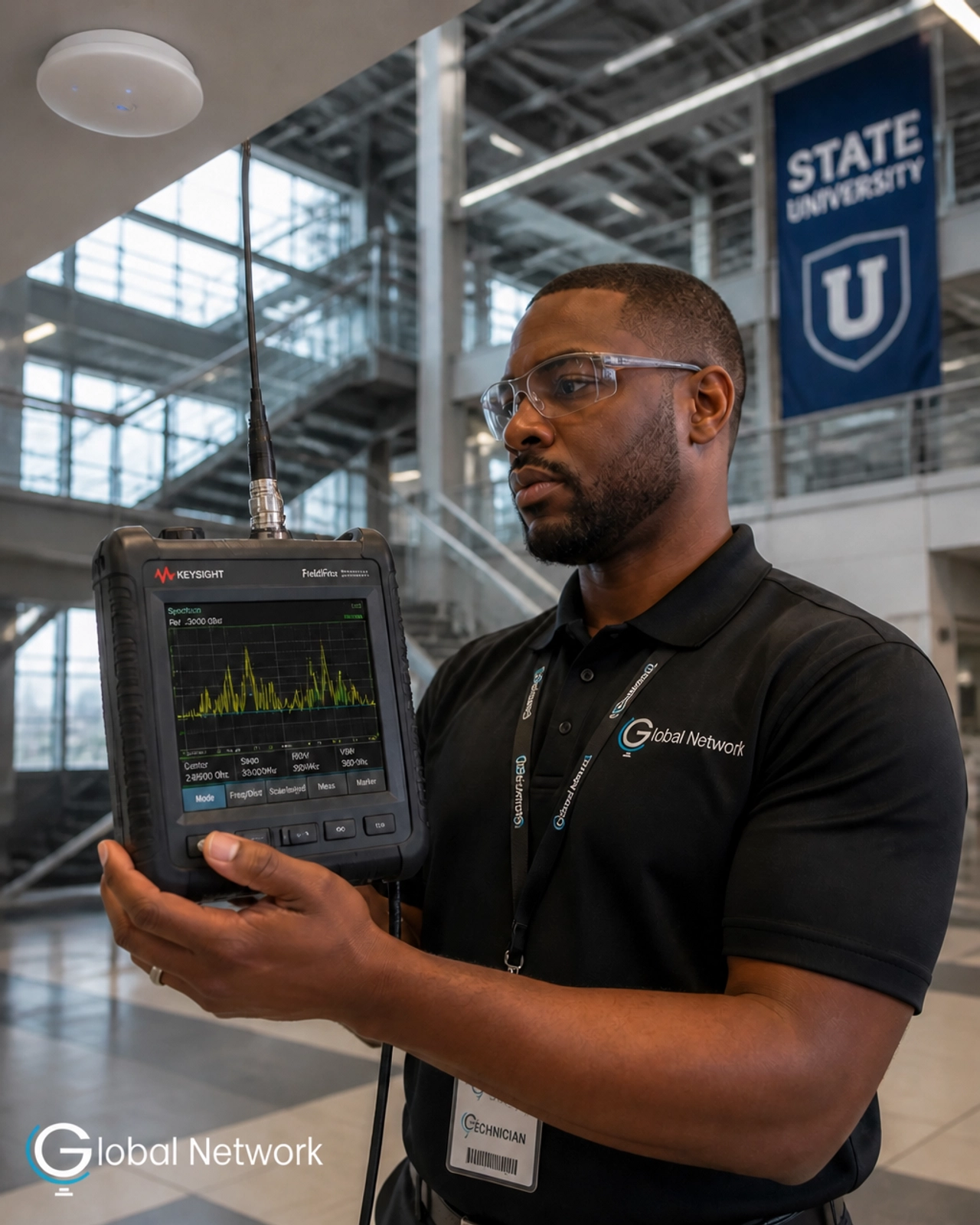
- Initial RF Survey: We use calibrated spectrum analyzers to map your building’s current signal strength.
- Custom Design & Engineering: Our team designs a FirstNet-compatible system tailored to your building’s specific layout.
- Professional Installation: We install BDA and DAS hardware that meets all NFPA 72 and IFC 510 standards.
- Commissioning and Annual Testing: We perform the rigorous testing required to secure your Certificate of Occupancy and maintain ongoing compliance.
Our Commitment: 0% Defects, 0% Missed Deadlines
We understand that with the World Cup approaching, time is of the essence. We operate with a mission-driven tone that prioritizes safety, reliability, and strict adherence to regulatory standards. Whether you are managing a high-rise hotel or a government facility, we ensure your infrastructure is "at the forefront of advancements."

Act Now: The Road to 2026 Starts Today
The surge in demand for ERCES and DAS installations will only increase as the World Cup draws closer. Building owners who wait until the last minute risk facing a shortage of qualified engineers and equipment, potentially leading to occupancy delays during the city's most profitable window in decades.
Ensure your building is ready. Ensure your fans are safe. Ensure your property is compliant.
Contact Global Network LLC Today
For a professional consultation and to schedule your mandatory RF coverage test, contact the specialists at Global Network LLC.
- OFFICE: 770.520.7633
- TOLL FREE: 877.231.1084
- Website: globalnetworkco.com
Stay connected. Stay compliant. Stay safe.