
Is Your Building Ready for the Fire Marshal? The 3 Pillars of BDA Compliance
For property managers and building owners in Atlanta, the sight of a Fire Marshal walking through the front doors usually brings a spike in blood pressure. Most of the time, you’re confident in your sprinklers, your alarms, and your extinguishers. But there is one critical safety component that is increasingly becoming the "make or break" factor for a Certificate of Occupancy: your Emergency Radio Communication Enhancement System (ERCES), often referred to as a BDA system.
If first responders: police, fire, and EMS: can’t communicate inside your building during an emergency, the building isn't safe. Period. This isn't just a best practice; it is a legal mandate enforced by rigorous codes.
At Global Network LLC, we specialize in making sure you never have to sweat a Fire Marshal inspection. We operate with a 0% missed deadline policy and a deep understanding of Georgia’s specific regulatory landscape. To help you navigate this, we’ve broken down the three essential pillars of BDA compliance.
Pillar 1: Absolute Compliance with IFC 510 and NFPA Standards
The first pillar is the most technical and the most unforgiving. Compliance isn't a suggestion; it’s a detailed set of rules established by the International Fire Code (IFC) Section 510 and the National Fire Protection Association (NFPA) 1221 (now largely integrated into NFPA 1225).
When a Fire Marshal inspects your property, they are looking for a system that meets these specific legal benchmarks:
- IFC 510 Compliance: This code requires all new and existing buildings to have a minimum level of radio coverage for public safety personnel. If your building’s construction: steel, low-E glass, or reinforced concrete: blocks those signals, you are legally required to install a Public Safety DAS installation.
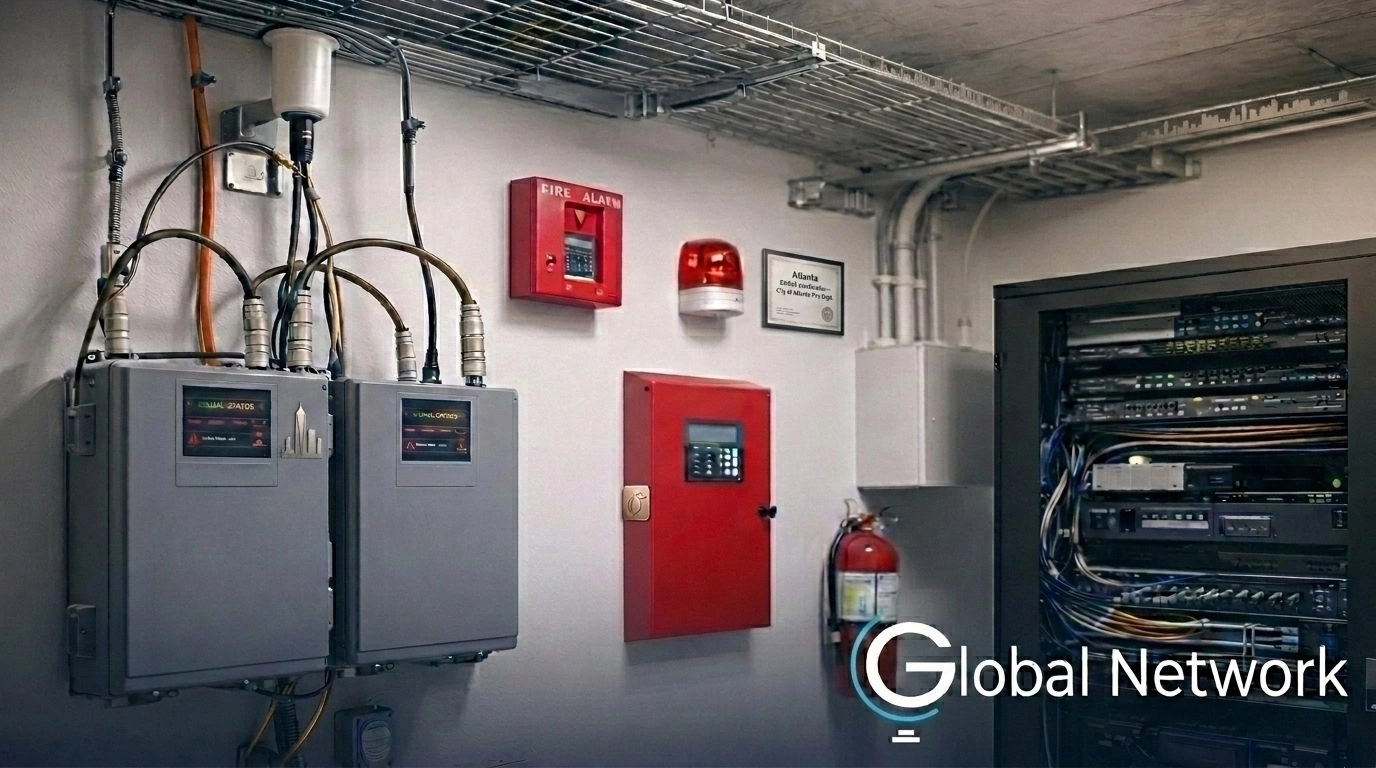
- NFPA 1221/1225 Standards: These standards dictate how the hardware is installed. It’s not just about the signal; it’s about the survivability of the system. This includes NEMA 4-rated enclosures for equipment to protect against water and dust, and specific circuit integrity for the cabling.
- Battery Backup: The code mandates that your BDA system must remain operational for at least 24 hours in the event of a total power failure.
Navigating these codes is where most developers run into trouble. A "cookie-cutter" installation won't pass an Atlanta Fire Department inspection. You need a partner who understands the local nuances. At Global Network LLC, we don't just install hardware; we design BDA system designs that are engineered to pass on the first attempt.

Pillar 2: Reliable Coverage in Critical Areas (The 99% Rule)
It is a common misconception that "some" signal is enough. In the world of public safety, "some" signal can lead to a tragedy. The second pillar of compliance focuses on where the signal actually reaches.
The fire code divides your building into two categories: Critical Areas and General Areas.
1. Critical Areas (99% Coverage Requirement)
In the areas where first responders are most likely to be operating during a crisis, the standards are incredibly high. You must provide 99% signal coverage in:
- Fire command centers
- Exit stairs and enclosed exit passageways
- Elevator lobbies
- Standpipe cabinets
- Sprinkler sectional valve locations
If a firefighter is in a stairwell on the 15th floor and can’t reach dispatch, your system has failed, regardless of how well it works in the lobby.
2. General Areas (90% Coverage Requirement)
For the rest of the building: offices, hallways, and common rooms: the requirement is generally 90% coverage.
Achieving this level of reliability requires sophisticated engineering. It’s not just about boosting a signal; it’s about managing "near-far" interference and ensuring that your system doesn't "leak" signal back into the public safety tower network, which can cause massive outages for the entire city. This is why professional BDA system design is non-negotiable.

Pillar 3: Identification of Weak Signal Zones through Professional Grid Testing
You can’t fix what you can’t see. The third pillar of BDA compliance is the rigorous Identification of weak signal zones.
How do we do this? Through a process called RF Grid Testing.
Instead of walking around with a radio and saying "Can you hear me now?", our technicians divide every floor of your building into a grid (typically 20 to 40 squares per floor). We then use calibrated spectrum analyzers to measure the "Downlink" and "Uplink" signal strength in every single square.
- Dead Zone Discovery: Most buildings have "shadow zones": areas behind elevator shafts or inside mechanical rooms: where the signal drops off a cliff.
- Initial Benchmarking: We perform these tests before the system is installed to determine exactly where the antennas need to be placed.
- Final Certification: Once the system is live, we re-test every grid square to provide the data-backed proof the Fire Marshal needs to sign off on your permit.
If your building is failing to meet these benchmarks, you need to schedule a test immediately. Waiting until the final inspection to find a dead zone is a recipe for expensive construction delays and missed opening dates.

Why Atlanta Property Managers Trust Global Network LLC
In the Atlanta market, the stakes are high. Construction is booming, and the local AHJs (Authorities Having Jurisdiction) are some of the strictest in the country. You don’t need a vendor; you need a specialist who lives and breathes IFC 510 compliance.
We understand the pressure of a looming grand opening. That’s why we’ve built our reputation on two core promises:
- Expert Engineering: We don't guess. We use precision tools and local expertise to ensure your system is perfectly tuned to the Atlanta public safety radio network.
- 0% Missed Deadlines: We know that a delay in BDA certification means a delay in your Certificate of Occupancy. We move at the speed of your project, ensuring that the technology is ready when the inspectors arrive.
Peace of Mind is Only a Test Away
Compliance doesn't have to be a headache. When you prioritize these three pillars: regulatory adherence, critical area coverage, and precise grid testing: you aren't just checking a box for the Fire Marshal. You are ensuring that if the worst happens, the people tasked with saving lives have the tools they need to communicate.
Don't wait for a failed inspection to take action. Whether you are in the design phase of a new build or managing an existing property that needs recertification, we are here to help.
Is your building ready?
Contact Global Network LLC today to discuss your Public Safety DAS installation or to schedule your annual compliance testing.
Global Network LLC
Atlanta’s Public Safety Technology Specialists
Contact Us Today
770.520.8124
0% Missed Deadlines. 100% Compliance.
